
Risk Indicators
- FATF/EU Blacklist/Greylist (Higher Concern)
- Terrorism Financing (Medium Concern)
- US Dept of State INCSR
- Proliferation Financing
- Corruption
- Criminality
- Resilience & Governance
- Financial Transparency
- Offshore Finance Centres
- Sanctions
Background
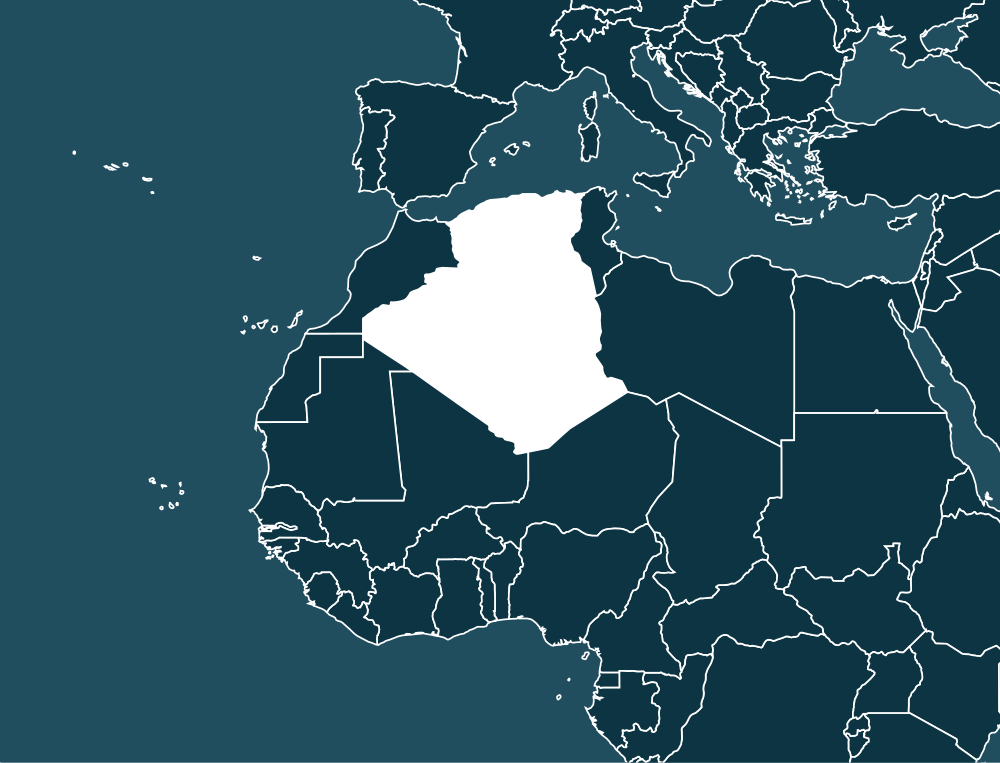
Algeria’s history reflects successive Numidian, Arab, Amazigh, Ottoman, and French influences, culminating in a costly independence struggle in 1962. The FLN, founded during that struggle, remained central to national politics, while the interrupted 1991 elections and ensuing conflict with the FIS shaped the country’s modern security landscape. More recent changes—including Abdelmadjid TEBBOUNE’s presidency, constitutional reforms, open-list voting, and exceptionally low electoral participation—suggest a political system still managing questions of legitimacy and representation.
Algeria’s strategic environment is complicated by instability across the Sahel and fractured governance in Libya, alongside a particularly severe breakdown in relations with Mali and Niger. Tensions with Morocco remain entrenched around Western Sahara, with closed borders and severed diplomatic ties, while Tunisia and Mauritania present comparatively less acute but still relevant security considerations. Beyond its immediate neighborhood, disputes with France involving migration, deportations, restrictions, and possible economic measures add an additional layer to Algeria’s external pressures, alongside scrutiny involving bodies such as ECOWAS, the African Union, and the United Nations.
AML & Terrorist Financing
Algeria has made notable AML/CFT progress, leaving the FATF list in June 2026 after strengthening risk-based supervision, beneficial ownership controls, suspicious transaction reporting, targeted sanctions, and nonprofit oversight, although it remains in enhanced follow-up and was added to the European Commission’s high-risk list in August 2025. Persistent vulnerabilities include a cash-heavy informal economy, porous borders, corruption, smuggling, uneven customer and beneficial-owner due diligence, limited supervision of insurance and DNFBPs, and capacity and digitalization challenges affecting the CTRF. Terrorist-financing controls show stronger investigative outcomes than preventive mechanisms, with delays and legal gaps affecting targeted financial sanctions, limited risk-based oversight of nonprofits, and particularly weak implementation and understanding of proliferation-financing requirements.
Sanctions
Algeria is obligated to implement UN Security Council measures and has participated in Arab League restrictions, including sanctions concerning Syria that have largely been lifted. Algeria does not maintain autonomous sanctions and is not currently subject to comprehensive US, EU, or UN sanctions, although the US State Department warned in February 2026 of possible CAATSA action linked to the Su-57 purchase from Russia. Additional concerns involve alleged sanctions-evasion vulnerabilities connected to North Korean procurement networks, Mediterranean shipping routes, Sonatrach-related bribery, and weak compliance oversight.
Criminality
Algeria has established bodies such as the Central Office for the Suppression of Corruption, the National Organization for the Prevention and Fight Against Corruption, and the High Authority for Transparency, yet concerns persist over state-embedded corruption, weak whistleblower safeguards, and limited institutional reform. Criminal activity spans trafficking, illicit resource extraction, counterfeit goods, informal financial abuse, and expanding cyber and drug markets, with powerful public- and private-sector figures reportedly implicated in some schemes.
Reports
Algeria remains a significant transit corridor for cannabis, psychotropic substances, and smaller quantities of cocaine and heroin, while the ONLCDT, DGSN, Customs, National Gendarmerie, and 42 addiction treatment centers support enforcement and prevention efforts. The country’s security operations have constrained AQIM and Jund al-Khilafah, yet trafficking vulnerabilities persist among migrants, children, and other at-risk groups, alongside continuing concerns over victim protection, organized crime links, and the effectiveness of counterterrorism and anti-money-laundering measures.
Industry/Product Sector Risk
Algeria’s financial and commercial landscape is shaped by extensive cash use, a sizeable informal economy, strict exchange controls, and significant exposure to cross-border trade, with Algeria Post and banks central to formal payments and remittances. Higher-risk areas include retail banking, real estate, trade finance, virtual currencies, oil and gas, public works, hospitality, and transportation, where corruption, smuggling, fraud, and trade-based value movement intersect with gaps in beneficial-ownership transparency and risk-based controls. At the same time, less-developed markets, informal exchange and lending channels, unregulated high-value dealers, and diverse NPO activity create a complex picture in which sector-specific vulnerabilities—and notable areas where information is limited—warrant closer examination.
Economy & Investment Climate
Algeria’s hydrocarbon-led, state enterprise-dominated economy is gradually seeking broader growth through agriculture, technology, mining, renewable energy, healthcare, and local manufacturing, with AAPI and ALNAFT serving as notable gateways for investors. Yet protectionist policies, shifting regulations, complex currency procedures, dominant public banks and enterprises, and uneven enforcement create a demanding environment in which the 2022 Investment Law and evolving energy and mining frameworks may offer both incentives and uncertainty.
Cryptocurrency Regulations
Algeria maintains an exceptionally restrictive position on cryptocurrency, with Law No. 25-10 criminalizing activities ranging from possession and trading to operating exchanges and wallet platforms, leaving no licensed VASPs or recognized token-offering framework. The Bank of Algeria, Banking Commission, and Instruction No. 06/2025 reinforce this prohibition through financial-sector controls, while the Central Bank’s September 2025 risk assessment highlights fraud and hacking concerns despite limited identified AML/CTF exposure.
Get full access
The information on this page is a brief summary. Get access to EDD country reports, all risk category scores and customisable weightings for 245 jurisdictions.