
Risk Indicators
- FATF/EU Blacklist/Greylist (Lower Concern)
- Terrorism Financing (Lower Concern)
- US Dept of State INCSR
- Proliferation Financing
- Corruption
- Criminality
- Resilience & Governance
- Financial Transparency
- Offshore Finance Centres
- Sanctions
Background
Antigua and Barbuda’s history reaches back to the Siboney and Arawak peoples, followed by European settlement and the establishment of an English colony in 1667. The islands’ development was shaped by sugar plantations and slavery until abolition in 1834, before independence within the British Commonwealth in 1981. Hurricane Irma’s devastation of Barbuda in 2017, contrasted with Antigua’s relative protection, remains a defining recent event.
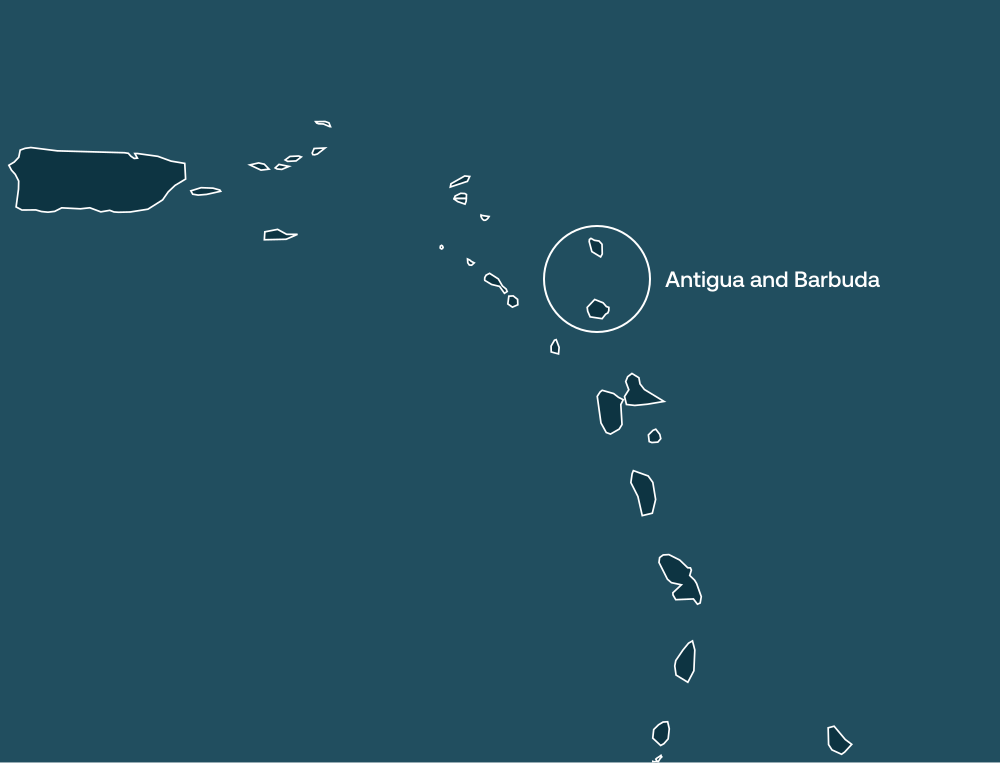
The surrounding Eastern Caribbean is generally stable, though Saint Kitts and Nevis presents notable concerns involving violent crime, political tensions, and scrutiny of its Citizenship-by-Investment program. Anguilla’s financial transparency and tax-haven reputation draw attention, while Montserrat and Saint Barthélemy largely reflect the sanctions frameworks of the United Kingdom and France without comparable reported challenges. Together, these dynamics give Antigua and Barbuda a regional setting where security is mostly calm but financial and sanctions-related risks warrant closer examination.
AML & Terrorist Financing
Antigua and Barbuda has strengthened its AML/CFT framework and is no longer subject to FATF strategic-deficiency listing, but the November 2021 follow-up evaluation left the jurisdiction in enhanced follow-up, with effectiveness concerns across much of the regime. Risks remain concentrated around offshore banking, money services, real estate, cash-intensive businesses, online gaming, beneficial ownership, and the medium-high-risk Citizenship by Investment Programme, while supervision outside the banking sector and the consistent application of risk-based controls remain uneven. The ONDCP, FIU, FSRC, and Royal Police Force share important responsibilities, yet low-quality suspicious activity reporting, limited money-laundering prosecutions, incomplete treatment of UNSCR 1373 designations, uncertainties surrounding vulnerable nonprofits, and limited terrorist-financing investigative experience point to areas requiring closer scrutiny.
Sanctions
Antigua and Barbuda has no international sanctions currently in force against it, while its obligations as a UN member require implementation of applicable Security Council measures. Through its Maritime Administration’s Miscellaneous Circulars 2024-002 and 2025-001, the country requires Antigua-flagged vessels to observe UN and G7 sanctions, including controls related to Russia-linked petroleum trade and risks such as ship-to-ship transfers and flag-hopping. Regional attention also centers on the Haiti sanctions regime, including the designated individuals and entities identified under Security Council Resolutions 2752 (2024) and 2794 (2025), with CARICOM members expected to support the arms embargo and counter illicit firearm flows.
Criminality
Antigua and Barbuda faces notable concerns involving human trafficking, cocaine transit, firearms, and financial crime risks linked to its offshore financial sector and citizenship-by-investment schemes. Corruption allegations against officials are common, while the Integrity Commission is understaffed and investigations often produce few results, leaving the Office of National Drug and Money Laundering Control Policy with an important role in addressing suspicious activity and proceeds of crime.
Reports
Antigua and Barbuda is strengthening regional counternarcotics cooperation through maritime intelligence, coordinated enforcement, and community initiatives such as Drug Awareness Month, while the National Drug Council and partner institutions continue working amid resource, treatment, and integrity challenges. Its trafficking-in-persons response remains on Tier 2, with a 2025 National Action Plan, training, and victim-referral efforts alongside persistent concerns involving screening, labor and sex trafficking risks, and the absence of prosecutions or confirmed victim identifications.
Industry/Product Sector Risk
Antigua and Barbuda’s financial and commercial landscape combines a tourism-led economy with offshore banking, real estate, construction, gaming, and cross-border payment activity, creating a varied risk profile across regulated and less-regulated sectors. Particular attention surrounds casinos, money service businesses, real estate linked to the Citizenship by Investment Programme, international banks, corporate service providers, and cash-intensive dealers, alongside concerns involving beneficial ownership, customer due diligence, and foreign proceeds. The FSRC, Inspector of Casinos, ECCB, and other authorities operate within this environment, where domestic and foreign corruption, drug trafficking, fraud, tax offences, and illicit online pharmaceutical sales intersect with financial and professional services.
Economy & Investment Climate
Antigua and Barbuda’s services-led economy is gaining momentum through tourism and construction, supported by a stable Eastern Caribbean dollar and broad regional trade relationships, while the IMF projects continued growth. The Antigua and Barbuda Investment Authority promotes largely unrestricted foreign ownership across priority areas including tourism, yachting, agro-processing, infrastructure, and business services, although climate exposure, water constraints, and unresolved property and investment disputes add important considerations.
Cryptocurrency Regulations
Antigua and Barbuda permits cryptocurrency activity under the Digital Assets Business Act, 2020, with the Financial Services Regulatory Commission overseeing licensed exchanges, custodians, and other digital asset businesses. While crypto is not legal tender and individual gains generally face no personal income or capital gains tax, the framework incorporates FATF-aligned controls, prospectus expectations for token offerings, and detailed obligations for regulated intermediaries.
Get full access
The information on this page is a brief summary. Get access to EDD country reports, all risk category scores and customisable weightings for 245 jurisdictions.