
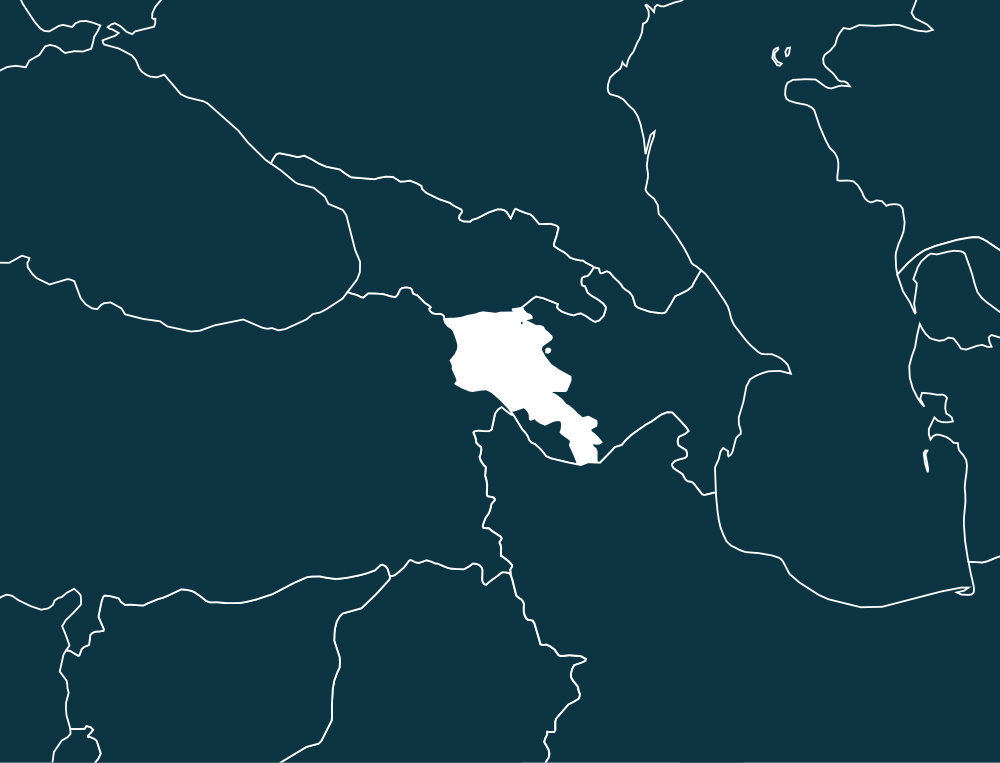
Risk Indicators
- FATF/EU Blacklist/Greylist (Lower Concern)
- Terrorism Financing (Lower Concern)
- US Dept of State INCSR
- Proliferation Financing
- Corruption
- Criminality
- Resilience & Governance
- Financial Transparency
- Offshore Finance Centres
- Sanctions
Background
Armenia’s history spans early Christian statehood, successive imperial influences, Soviet incorporation, and renewed independence in 1991, with collective memory shaped by the mass deaths of Armenians under the Ottoman Empire during World War I. Its modern security environment has been dominated by the Nagorno-Karabakh conflict, culminating in Azerbaijan’s 2023 military takeover and the flight of nearly the region’s entire ethnic Armenian population to Armenia. Closed borders with Turkey and Azerbaijan continue to constrain Armenia’s regional position, even as it maintains a strategic relationship with Iran and participates in both the Eurasian Economic Union and the EU’s CEPA framework.
The 2018 “Velvet Revolution” brought Civil Contract leader Nikol PASHINYAN to the premiership after Serzh SARGSIAN’s attempt to extend his rule triggered mass protests, and PASHINYAN’s party has since prevailed in legislative elections, including in 2021. Relations with Azerbaijan remain highly tense despite a 2025 peace treaty announcement, while Turkey’s alliance with Baku and continued border closure reinforce Armenia’s sense of vulnerability. Georgia offers pragmatic regional cooperation, but its own disputes with Russia and cautious sanctions posture add to a neighborhood shaped by militarization, competing alliances, and external economic pressure.
AML & Terrorist Financing
Armenia is not identified by FATF as having strategic AML deficiencies, yet its principal money-laundering threats include fraud, embezzlement, corruption, tax crime, drug trafficking, and cybercrime, with foreign-factor and virtual-asset risks requiring further examination. The Financial Monitoring Center and Central Bank of Armenia have strengthened supervision, reporting, and financial intelligence capabilities, while smaller institutions, beneficial-ownership verification, access to banking information, and interagency coordination remain areas of concern. Terrorist-financing risk is assessed as low and targeted sanctions systems are generally effective, but limited private-sector reporting, the absence of TF convictions, predicate-offence-focused investigations, and dispersed asset-recovery responsibilities leave important questions around practical effectiveness.
Sanctions
Armenia supports applicable United Nations sanctions measures, but no distinct autonomous sanctions imposed by Armenia on other nations are identified. No comprehensive embargo targets Armenia, although the former OSCE-related arms embargo lapsed in 2025 and foreign authorities including OFAC, the EU, the UK, and Japan have applied targeted measures, export controls, or heightened scrutiny to Armenian entities and transactions. Cases involving VTB Bank Armenia, TAKO LLC, and AO PKK Milandr, alongside UK FCDO guidance and EU anti-circumvention requirements, reflect concerns over possible facilitation of Russia- and Iran-related sanctions evasion rather than broad countrywide restrictions.
Criminality
Armenia has developed a more formal anti-corruption architecture—including the Corruption Prevention Commission, Anti-Corruption Committee, and Specialized Anti-Corruption Court—but concerns persist over institutional independence, political influence, uneven enforcement, and limited transparency in procurement and politically connected business activity. Corruption risks remain particularly visible in the justice system and several public sectors, while embezzlement, tax evasion, trafficking, illicit goods, and other organized criminal activity continue to challenge enforcement capacity and public accountability.
Reports
Armenia’s security transparency has come under scrutiny after repeated failures to submit Vienna Document 11 military data, defense information, and required activity notifications, while diplomatic signals suggest only limited bilateral engagement may resume. At the same time, the Armenian State Revenue Committee and law-enforcement partners have pursued counternarcotics initiatives amid trafficking-route concerns, and Armenia remains on Tier 2 for human trafficking as prosecutions and victim funding increase but screening, long-term support, recruitment oversight, and protections for displaced people and migrant workers remain uneven.
Industry/Product Sector Risk
Armenia’s financial and business landscape is shaped by substantial cash use, a sizeable shadow economy, and banks that handle most domestic and cross-border flows, with casinos, real estate, and cash-intensive activities presenting particularly notable exposure. The Central Bank and Ministry of Finance oversee key sectors, yet uneven risk-based supervision and limited suspicious transaction reporting among certain DNFBPs leave potential pathways through property, precious stones, trade finance, remittances, and professional services. Alongside domestic tax evasion, fraud, corruption, and smuggling, cross-border cybercrime and trade-related schemes add complexity across channels linked to Russia, Iran, Belgium, and other jurisdictions.
Economy & Investment Climate
Armenia’s economy combines strong recent growth, a well-educated technology workforce, and an increasingly open investment framework supported by Enterprise Armenia, EAEU membership, and EU CEPA alignment. Opportunities in ICT, construction, mining, energy, and advanced manufacturing remain tempered by market size, regional access constraints, security concerns, and persistent questions surrounding judicial effectiveness, institutional capacity, and regulatory predictability.
Cryptocurrency Regulations
Armenia’s crypto landscape is moving into a formal licensing and compliance phase under the Law of the Republic of Armenia on Crypto-Assets, effective July 4, 2025, with the Central Bank of Armenia overseeing CASPs, AML controls, Travel Rule obligations, and a transitional list that included 12 entities by April 2026. Crypto-assets may be held and traded but are not legal tender, while taxation, ICO disclosures, token classifications, and the planned 2027 CARF information exchange add further layers to an evolving framework shaped by identified sector risks and international standards.
Get full access
The information on this page is a brief summary. Get access to EDD country reports, all risk category scores and customisable weightings for 245 jurisdictions.