
Risk Indicators
- FATF/EU Blacklist/Greylist (Lower Concern)
- Terrorism Financing (Medium Concern)
- US Dept of State INCSR
- Proliferation Financing
- Corruption
- Criminality
- Resilience & Governance
- Financial Transparency
- Offshore Finance Centres
- Sanctions
Background
Bhutan’s modern state was shaped by the 1865 Treaty of Sinchulu, the rise of Ugyen WANGCHUCK, and evolving arrangements first with Britain and later with India. Under successive monarchs, the country gradually expanded its international engagement, joining the United Nations in 1971 while preserving a distinctive Himalayan identity. The transition toward constitutional democracy included the 2005 draft constitution, the 2008 parliamentary election, subsequent changes in governing parties, and the continuing displacement of many Lhotshampa refugees.
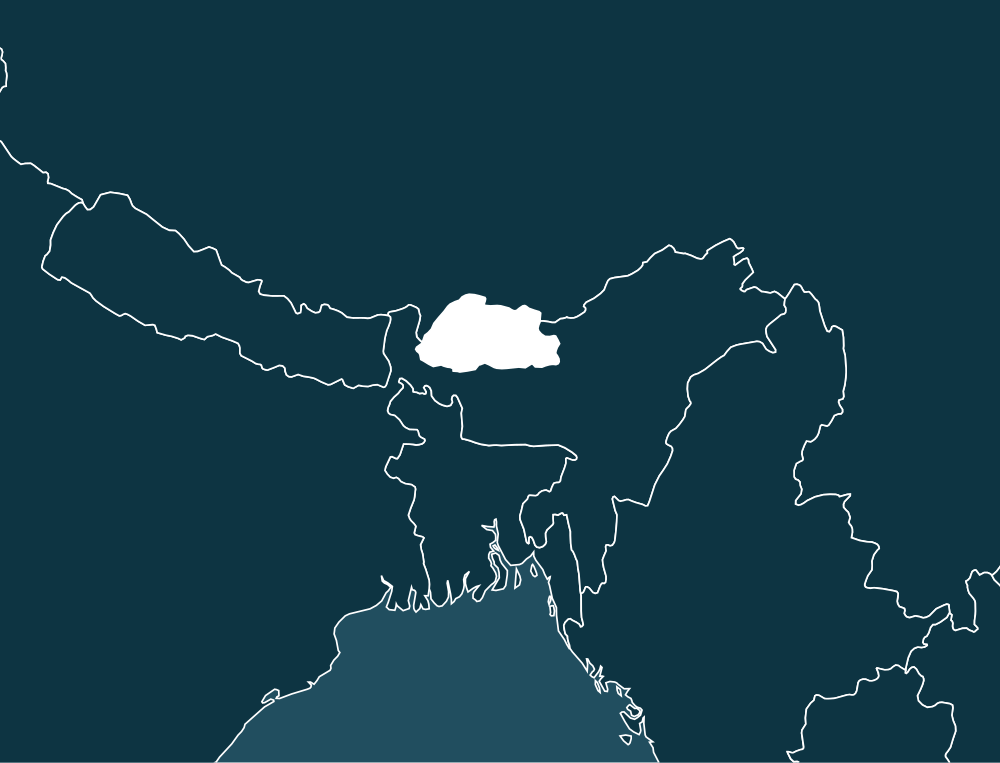
Today, Bhutan’s strategic environment is defined by its narrow geography between China and India, including unresolved claims in the Doklam/Chumbi Valley and the Jakarlung and Pasamlung valleys. Thimphu continues to coordinate closely with New Delhi, whose security concerns include the Siliguri Corridor, northeastern instability, and the wider India-China confrontation. Regional pressures are further complicated by sanctions and alleged evasion networks involving China and India, including US measures announced in October 2024 against Indian entities and nationals linked to Russian sanctions evasion.
AML & Terrorist Financing
Bhutan is not FATF-listed, yet its 2023 assessment left the country in enhanced follow-up, with effectiveness generally low and important gaps across risk understanding, supervision, investigations, confiscation, and preventive controls. Money-laundering exposure is linked chiefly to corruption and bribery, alongside border-related smuggling, fraud, narcotics and pharmaceutical trafficking, while terrorist-financing concerns focus on self-financing by Indian Insurgent and Radical Groups near porous borders rather than known Al Qaeda, Taliban or ISIL activity. The Royal Monetary Authority’s Financial Intelligence Department, Anti-Corruption Commission and Royal Bhutan Police CID form the core institutional response, but limitations involving beneficial ownership, non-bank and DNFBP implementation, targeted financial sanctions and proliferation-financing controls leave significant areas requiring closer attention.
Sanctions
Bhutan supports United Nations Security Council sanctions, including measures involving arms, travel, finance, commodities, and the Consolidated List of designated individuals and entities. No international sanctions are currently in force against Bhutan, and available evidence does not indicate that it imposes independent sanctions regimes on other nations. Although its participation in the Asian Clearing Union and expanding trade routes could theoretically create evasion pathways, relationships centered on India, Bangladesh, and legitimate regional commerce show no evidence of systematic dealings with heavily sanctioned states.
Criminality
Bhutan has established a formal anti-corruption framework, including the independent Anti-Corruption Commission, strengthened legislation, procurement safeguards, and asset-declaration requirements, though limited resources, selective enforcement concerns, and restricted space for whistleblowers and civil society may constrain its reach. Crime concerns include cross-border gold and timber smuggling, wildlife poaching, drug trafficking, human trafficking, and the involvement of loose domestic networks and foreign actors in activities such as illegal logging.
Reports
Bhutan has expanded trafficking investigations, specialized police units, victim referrals, repatriation efforts, and access to labor complaints while remaining on Tier 2 amid continuing gaps in prosecutions, training, inspections, and protections for adult men and foreign workers. Vulnerabilities span Bhutanese migrants recruited through informal and social-media channels, forced labor and scam operations abroad, exploitation in border-area businesses and domestic work, and the tens of thousands of foreign laborers supporting construction and other sectors.
Industry/Product Sector Risk
Bhutan’s financial and commercial landscape is small, predominantly bank-led and cash-based, with notable exposure concentrated in retail banking, real estate, money remittance, construction, and border-related trade. The Royal Monetary Authority, including its Foreign Exchange Department, oversees key channels such as correspondent banking, money changers, and remittance providers, while implementation across banks and DNFBPs remains uneven and developing. Corruption and bribery, smuggling, pharmaceutical trafficking, fraud, and the movement of proceeds through property, consumer assets, infrastructure projects, and cross-border payment flows form a distinctive risk picture that warrants closer examination.
Economy & Investment Climate
Bhutan’s economy is expanding steadily after its 2023 graduation from the United Nations’ Least Developed Countries list, with hydropower, agriculture, tourism, and emerging digital and service sectors shaping its ambitions under the “10X National Economic Vision.” Investment prospects are being broadened through MoICE-led reforms, approved FDI projects, and the developing Gelephu Mindfulness City, although skilled-labor shortages, mountainous terrain, financial access constraints, and evolving regulations remain important considerations.
Cryptocurrency Regulations
Bhutan’s cryptocurrency landscape remains cautious and largely undefined, with the Royal Monetary Authority’s Regulatory Sandbox Framework focusing on mining, customer identification, and protection rather than establishing broad rules for payments, exchanges, or token offerings. Influenced by FATF principles but without a dedicated compliance registry, clear VASP licensing structure, or established digital-asset tax treatment, the country appears to be watching the sector closely while the Department of Revenue and Customs reviews possible changes to the Income Tax Act.
Get full access
The information on this page is a brief summary. Get access to EDD country reports, all risk category scores and customisable weightings for 245 jurisdictions.