
Risk Indicators
- FATF/EU Blacklist/Greylist (Higher Concern)
- Terrorism Financing (Medium Concern)
- US Dept of State INCSR
- Proliferation Financing
- Corruption
- Criminality
- Resilience & Governance
- Financial Transparency
- Offshore Finance Centres
- Sanctions
Background
Bosnia and Herzegovina’s modern political landscape reflects successive periods of Ottoman, Austro-Hungarian, Yugoslav, and post-independence rule, followed by the devastating 1992–1995 war and mass displacement. The Dayton Accords preserved its international borders while establishing a complex multiethnic state organized around the Federation of Bosnia and Herzegovina and Republika Srpska. The Office of the High Representative, NATO’s SFOR, and later EUFOR have each played important roles in maintaining the country’s fragile peace, as its 2022 EU candidate status signals an ongoing European trajectory.
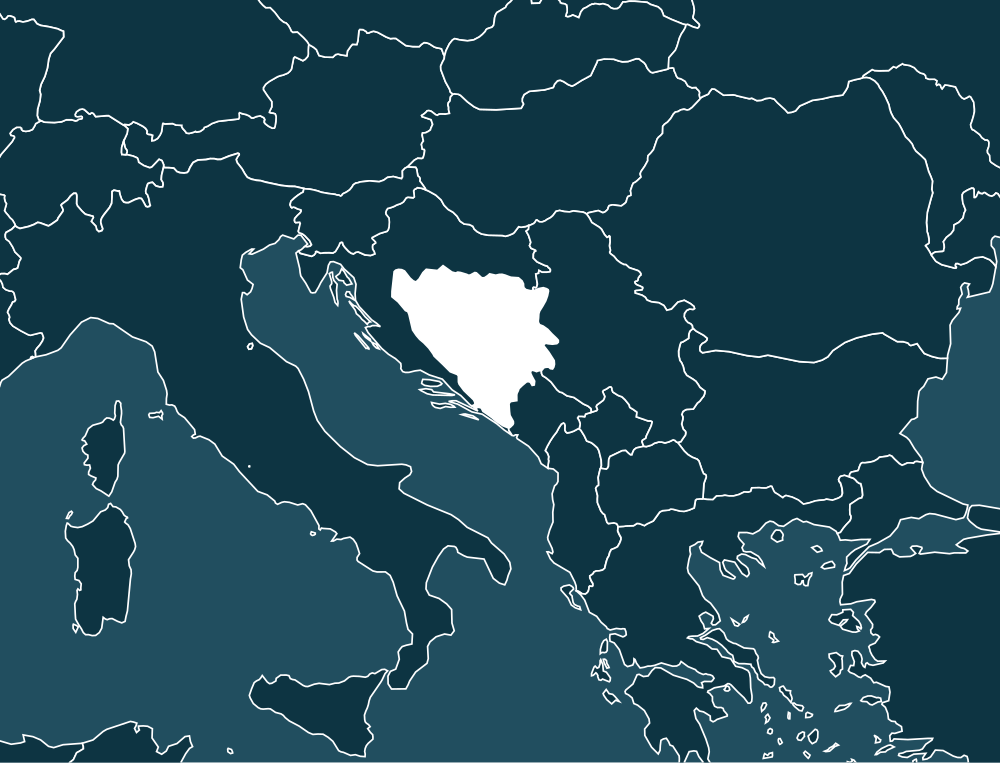
Situated between Croatia, Serbia, and Montenegro, Bosnia and Herzegovina is affected by a neighborhood marked by differing political tensions, security concerns, and approaches to international sanctions. Croatia broadly follows EU and UN measures, Serbia remains closely connected to Moscow and has attracted scrutiny over Russian sanctions evasion, while Montenegro’s implementation has at times been slowed by internal political divisions. These surrounding dynamics, alongside unresolved regional disputes and shifting foreign-policy alignments, add further complexity to Bosnia and Herzegovina’s security and compliance environment.
AML & Terrorist Financing
Bosnia and Herzegovina’s AML/CFT framework has developed through reforms and improved cooperation, but its fragmented state, entity and district structures continue to create uneven implementation and coordination challenges, contributing to its FATF listing in June 2026. The Financial Intelligence Department of SIPA receives and analyses substantial reporting, yet financial intelligence is not consistently translated into risk-aligned investigations and prosecutions, while supervision and sanctions remain particularly uneven beyond the banking sector. Terrorist-financing understanding and enforcement, targeted financial sanctions, non-profit oversight, cross-border cash controls and the accuracy and availability of beneficial-ownership information remain areas where important details—including the evolving entity-level registers—matter.
Sanctions
Bosnia and Herzegovina has no current comprehensive UN sanctions regime of its own, but as an EU candidate it has aligned with selected EU measures concerning Russia, Iran, and other international situations. Sanctions against Bosnian actors primarily involve asset freezes, travel restrictions, and related measures under U.S. OFAC authorities including Executive Orders 14033 and 14140, the EU’s Council Decision 2011/173/CFSP, the UK’s 2020 EU Exit Regulations, and corresponding Swiss arrangements. Although OFAC removed Milorad Dodik, members of his family, and roughly 48 associated individuals and entities from its SDN List in October 2025, Austria, Germany, and other European jurisdictions retain or have pursued separate measures, leaving continuing exposure under non-U.S. regimes.
Criminality
Bosnia and Herzegovina faces entrenched corruption across political and economic institutions, with reported pressure on law enforcement, prosecutors, journalists, and civil society, while licensing, procurement, and public-sector contracting remain vulnerable to bribery and undue influence; the state-level APIK has limited enforcement powers despite its coordinating mandate. Criminal activity includes human trafficking, smuggling, arms and illicit tobacco trade, drug trafficking, and financial and environmental offenses, with organized groups benefiting from corruption and weak prosecution, even as a specialized Federation anti-corruption and organized-crime court and prosecutor’s office began operating in April 2025.
Reports
Bosnia and Herzegovina remains primarily a transit point for narcotics and faces persistent challenges from fragmented enforcement, corruption, and limited investigative capacity, despite seizures and the involvement of SIPA, the Border Police, and multiple entity-level ministries. Authorities have expanded anti-trafficking and counterterrorism measures—including shelter funding, new strategic guidelines, repatriations from Syria, and updated anti-money-laundering rules—while concerns remain over victim protection, forced child exploitation, jurisdictional disputes, and the resources available to agencies such as SIPA and the State Prosecutor’s Office.
Industry/Product Sector Risk
Bosnia and Herzegovina’s industry risk landscape is shaped by a cash-intensive informal economy, significant cross-border activity along the Balkan route, and exposure to corruption, tax offences, organised crime, trafficking, and fraud. The NRA and MER identify heightened vulnerabilities in banking, casinos, real estate, legal and company services, money remittance, construction, and other sectors where opaque ownership, high-value transactions, or limited risk-based supervision can facilitate laundering. Although banking agencies, insurance agencies, securities commissions, inspection bodies, and the FIU provide important control points, uneven supervisory powers, limited sanctions, and emerging gaps involving virtual assets and non-profit organisations leave substantial detail beneath the surface.
Economy & Investment Climate
Bosnia and Herzegovina’s economy combines modest growth, a stable currency-board banking system overseen by the Central Bank of Bosnia and Herzegovina, and opportunities in manufacturing, energy, agriculture, timber, mining, and tourism, while remaining closely tied to European trade and diaspora remittances. Although the Foreign Investment Promotion Agency highlights a liberal tax and trade regime, investors must navigate fragmented institutions, entity-level regulations, state-owned enterprises, labor shortages, corruption, and unresolved property and judicial issues, particularly amid tensions involving Republika Srpska.
Cryptocurrency Regulations
Bosnia and Herzegovina is moving toward FATF-aligned cryptocurrency oversight through its 2024 AML/CFT Law, with Virtual Asset Service Providers expected to apply registration, KYC, and transaction-monitoring measures, while the Central Bank continues to recognize only the BAM as legal tender. The framework remains divided between the Federation and Republika Srpska—where the Securities Commission and Law on Digital Assets provide more structure—leaving taxation, exchanges, token offerings, and asset tokenization subject to notable uncertainty.
Get full access
The information on this page is a brief summary. Get access to EDD country reports, all risk category scores and customisable weightings for 245 jurisdictions.