
Risk Indicators
- FATF/EU Blacklist/Greylist (Lower Concern)
- Terrorism Financing (Lower Concern)
- US Dept of State INCSR
- Proliferation Financing
- Corruption
- Criminality
- Resilience & Governance
- Financial Transparency
- Offshore Finance Centres
- Sanctions
Background
Brazil’s modern political trajectory has moved from Portuguese colonial rule and monarchy through military dictatorship to the constitutional order established in 1988. Its emergence as a major economy was accompanied by industrial and agricultural expansion, international prominence under Luiz Inácio LULA da Silva, and later turbulence involving recession, impeachment, and Operation Lava Jato. The return of LULA in 2022 and Brazil’s 2024 G20 presidency have underscored its effort to balance global leadership, climate policy, poverty reduction, and continued economic development.
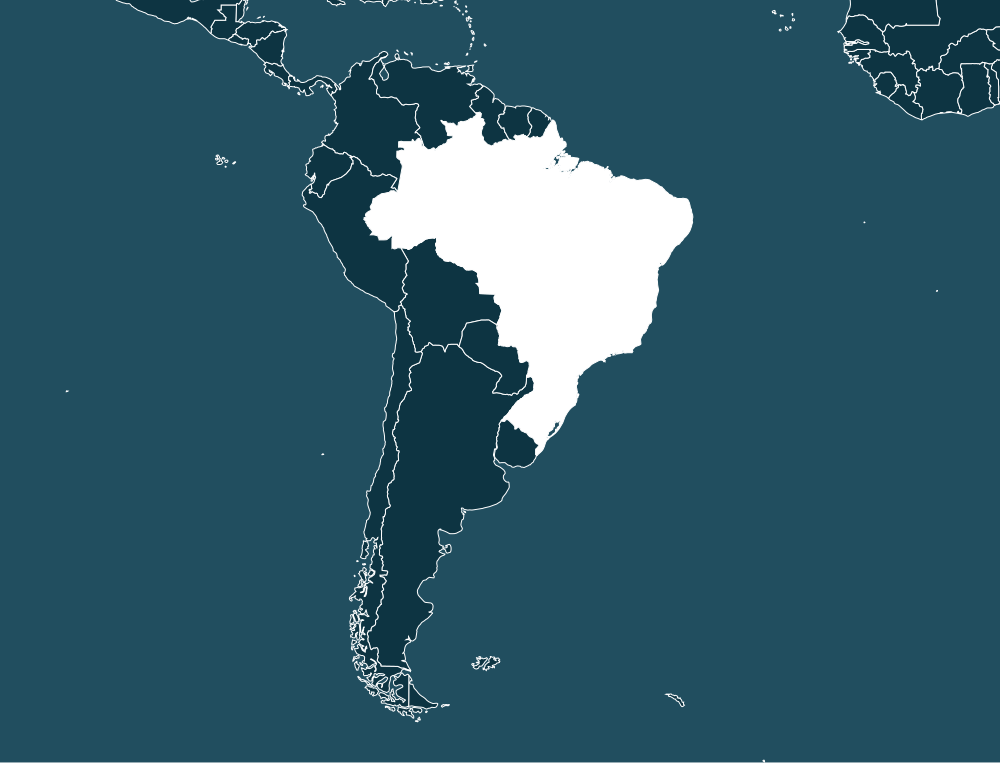
As South America’s largest and most populous country, Brazil’s security environment is shaped partly by instability beyond its extensive borders. Venezuela’s crisis, sanctions-evasion networks, and refugee flows intersect with Brazilian border concerns, while Colombia, Bolivia, and Paraguay present varying risks involving armed groups, narcotics, smuggling, and organized crime. Tensions involving Guyana and Venezuela add a wider regional dimension, even as Argentina, Peru, Suriname, French Guiana, and Uruguay are described as posing comparatively limited challenges.
AML & Terrorist Financing
Brazil has a substantial AML/CFT framework and is not subject to FATF enhanced-monitoring listing, but significant risks arise from corruption, drug trafficking, environmental crime, cross-border cash movements, informal value transfers, and increasingly sophisticated use of companies, real estate, and virtual assets. ENCCLA, COAF, the Central Bank of Brazil, and the Federal Revenue Service support a broad institutional response, yet resource constraints, fragmented coordination, lengthy proceedings, limited final confiscation, and restricted access to beneficial-ownership information continue to weaken outcomes. Terrorist-financing risks remain comparatively low but are evolving through far-right extremism, while the absence of prosecutions, limited use of targeted sanctions, uneven DNFBP and NPO controls, and gaps affecting virtual asset providers and proliferation-financing coordination leave areas requiring closer attention.
Sanctions
Brazil is expected to implement United Nations Security Council measures, spanning targeted restrictions such as arms embargoes, travel bans, and financial or commodity controls, while no international sanctions are currently in force against Brazil. The principal concern is not a named Brazilian sanctions program but alleged weak enforcement that allows Brazilian ports, shipping documentation, and financial channels to facilitate the movement of Russian dual-use goods and Venezuelan oil toward China, including activity involving PdVSA and U.S. licensing arrangements. References to shell companies, falsified cargo records, signal spoofing, and the tanker Karina—also identified as Katelyn—suggest a sanctions-evasion environment attracting heightened scrutiny rather than direct punitive measures against the Brazilian state.
Criminality
Brazil maintains a broad legal and institutional framework against corruption, yet enforcement—especially at the state level—remains uneven, with the dissolution of Operação Lava Jato leaving questions about the durability of reforms and the need for stronger independent oversight, prevention, and prosecution. Corruption continues to intersect with environmental crimes, money laundering, and illicit contracting, while groups such as the PCC and Comando Vermelho are associated with major drug, arms, and illegal-mining markets, alongside reported extortion and violence involving paramilitary actors.
Reports
Brazil remains a major cocaine destination and transit hub, with the Federal Police and U.S.-trained officers recording significant seizures while the PCC maintains a broad domestic and international presence and authorities expand responses to synthetic drugs. Human trafficking vulnerabilities span forced labor, sexual exploitation, and overseas recruitment, while Brazil’s counterterrorism efforts—led by the Federal Police—address terrorist financing, extremist recruitment, and threats linked to international travel.
Industry/Product Sector Risk
Brazil’s financial and wider commercial landscape presents varied exposure to money laundering and terrorist financing, with heightened concerns around retail banking, currency exchange, money remitters, real estate, trade finance, virtual currencies, mining, and public works. Complex ownership structures, informal markets, cash movements, cross-border trade, and professional intermediaries recur across the risk picture, with corruption, environmental crime, organised crime, tax offences, and fraud appearing among the principal underlying threats. Oversight involves bodies including the Central Bank of Brazil, CVM, SUSEP, CFC, and COAF, while differences in supervisory maturity and beneficial ownership transparency create a nuanced environment that merits closer examination.
Economy & Investment Climate
Brazil combines the scale of a major global economy with steady recent growth, substantial FDI appeal, and opportunities linked to infrastructure, energy, industrial policy, and the Novo PAC, while fiscal pressures, currency volatility, regulatory complexity, and uneven infrastructure remain important considerations. Ongoing reforms involving tax simplification, BNDES-backed investment, and initiatives from APEX-Brasil, the Central Bank of Brazil, and sector regulators point to a market that is modernizing, though foreign investors must still navigate sectoral restrictions, local requirements, and lengthy legal processes.
Cryptocurrency Regulations
Brazil permits cryptocurrency activity under a developing framework led by Law No. 14,478, with the Central Bank of Brazil, CVM, COAF, and Receita Federal each overseeing different aspects of authorization, securities classification, AML, and taxation. Exchanges and users face expanding KYC, Travel Rule, transaction-reporting, and capital-gains obligations, while evolving treatment of token offerings, tokenization, and CARF-aligned disclosures leaves important details still taking shape.
Get full access
The information on this page is a brief summary. Get access to EDD country reports, all risk category scores and customisable weightings for 245 jurisdictions.