
Risk Indicators
- FATF/EU Blacklist/Greylist (Lower Concern)
- Terrorism Financing (Lower Concern)
- US Dept of State INCSR
- Proliferation Financing
- Corruption
- Criminality
- Resilience & Governance
- Financial Transparency
- Offshore Finance Centres
- Sanctions
Background
Established as a UK overseas territory in 1965 after formerly being administered with Mauritius, the British Indian Ocean Territory now comprises the Chagos Archipelago, with Diego Garcia as its only inhabited island. The island hosts a joint UK-US naval support facility, GPS ground infrastructure, and a US Air Force GEODSS telescope array, underscoring its strategic importance. Its history is also shaped by the relocation of Chagossians, decades of litigation, and findings involving the Permanent Court of Arbitration, the International Court of Justice, and the United Nations General Assembly.
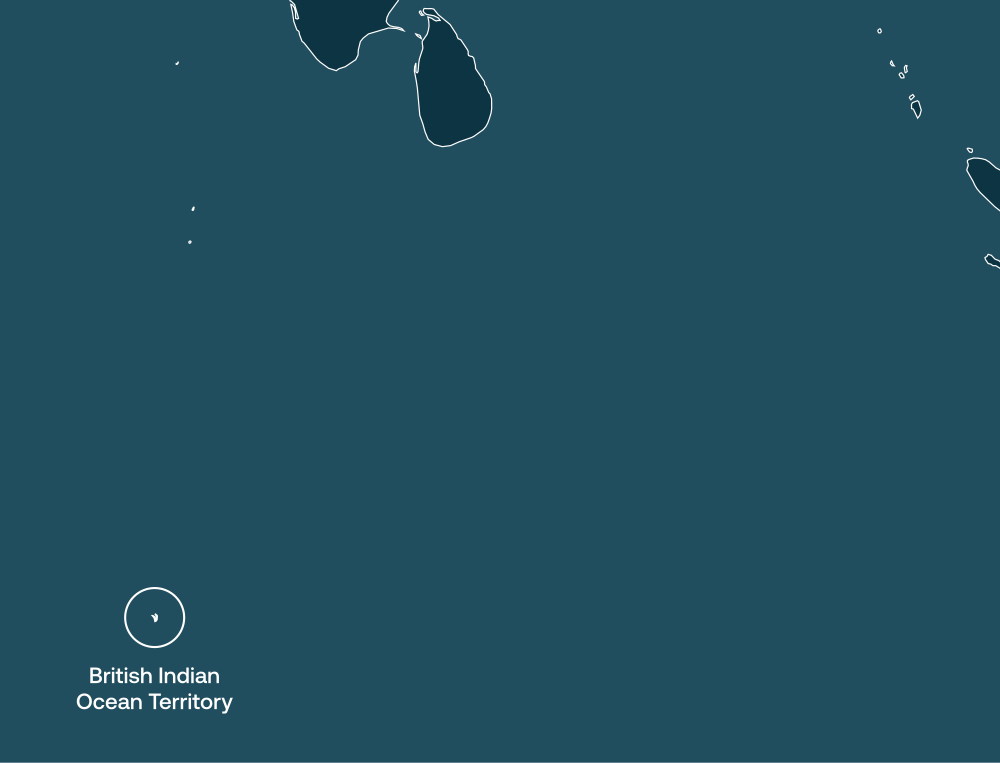
On May 22, 2025, the United Kingdom signed a treaty providing for the transfer of sovereignty to Mauritius, while preserving a 99-year lease for the Anglo-American military base and maintaining restrictions on the outer islands. Parliamentary approval, implementation legislation, and unresolved questions concerning Chagossian resettlement and compensation remain central to the territory’s future. Situated near the Maldives and Sri Lanka, BIOT occupies a regional environment marked by terrorism concerns, political instability, human-rights disputes, and vulnerabilities involving sanctions enforcement and evasion.
AML & Terrorist Financing
As a British Overseas Territory, British Indian Ocean Territory operates within the United Kingdom’s broader AML/CFT framework, which is not subject to FATF strategic-deficiency listing and has demonstrated strong capabilities in risk understanding, investigations, prosecutions, confiscation, and terrorist-financing disruption. Persistent concerns nevertheless include high-end and cash-based laundering, misuse of professional services and corporate structures, uneven risk-based supervision, and limitations affecting the UKFIU’s resources, SAR analysis, and the reliability or completeness of certain beneficial-ownership information. Bodies such as the NCA, JMLIT, OFSI, FCA, HMRC, and Companies House support the response, while smaller financial institutions, money-service businesses, and DNFBPs remain areas where implementation and sanctions compliance may be less consistent.
Sanctions
As a British Overseas Territory, British Indian Ocean Territory follows the United Kingdom’s sanctions framework, including financial, trade, immigration, and transport-related measures administered by bodies such as OFSI, FCDO, and ECJU. UK enforcement focuses particularly on Russia-related restrictions, export controls, high-risk goods, and intermediary networks involving jurisdictions such as the UAE, Türkiye, Central Asia, China, India, and Serbia, with tools including the CHPL and “No-Russia” clauses. No international sanctions are currently in force against British Indian Ocean Territory, while UK measures operate alongside—not as part of—ECOWAS sanctions and controls.
Criminality
As a British Overseas Territory, the British Indian Ocean Territory is covered through the United Kingdom’s legal and enforcement framework, where isolated bribery and corruption have occurred but are not generally identified as a significant business concern. The Bribery Act 2010, Serious Fraud Office, National Crime Agency, and unexplained-wealth measures provide mechanisms for addressing corruption, fraud, and illicit assets, while the territory-specific picture remains less defined.
Reports
Coverage for the British Indian Ocean Territory, through the United Kingdom, highlights major concerns involving illicit drug trafficking, rising synthetic opioid risks, industrial-scale cannabis activity, and online drug markets, alongside close cooperation between the UK National Crime Agency, Home Office, Border Force, and U.S. authorities. It also points to the UK’s Tier 1 anti-trafficking status amid persistent victim-identification and support gaps, while terrorism monitoring focuses on Islamist extremism, Northern Ireland-related threats, online propaganda, and increased terrorism-related arrests.
Economy & Investment Climate
British Indian Ocean Territory’s economy is concentrated around Diego Garcia, where UK and US military operations underpin construction, services, and imports, with the US dollar used and governance administered from London under applicable UK law. Trade data points to fish exports led by Singapore and imports such as refined petroleum and prefabricated buildings from Greece and Singapore, while restricted fishing, limited private investment, and environmental concerns including lagoon wastewater discharge constrain broader economic development.
Cryptocurrency Regulations
Cryptocurrency in the British Indian Ocean Territory occupies a largely undefined space, with no local legal-tender status, dedicated VASP registry, exchange licensing regime, or established framework for tokens and ICOs. Given the territory’s limited financial activity and military focus, relevant considerations appear likely to follow broader UK principles—including the 2017 money-laundering regulations and potential asset-based tax treatment—although the FCA has no direct local role and practical oversight remains unclear.
Get full access
The information on this page is a brief summary. Get access to EDD country reports, all risk category scores and customisable weightings for 245 jurisdictions.