
Risk Indicators
- FATF/EU Blacklist/Greylist (Lower Concern)
- Terrorism Financing (Medium Concern)
- US Dept of State INCSR
- Proliferation Financing
- Corruption
- Criminality
- Resilience & Governance
- Financial Transparency
- Offshore Finance Centres
- Sanctions
Background
Cabo Verde emerged from Portuguese colonization of previously uninhabited islands and developed through Atlantic commerce, leaving a distinctive blend of African and European influences visible in Crioulo, music, and pano textiles. Since independence in 1975, it has moved from one-party rule to a durable multiparty democracy, supported by a currency relationship that has progressed from the Portuguese escudo to the euro. Drought, famine, epidemics, and emigration have shaped the country’s population and economy, while uneven rainfall and environmental pressures distinguish its inhabited islands.
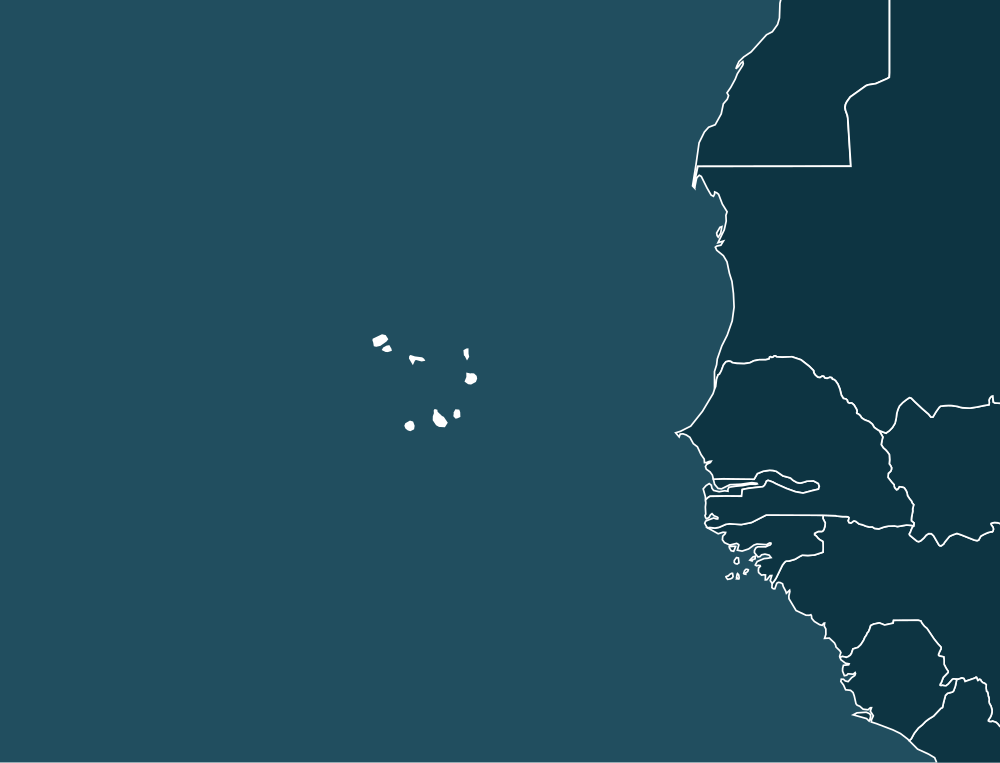
Although Cabo Verde remains comparatively stable, its maritime neighborhood includes states facing varied political, security, and sanctions-related risks. Guinea-Bissau’s election disputes, coup history, and UN, EU, and UK measures contrast with Senegal’s political unrest and Casamance conflict, while Mauritania confronts regional terrorism risks and The Gambia continues institutional and security-sector reforms. These surrounding conditions, together with Cabo Verde’s position near major Atlantic routes and a diaspora concentrated in Boston and Western Europe, add important context to its strategic profile.
AML & Terrorist Financing
Cabo Verde is not listed by FATF as having strategic AML deficiencies, yet it remains in enhanced follow-up, with the 2025 assessment finding most recommendations only largely compliant or partially compliant and no effectiveness ratings at the higher levels. Its archipelagic position, cash-intensive economy, narcotics transit exposure, and risks linked to tourism, real estate, DNFBPs, NPOs, and beneficial ownership continue to challenge detection and supervision, particularly where targeted financial sanctions and cross-border currency controls are concerned. Although the Unidade de Informação Financeira, Banco de Cabo Verde, Judicial Police, and Border Intelligence Group are strengthening cooperation, shortages of staff and technical capacity, limited feedback and information sharing, and uneven sectoral awareness continue to constrain enforcement and terrorist-financing oversight.
Sanctions
Cabo Verde is required, as a UN member, to implement Security Council sanctions, including measures involving arms, travel, finance, and commodities, but no distinct national sanctions regime against other countries is identified. There are no international sanctions currently in force against Cabo Verde, although its ports, air routes, and corporate structures are cited in connection with alleged evasion networks involving Venezuela, Iran, and Russia. Enforcement actions by bodies including the EU, UK, and OFAC have focused on linked vessels and entities such as Cape Gemi Işletmeciliği AŞ, while the Alex Saab case illustrates the broader concerns.
Criminality
Cabo Verde maintains a formal anti-corruption framework, including the Corruption Prevention Council and oversight by the Court of Auditors, Public Prosecutor’s Office, Judicial Police, and Financial Intelligence Unit, although allegations have touched senior political, law-enforcement, and judicial figures. Its geographic position exposes the islands to trafficking in people, cocaine, and arms, while street gangs and transnational networks contribute to violence, money laundering, and other illicit financial activity.
Reports
Cabo Verde’s mid-Atlantic position and extensive maritime zone continue to attract cocaine and cannabis trafficking toward Africa and Europe, prompting support from the United States and UNODC while leaving authorities with limited maritime and forensic capacity. Human trafficking vulnerabilities span children, migrants, tourist areas, and foreign workers, and although the National Observatory Against Trafficking in Persons and Attorney General’s Office have taken steps to respond, victim identification, prosecutions, and resources remain significant concerns.
Industry/Product Sector Risk
Cabo Verde’s industry landscape reflects a cash-intensive, tourism-driven economy shaped by substantial remittances, foreign investment, and its position along routes linking Latin America, Africa, and Europe. Casinos, retail banking, money remitters, real estate, construction, hospitality, transportation, and high-value dealers present notable exposure, with recurring concerns around beneficial ownership, informal activity, cross-border flows, and limited risk-based supervision by relevant authorities, including the Central Bank. Emerging electronic transfer channels, politically exposed persons, and foreign-funded non-profit organizations—nominally overseen by the NGO Platform—add further layers of complexity to risks associated with drug trafficking, corruption, tax offences, and other economic crimes.
Economy & Investment Climate
Cabo Verde’s economy combines strong institutions, political stability, and a powerful tourism-led recovery with significant exposure to external shocks, climate pressures, import dependence, and the constraints of a small, dispersed island market. As the government pursues diversification through Cabo Verde TradeInvest, PEDS II, Ambition 2030, renewable energy, and the blue and digital economies, privatization, labor shortages, infrastructure costs, and the performance of state-owned enterprises remain important areas to watch.
Cryptocurrency Regulations
Cape Verde’s cryptocurrency landscape remains permissive but largely undefined: digital assets are not legal tender, while the Bank of Cape Verde applies broader AML/CFT expectations aligned with FATF standards rather than dedicated virtual-asset rules. Businesses and investors face further uncertainty around exchange licensing, VASP registration, taxation—including a possible 15% capital-gains treatment—and token offerings, with no formal Travel Rule or CARF commitment currently identified.
Get full access
The information on this page is a brief summary. Get access to EDD country reports, all risk category scores and customisable weightings for 245 jurisdictions.