
Risk Indicators
- FATF/EU Blacklist/Greylist (Lower Concern)
- Terrorism Financing (Lower Concern)
- US Dept of State INCSR
- Proliferation Financing
- Corruption
- Criminality
- Resilience & Governance
- Financial Transparency
- Offshore Finance Centres
- Sanctions
Background
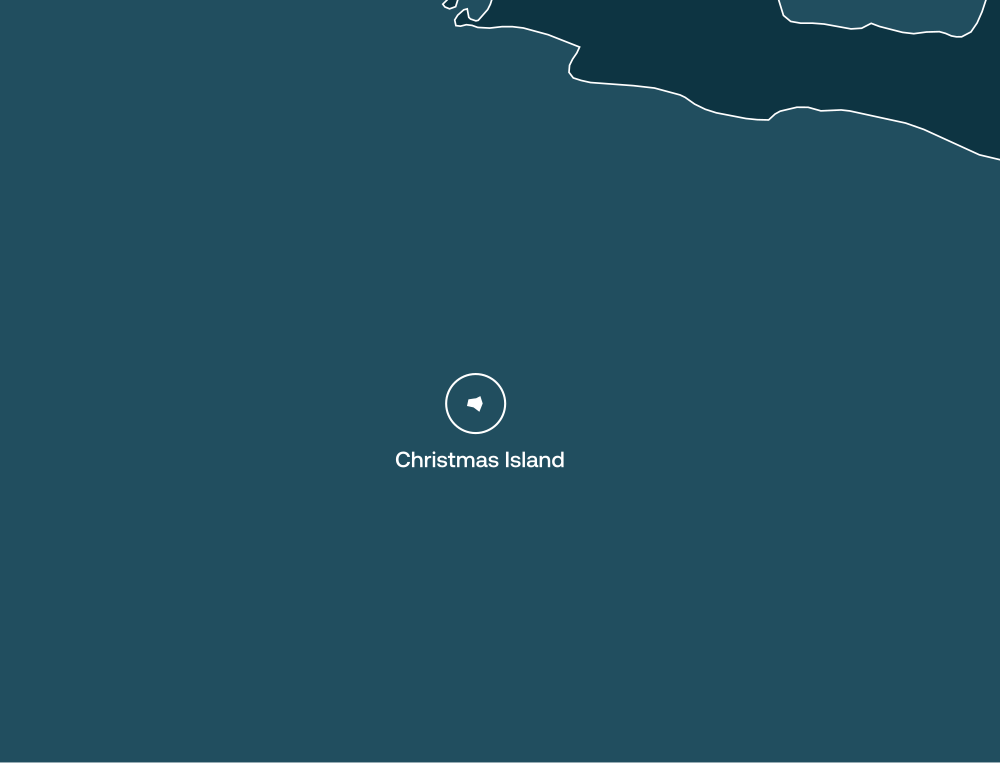
Christmas Island’s modern history was shaped by its remote Indian Ocean setting, difficult terrain, and the discovery of phosphate in 1887, which prompted British annexation and brought workers from China, Malaya, India, and Europe. Administered from Singapore, the island endured Japanese occupation before sovereignty passed to Australia in 1958 following a $20 million arrangement linked to lost phosphate income. Australia later established Christmas Island National Park across more than 60% of the territory, while environmental concerns led to the mine’s closure and resistance to reopening it.
Its strategic position, roughly 350 km from Indonesia, has given the island significance beyond its small population and resource history. Since the 1980s, arrivals by boat and changing Australian migration policies made it a focal point for asylum processing, detention, and, briefly, pandemic quarantine. Indonesia’s nearby conflicts, maritime pressures, terrorism concerns, and evolving sanctions controls—including scrutiny involving Iran and Russia—add a wider regional dimension to the island’s background.
AML & Terrorist Financing
Christmas Island, as an Australian territory, operates within a generally robust AML/CFT framework, with Australia outside the FATF list of jurisdictions with strategic deficiencies and showing improved ratings in the 2024 follow-up process. Important vulnerabilities remain around the identification and prosecution of money laundering, beneficial ownership transparency, oversight of higher-risk professional and non-profit sectors, and confirmation that targeted financial sanctions are effectively implemented. AUSTRAC, the Australian Federal Police, the Australian Criminal Intelligence Commission and Fintel Alliance support enforcement and intelligence-sharing, while typologies involving fraud-linked money mules, remittance channels, corporate structures and funds connected to overseas conflicts add further complexity.
Sanctions
Through its status as an Australian territory, Christmas Island falls under Australia’s extensive implementation of United Nations and autonomous sanctions regimes covering areas such as Russia, Iran, North Korea, terrorism, human rights, cyber incidents, and regional conflicts. Enforcement and evasion monitoring involve the Australian Sanctions Office, AUSTRAC, Australian Border Force, and the Australian Federal Police, with attention to shadow fleets, third-country financial intermediaries, and digital channels. No international sanctions are currently in force against Christmas Island, while recent measures—including designations involving Russian vessels and individuals linked to settler violence—illustrate the scope of the framework applied there.
Criminality
Christmas Island falls under Australia’s generally strong anti-corruption framework, with the Attorney-General’s Department, the National Anti-Corruption Commission, and state-level bodies such as Western Australia’s Corruption and Crime Commission providing avenues for investigation and reporting. Crime concerns nevertheless include organized drug trafficking, human trafficking and forced labour, counterfeit and illicit tobacco trade, cyber-enabled fraud and ransomware, and money laundering linked to outlaw motorcycle gangs and international criminal networks.
Reports
As an Australian territory, Christmas Island falls within Australia’s Tier 1 standing on human trafficking, alongside efforts by the Fair Work Ombudsman and new pathways and visa pilots to support vulnerable workers, though screening and victim accommodation remain concerns. Australia recorded no terrorist attacks in 2023 while expanding police powers, strengthening restrictions on extremist symbols and materials, and relying on agencies including AUSTRAC and the Australia-New Zealand Counterterrorism Committee to support domestic and regional security.
Economy & Investment Climate
Christmas Island’s economy combines tourism, government activity, and phosphate extraction that is nearing depletion, with future prospects increasingly tied to eco-tourism, biodiversity protection, and sustainable development. Its Australian legal and monetary framework supports stability, while trade remains import-dependent—particularly on the United States and Australia—and exports include fertilizers, paintings, and amine compounds.
Cryptocurrency Regulations
Christmas Island’s cryptocurrency landscape follows Australia’s framework, with AUSTRAC registration, AML/CTF controls, and ASIC oversight shaping exchange activity even though crypto is not legal tender. Tax treatment through the ATO, evolving expectations around the Travel Rule and CARF, and potential Corporations Act obligations for token offerings create a compliance environment whose local details remain limited but significant.
Get full access
The information on this page is a brief summary. Get access to EDD country reports, all risk category scores and customisable weightings for 245 jurisdictions.