
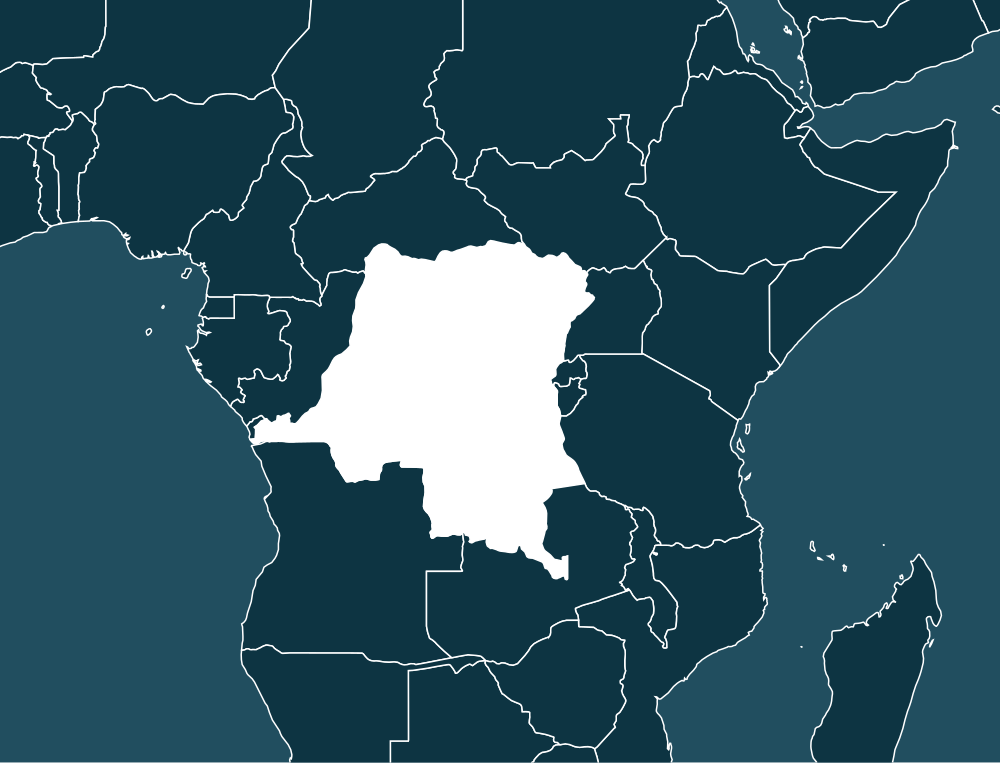
Risk Indicators
- FATF/EU Blacklist/Greylist (Higher Concern)
- Terrorism Financing (Higher Concern)
- US Dept of State INCSR
- Proliferation Financing
- Corruption
- Criminality
- Resilience & Governance
- Financial Transparency
- Offshore Finance Centres
- Sanctions
Background
The Democratic Republic of the Congo is shaped by extraordinary ethnic and political diversity, with historic kingdoms such as Kongo, Luba, and Lunda later disrupted by the Congo Free State and Belgian colonial rule. Independence in 1960 was followed by prolonged authoritarianism under Mobutu Sese Seko, regional wars, and a difficult transition involving Laurent and Joseph Kabila. Felix Tshisekedi’s election marked a notable political transfer, although subsequent voting and governance have remained contested.
Eastern insecurity continues to involve more than 100 armed groups, including M23, the Allied Democratic Forces, the FDLR, and Mai Mai militias. Regional military involvement by Rwanda, Uganda, and Burundi, along with instability in South Sudan and the Central African Republic, has intensified cross-border risks and illicit mineral and arms networks. MONUSCO, alongside international sanctions targeting armed actors and their supporters, remains central to efforts complicated by weak borders, political resistance, and persistent evasion.
AML & Terrorist Financing
The Democratic Republic of the Congo remains exposed to money laundering and terrorist financing through corruption, mineral and wildlife trafficking, customs fraud, widespread informality, cash-based transactions, dollarization, and porous borders, while armed groups and regional instability heighten terrorism-financing concerns. Although the country has strengthened parts of its framework through commitments involving FATF and GABAC, significant weaknesses have persisted in risk-based supervision, beneficial-ownership transparency, suspicious transaction reporting, investigative capacity, and the practical implementation of targeted financial sanctions. CENAREF, the BCC, and ARCA remain central to the response, but limited resources, institutional vulnerabilities, and low effectiveness in investigations, prosecutions, and terrorism-financing controls continue to shape the overall risk picture.
Sanctions
The Democratic Republic of the Congo does not appear to impose an independent sanctions regime on other nations, but it is required to implement United Nations measures, including restrictions on arms transfers and designated persons. International measures affecting actors connected to the DRC include UN, OFAC, EU, UK, Canadian, Australian, Swiss, and Norwegian asset freezes, travel bans, and arms controls, with recent attention to Rwandan officials, M23 leaders, and the Rwanda Defence Force. Enforcement remains complicated by weaknesses involving CENAREF, Gécamines, and Congolese banks, alongside alleged evasion networks linked to Dan Gertler, North Korean operatives, and Hizballah financiers.
Criminality
Crime and corruption in the Democratic Republic of the Congo remain closely intertwined, with armed groups, security personnel, political figures, and commercial networks linked to illicit mineral trading, trafficking, extortion, and the diversion of public resources. Although the APLC’s National Anti-Corruption Strategy, the IGF’s investigation into alleged losses at Gécamines, and civil-society initiatives such as CNPAV and ODEP indicate pressure for greater accountability, weak enforcement, selective prosecutions, and risks facing whistleblowers and NGOs continue to limit progress.
Reports
The Democratic Republic of the Congo faces persistent trafficking risks linked to conflict, displacement, mining, domestic work, and armed-group recruitment, while government efforts include convictions, child-soldier screening, and a pending national action plan amid concerns over impunity, limited services, and complicity involving FARDC-linked actors. In eastern provinces, ISIS-DRC/ADF violence and M23 activity continued to affect civilians, with terrorism incidents rising in 2024, although joint operations, UN support, and convictions for ISIS-DRC members produced some notable responses.
Industry/Product Sector Risk
The Democratic Republic of the Congo’s industry landscape is shaped by a highly dollarised, cash-intensive economy, extensive informality, limited financial inclusion, and significant exposure in mining, construction, real estate, transport, agriculture, forestry, gaming, and money-transfer activities. Across sectors, weak customer identification, limited beneficial-ownership transparency, porous borders, and uneven AML/CFT supervision—including gaps overseen by the BCC and emerging sector authorities—create channels for proceeds linked to corruption, customs and tax fraud, natural-resource trafficking, and armed-group financing. At the same time, expanding mobile-money services, infrastructure projects, and formal financial relationships offer important areas for deeper analysis of evolving risks, controls, and enforcement capacity.
Economy & Investment Climate
The Democratic Republic of the Congo combines rapid growth and exceptional mineral potential—particularly in copper, cobalt, lithium, and related processing—with emerging opportunities in telecommunications, energy, agriculture, infrastructure, and Special Economic Zones overseen by AZES. Investment promotion through ANAPI, business-climate reforms, and financial-sector digitalization point to meaningful potential, while insecurity in the east, infrastructure gaps, currency volatility, corruption, limited access to finance, and uneven legal enforcement continue to shape the operating environment.
Cryptocurrency Regulations
Cryptocurrency use in the Democratic Republic of the Congo is permitted but remains outside legal tender status, with Law No. 04/016 and the Central Bank of the Congo providing only an indirect regulatory backdrop. The absence of VASP licensing, a crypto compliance registry, defined tax treatment, and dedicated rules for exchanges or token offerings leaves the market open yet marked by significant uncertainty, even as FATF participation points toward possible future alignment with international standards.
Get full access
The information on this page is a brief summary. Get access to EDD country reports, all risk category scores and customisable weightings for 245 jurisdictions.