
Risk Indicators
- FATF/EU Blacklist/Greylist (Lower Concern)
- Terrorism Financing (Lower Concern)
- US Dept of State INCSR
- Proliferation Financing
- Corruption
- Criminality
- Resilience & Governance
- Financial Transparency
- Offshore Finance Centres
- Sanctions
Background
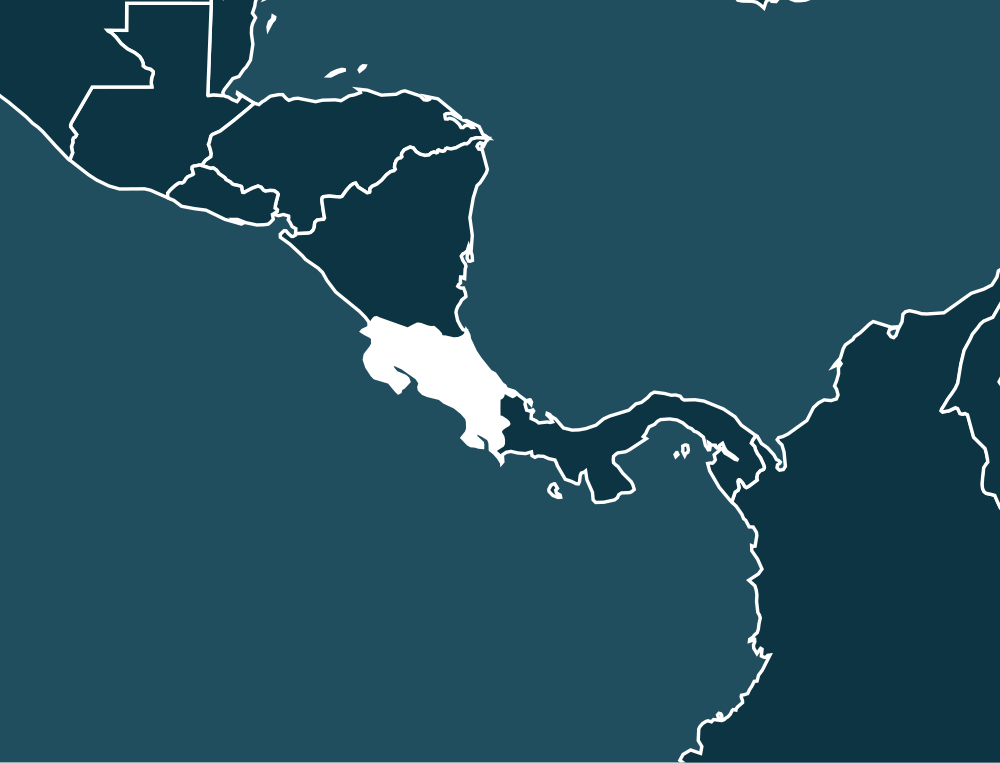
Costa Rica’s early colonial history was shaped by difficult terrain, disease, Indigenous resistance, and pirate raids before Cartago became a permanent settlement in 1563. After joining the United Provinces of Central America, it established sovereignty in 1838, setting the foundation for a distinct national trajectory. Its democratic development later endured only brief disruptions, including Federico Tinoco Granados’s 1917 coup and the 1948 conflict associated with José Figueres Ferrer.
Regional instability brought significant refugee movements during the Central American civil wars of the 1970s and 1980s, while subsequent peace supported economic recovery and diversification beyond agriculture. Today, Costa Rica’s setting includes an authoritarian and heavily sanctioned Nicaragua to the north and a more stable, though corruption-affected, Panama to the south. The contrasting approaches of Nicaragua’s sanctions resistance and Panama’s efforts to police its maritime registry add further dimensions to Costa Rica’s regional environment.
AML & Terrorist Financing
Costa Rica has established a broad AML/CFT framework and is not subject to FATF enhanced public listing, yet its 2024 follow-up ratings—17 Recommendations Compliant and 20 Largely Compliant—remain accompanied by continued enhanced follow-up through GAFILAT. Money laundering risks are linked to narcotics trafficking and vulnerable sectors including money transfers, real estate, construction, casinos, vehicle sales, and emerging virtual assets, while the UIF of the Costa Rican Institute on Drugs and SUGEF continue to strengthen detection and supervision. Terrorist-financing and proliferation-financing controls remain notably weaker, with limited case experience, gaps in targeted financial sanctions and freezing procedures, challenges accessing accurate beneficial-ownership information, and uneven oversight of DNFBPs despite tools such as the RTBF.
Sanctions
Costa Rica supports applicable UN Security Council sanctions, including measures involving asset freezes, travel bans, arms restrictions, and other targeted controls, while no international sanctions are currently in force against the country itself. U.S. Treasury OFAC has nevertheless designated Costa Rica-based individuals and entities under Executive Order 14059, including networks associated with narcotics trafficking and money laundering between November 2023 and January 2026. Costa Rica has also taken a distinctive enforcement role by requiring businesses to comply with U.S. sanctions concerning Russia, even as intermediaries and freight networks have created evasion risks involving Venezuela and other sanctioned jurisdictions.
Criminality
Costa Rica has a comparatively developed anti-corruption framework, including protections for whistleblowers and oversight through the Procuraduría General de la República, though limited enforcement resources and allegations involving public tenders, permits, and municipal administration remain concerns. Crime includes persistent trafficking in people, drugs, arms, and contraband, alongside environmental offenses, cyber threats, and money laundering through sectors such as construction, real estate, and tourism, with networks operating across areas including Limón, Puntarenas, and San José.
Reports
Costa Rica remains a key maritime and regional transit point for cocaine and other illicit drugs, while agencies including the Ministry of Public Security, Costa Rican Coast Guard, and Costa Rican Drug Institute pursue interdiction, prevention, and institutional reforms with substantial U.S. support. Human trafficking continues to affect domestic and foreign victims across sex trafficking, forced labor, migrant exploitation, and child exploitation contexts, even as authorities increase investigations, victim assistance, and labor-trafficking convictions amid persistent gaps in services and enforcement.
Industry/Product Sector Risk
Costa Rica’s financial and broader commercial landscape presents uneven exposure, with particularly significant vulnerabilities in banking, casinos, money remitters, virtual currencies, real estate, construction, transportation, and other cash-intensive or cross-border activities. While SUGEF, SUGEVAL, and SUGESE oversee important parts of the regulated system, gaps affecting DNFBPs, beneficial ownership transparency, informal financial channels, and emerging digital services remain notable. The Liberty Reserve case, coastal property development, Central American drug-trafficking routes, and the use of corporate, trust, and professional structures offer only a glimpse of the country-specific dynamics shaping illicit finance risks.
Economy & Investment Climate
Costa Rica combines resilient growth, a diversified services- and technology-oriented economy, strong foreign investment inflows, and established institutions, with PROCOMER, CINDE, and the free trade zone regime supporting activity in areas such as medical devices, semiconductors, tourism, and digital services. Its positive trajectory is tempered by fiscal pressures, infrastructure and energy constraints, labor informality, security concerns, and the continued need for reforms highlighted through its OECD and IMF engagement.
Cryptocurrency Regulations
Costa Rica permits cryptocurrency activity in a largely evolving regulatory grey area, with the Central Bank of Costa Rica (BCCR) treating digital assets as “crypto assets” or “quasi-money,” while Conassif oversight and Law No. 8204 do not provide a dedicated VASP framework. Tax treatment is more defined through the Dirección General de Tributación, including a 15% capital gains rate in relevant cases, as proposed Bill 23415 signals potential changes for exchanges, ICOs, AML controls, and broader market supervision.
Get full access
The information on this page is a brief summary. Get access to EDD country reports, all risk category scores and customisable weightings for 245 jurisdictions.