
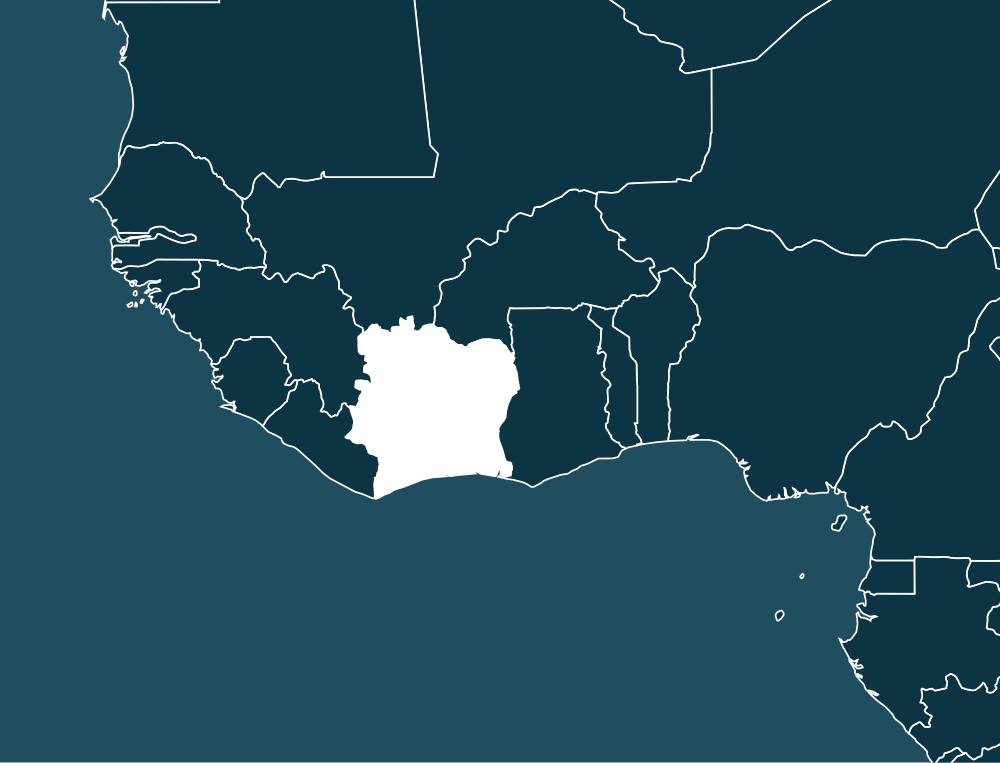
Risk Indicators
- FATF/EU Blacklist/Greylist (Higher Concern)
- Terrorism Financing (Medium Concern)
- US Dept of State INCSR
- Proliferation Financing
- Corruption
- Criminality
- Resilience & Governance
- Financial Transparency
- Offshore Finance Centres
- Sanctions
Background
Côte d’Ivoire’s history reflects the interaction of longstanding kingdoms, French influence, and a post-independence economy shaped by cocoa and foreign investment. Independence in 1960 was followed by close ties with France, while disputes over identity and political authority persisted, including the Sanwi kingdom’s 1969 separatist effort. A military coup, contested elections, and the 2002 civil war eventually led to a divided country, a buffer zone, and international peacekeeping involvement.
The transition from Laurent GBAGBO to Alassane Dramane OUATTARA culminated in renewed violence before OUATTARA assumed office in 2011, with later elections continuing to draw controversy. Political compromise enabled opposition participation in the 2021 legislative elections, while the International Criminal Court’s final acquittal of GBAGBO helped create an opening for public reconciliation in Abidjan. Côte d’Ivoire’s regional environment remains complex, bordered by countries facing insurgencies, military rule, sanctions, cross-border trafficking, and related concerns monitored by bodies including ECOWAS, the EU, the UK, and the US.
AML & Terrorist Financing
Côte d’Ivoire remains subject to enhanced scrutiny for strategic AML/CFT deficiencies, despite a high-level commitment with FATF and GIABA and recent progress toward an on-site assessment. Persistent vulnerabilities include cash-heavy and informal activity, porous borders, corruption, cross-border crime, real estate laundering, limited beneficial-ownership verification, uneven risk-based supervision, and weak implementation among DNFBPs and other sectors. CENTIF, the PPEF, AGRAC, and regional bodies such as the WAEMU Banking Commission are central to the response, yet terrorist-financing investigations, convictions, targeted financial sanctions, and proliferation-financing controls remain notably limited.
Sanctions
As a UN member, Côte d’Ivoire is expected to implement Security Council measures, including those reflected on the UN Consolidated List, although no distinct sanctions imposed by Côte d’Ivoire on other nations are identified. No international sanctions are currently in force against Côte d’Ivoire. At the same time, international cases have linked the country to sanctions-evasion networks involving Hizballah and IRGC-related interests, with shell companies, falsified shipping documents, and transit routes for diamonds, oil, charcoal, and other goods reportedly connecting Lebanon, Iran, the DRC, Angola, the UAE, and European markets.
Criminality
Corruption remains deeply embedded in Côte d’Ivoire’s public and private sectors, affecting judicial proceedings, contract awards, customs, and taxation, although the High Authority for Good Governance has recorded improved compliance with asset declarations. Illicit activity includes trafficking, illegal logging and artisanal mining, cocaine transit, cybercrime, and money laundering, while agencies such as CENTIF and SPACIA have pursued investigations amid limited prosecutions and weak whistleblower protections.
Reports
Côte d’Ivoire is taking stronger action against trafficking, including expanded investigations, victim repatriations, and a new Abidjan unit targeting child begging, while serious vulnerabilities persist in cocoa production, mining, domestic servitude, and migration routes. Counterterrorism efforts included cooperation that led to six ISIS arrests, increased attention to northern borders, and reforms involving the Financial Intelligence Unit, even as terrorist-financing weaknesses and regional instability remain concerns.
Industry/Product Sector Risk
Côte d’Ivoire’s financial and commercial landscape combines a regionally significant banking and capital-markets system with extensive cash usage, informal activity, and substantial cross-border flows. Elevated exposure is particularly evident in banking, real estate, casinos, foreign exchange, remittances, precious metals, mining, transportation, and virtual currencies, while mobile money, agriculture, telecommunications, and non-profit activity present more nuanced vulnerabilities. Oversight is shaped by institutions such as the BCEAO, WAEMU Banking Commission, CREPMF, LONACI, and specialized forest and mining enforcement units, although gaps in supervision, beneficial-ownership transparency, and informal-sector controls remain important features across the market.
Economy & Investment Climate
Côte d’Ivoire combines sustained growth, macroeconomic stability, and expanding opportunities in agriculture, energy, extractives, infrastructure, and digital services, with institutions such as CEPICI supporting investment and the country’s regional trade ambitions. Yet investors must also navigate informality, skills shortages, evolving tax and regulatory practices, commodity dependence, land complexities, and ongoing efforts by bodies such as the CCC and ANRMP to strengthen transparency, traceability, and governance.
Cryptocurrency Regulations
Côte d’Ivoire treats cryptocurrency as an intangible asset rather than legal tender, while exchanges, VASPs, and token offerings remain largely in a regulatory grey area without dedicated licensing, trading, or disclosure rules. Law No. 2016-966 brings AML/CFT oversight through the BCEAO and Cellule Nationale de Traitement des Informations Financières, but questions surrounding the Travel Rule, taxation, transaction monitoring, and future digital-asset standards remain open.
Get full access
The information on this page is a brief summary. Get access to EDD country reports, all risk category scores and customisable weightings for 245 jurisdictions.