
Risk Indicators
- FATF/EU Blacklist/Greylist (Lower Concern)
- Terrorism Financing (Lower Concern)
- US Dept of State INCSR
- Proliferation Financing
- Corruption
- Criminality
- Resilience & Governance
- Financial Transparency
- Offshore Finance Centres
- Sanctions
Background
Curaçao’s history reflects successive waves of Indigenous settlement, Spanish control, Dutch rule, and a pivotal role in the Caribbean slave trade. The island’s economic fortunes later became closely tied to the Isla Refineria and Venezuela’s oilfields, before its constitutional relationship with the Netherlands changed following referenda in 2005 and 2009. Since 2010, Curaçao has functioned as a self-governing country within the Kingdom of the Netherlands.
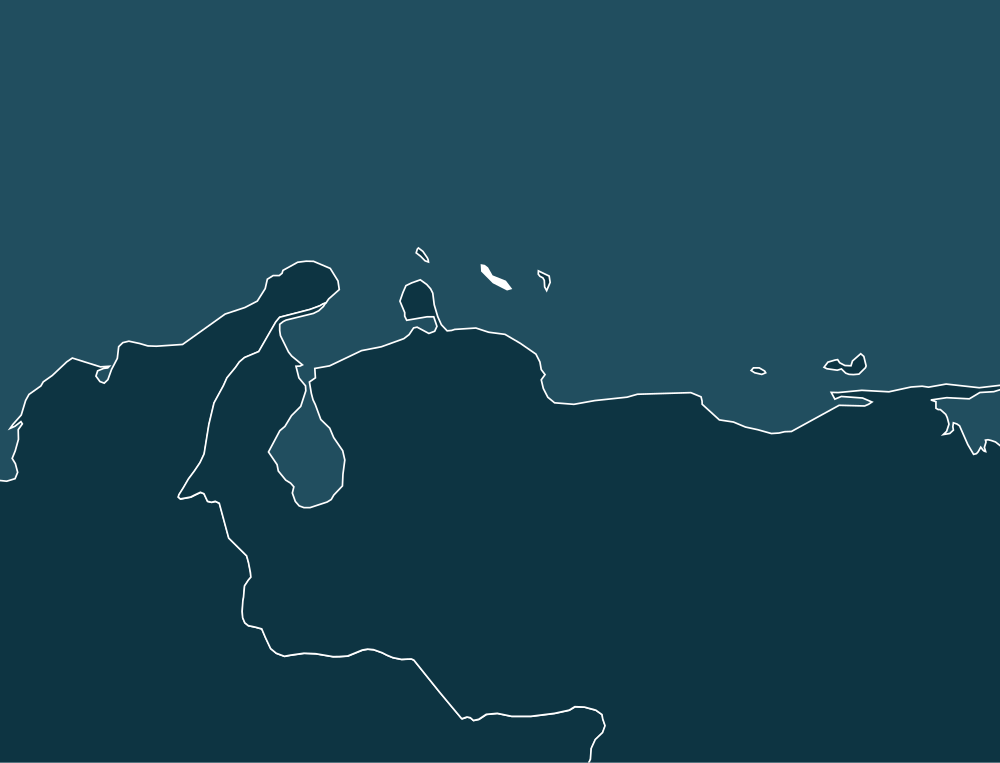
Its location approximately 60 kilometers from Venezuela places it near significant political, economic, and security pressures, including migration, smuggling, and illicit financial activity. Venezuela’s contested 2024 election, international sanctions from the United States, European Union, and Canada, and alleged evasion networks create particular regional concerns, while Aruba and Bonaire present differing levels of political and security exposure. Curaçao must also implement EU sanctions, including measures affecting Russia, as its role as a regional trade hub brings heightened scrutiny despite no evidence of widespread evasion originating on the island.
AML & Terrorist Financing
Curaçao is not identified by FATF as having strategic AML deficiencies, yet its 2025 evaluation found a mixed compliance and effectiveness profile, with important weaknesses affecting terrorist-financing risk analysis and implementation. Its medium-high money-laundering exposure is linked to financial services, real estate, online gambling, free-trade zones, underground banking, and cross-border proceeds associated with drug trafficking, while oversight of VASPs and online casinos remains a developing area. Capacity constraints at FIU Curaçao, law-enforcement and prosecution bodies, together with delays in international cooperation, asset freezing, confiscated-asset management, and the pending AML/CFT/CPF regulation, continue to shape the country’s financial-crime challenges.
Sanctions
Curaçao implements United Nations and European Union sanctions, with its Financial Intelligence Unit providing guidance on measures concerning Russia and Belarus and on suspicious transactions involving foreign lists such as those maintained by OFAC. Although no international sanctions are currently in force against Curaçao, its infrastructure has been linked to alleged evasion of U.S. sanctions targeting Venezuela, including activity involving the Bullenbaai terminal, the tanker Colon, and later maritime tactics associated with the Skipper. The island’s state-affiliated refining interests, opaque corporate structures, re-export arrangements, and Curaçao-flagged vessels have raised concerns about enforcement vulnerabilities despite public commitments to sanctions compliance.
Criminality
Available country-specific indicators provide only a partial basis for assessing the current state of corruption in Curaçao. Further detail would be needed to clarify the nature, scale, and institutional handling of corruption-related concerns.
Reports
Curaçao remains a strategically important transit point for cocaine and other illicit drugs from Venezuela and Colombia, with the Korps Politie Curaçao, RST, and KMAR working alongside U.S. and Dutch partners on maritime and airborne smuggling investigations, supported by surveillance and operations from the U.S. Cooperative Security Location. Separately, Curaçao’s anti-trafficking efforts showed progress through increased funding, victim assistance, awareness initiatives, and a first conviction in several years, while persistent concerns include vulnerable Venezuelan and other migrant communities, exploitation in sectors ranging from “snack bars” to construction and domestic work, limited official expertise, and gaps in screening, prosecution, and victim protection.
Industry/Product Sector Risk
Curaçao’s industry landscape combines a substantial cross-border banking and corporate-services environment with prominent exposure in online gaming, money remittance, real estate, transportation, construction, and oil-related activities. The Curaçao Gaming Control Board and the Central Bank of Curaçao and Sint Maarten feature prominently amid concerns involving cash intensity, foreign clients, complex legal structures, beneficial ownership, and trade-linked transactions. Further insight lies in how risks associated with drug trafficking, tax offences, fraud, corruption, and other organised crime may intersect across casinos, TCSPs, logistics networks, professional intermediaries, and high-value assets.
Economy & Investment Climate
Curaçao’s high-income, service-led economy combines tourism, petroleum activities, and international financial and business services, supported by its strategic Caribbean position and Dutch civil-law framework. While the government’s “Open Arms” approach seeks to attract investment into information technology and other sectors, external pressures, trade imbalances, and environmental concerns surrounding Sint Anna Bay continue to shape its economic outlook.
Cryptocurrency Regulations
Curaçao is moving toward a regulated but still developing cryptocurrency environment, with the Central Bank of Curaçao and Sint Maarten overseeing VASP registration and the amended LID and MOT ordinances imposing FATF-aligned AML/CFT expectations. Crypto is not legal tender or prohibited, while licensing, exchange oversight, taxation, ICOs, Travel Rule implementation, and the treatment of events such as airdrops remain areas where forthcoming measures—including proposed virtual-asset legislation and January 2025 guidance—may prove significant.
Get full access
The information on this page is a brief summary. Get access to EDD country reports, all risk category scores and customisable weightings for 245 jurisdictions.