
Risk Indicators
- FATF/EU Blacklist/Greylist (Lower Concern)
- Terrorism Financing (Lower Concern)
- US Dept of State INCSR
- Proliferation Financing
- Corruption
- Criminality
- Resilience & Governance
- Financial Transparency
- Offshore Finance Centres
- Sanctions
Background
The Dominican Republic’s history reflects the layered legacies of Taino societies, Spanish and French colonial rule, Haitian occupation, and repeated struggles over sovereignty. Independence in 1844, its brief return to Spain, and restoration in 1865 preceded decades of unsettled governance, including the Rafael Leonidas Trujillo dictatorship and the political upheavals surrounding Juan Bosch and Joaquín Balaguer. Since the pressures that shortened Balaguer’s final term in 1996, the country has maintained regular competitive elections.
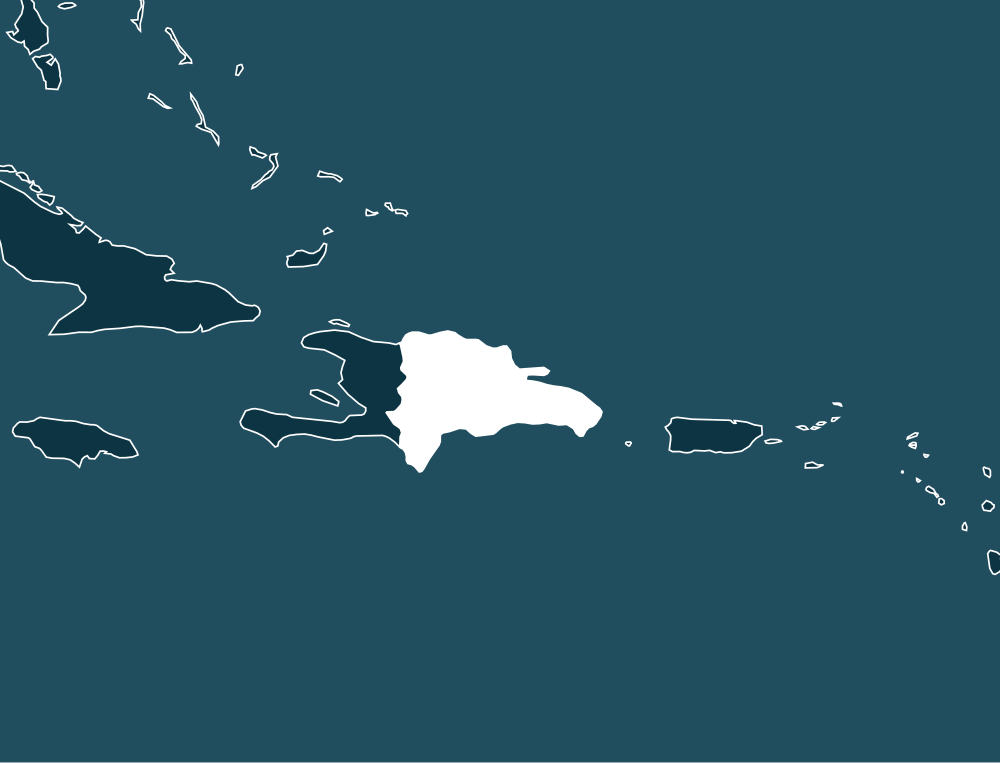
Today, the Dominican Republic’s principal security and political concern is its shared land border with Haiti, where gang control, institutional fragility, and humanitarian emergencies have intensified cross-border risks. Border deployments, wall construction, tighter immigration rules, and increased penalties reflect concerns over migration, arms trafficking, drugs, and other contraband. Haiti’s exposure to UN, EU, and Canadian sanctions—including asset freezes, travel bans, and arms restrictions—intersects with persistent money-laundering and sanction-evasion vulnerabilities, while nearby Puerto Rico presents a markedly different and more stable profile.
AML & Terrorist Financing
The Dominican Republic is not identified by FATF as having strategic AML deficiencies, yet the 2019 mutual evaluation found weaknesses across core recommendations and only moderate effectiveness overall. Law 155-17, CONCLAFIT, the UAF, DGII, and specialized prosecutorial bodies have strengthened the framework, while drug trafficking, corruption, fraud, the informal economy, DNFBPs, and emerging cryptocurrency activity continue to create significant exposure. Persistent concerns include limited sanctions and resources, uneven implementation outside the banking sector, incomplete beneficial-ownership and PEP controls, weak statistical capacity, and uncertainty over how financial intelligence and asset-forfeiture tools translate into prosecutions, while terrorist-financing risk is assessed as low despite gaps in awareness and DNFBP screening.
Sanctions
The Dominican Republic has no international sanctions currently in force against it and, as a UN member, supports Security Council measures covering areas such as conflict settlement, non-proliferation, and counter-terrorism. Its most visible enforcement activity has involved cooperation with U.S. authorities, including seizures of aircraft linked to Venezuela, PdVSA, and sanctioned Venezuelan officials under U.S. export-control and sanctions laws. Although Dominican airports have been used for refuelling, maintenance, and layovers in alleged evasion schemes, legal reforms and AML/CFT efforts—partly aimed at avoiding FATF repercussions—indicate a broader effort to prevent the country from becoming a sanctions-evasion hub.
Criminality
The Dominican Republic has strengthened corruption investigations under the Abinader administration, including cases involving senior officials, yet concerns persist over politically connected procurement, municipal permitting, and limited safeguards against bribery. Criminal activity spans cocaine and human-trafficking networks, illegal arms, gang-linked extortion, cybercrime, and money laundering, with agencies such as PEPCA and DIGEIG central to the country’s response.
Reports
The Dominican Republic is intensifying maritime interdiction and regional cooperation against cocaine trafficking, with the DNCD, Dominican Navy, National Police, and U.S.-supported initiatives contributing to record seizures while corruption and institutional challenges persist. Efforts to address trafficking in persons have advanced to Tier 2 through legal reforms, increased prosecutions and inspections, and a new national action plan, yet labor exploitation, child sexual trafficking, statelessness, and vulnerabilities affecting Haitian and other migrant communities remain significant concerns.
Industry/Product Sector Risk
The Dominican Republic’s highest-risk areas include retail banking, casinos and gaming, currency exchange, money remittance, real estate, cash-intensive businesses, politics, and public works, reflecting the influence of cash, cross-border flows, complex ownership, and substantial transaction values. Medium-risk exposure extends across insurance, investment funds, securities, high-value dealers, professional services, agriculture, hospitality, mining, transportation and storage, while non-profit organisations are assessed as comparatively low risk. Oversight is distributed among bodies such as the Superintendency of Banks, Superintendency of Insurance, Superintendency of Securities, tax authority, and Casinos and Gambling Department, with recurring concerns involving drug trafficking, corruption, fraud, tax offences, smuggling, and beneficial ownership transparency.
Economy & Investment Climate
The Dominican Republic continues to combine strong growth and broad foreign-investment opportunities—particularly in tourism, free trade zones, mining, energy, and services—with advantages linked to CAFTA-DR and extensive incentives administered through ProDominicana and other specialized agencies. Yet investors still encounter uneven enforcement, informality, infrastructure and electricity constraints, shallow capital markets, and concerns involving transparency, land tenure, customs, and judicial efficiency, even as institutions such as the Central Bank, CNZFE, and ONAPI pursue modernization and greater stability.
Cryptocurrency Regulations
Cryptocurrency in the Dominican Republic occupies a cautiously tolerated legal grey area: it is not legal tender or expressly banned, while the Central Bank of the Dominican Republic and Superintendencia de Valores apply broader financial and AML principles without a dedicated virtual-asset regime. Tax treatment through the DGII, exchange oversight, VASP licensing, the FATF Travel Rule, and token offerings remain marked by significant uncertainty, leaving important questions around KYC, reporting, investor protection, and future regulatory alignment.
Get full access
The information on this page is a brief summary. Get access to EDD country reports, all risk category scores and customisable weightings for 245 jurisdictions.