
Risk Indicators
- FATF/EU Blacklist/Greylist (Lower Concern)
- Terrorism Financing (Medium Concern)
- US Dept of State INCSR
- Proliferation Financing
- Corruption
- Criminality
- Resilience & Governance
- Financial Transparency
- Offshore Finance Centres
- Sanctions
Background
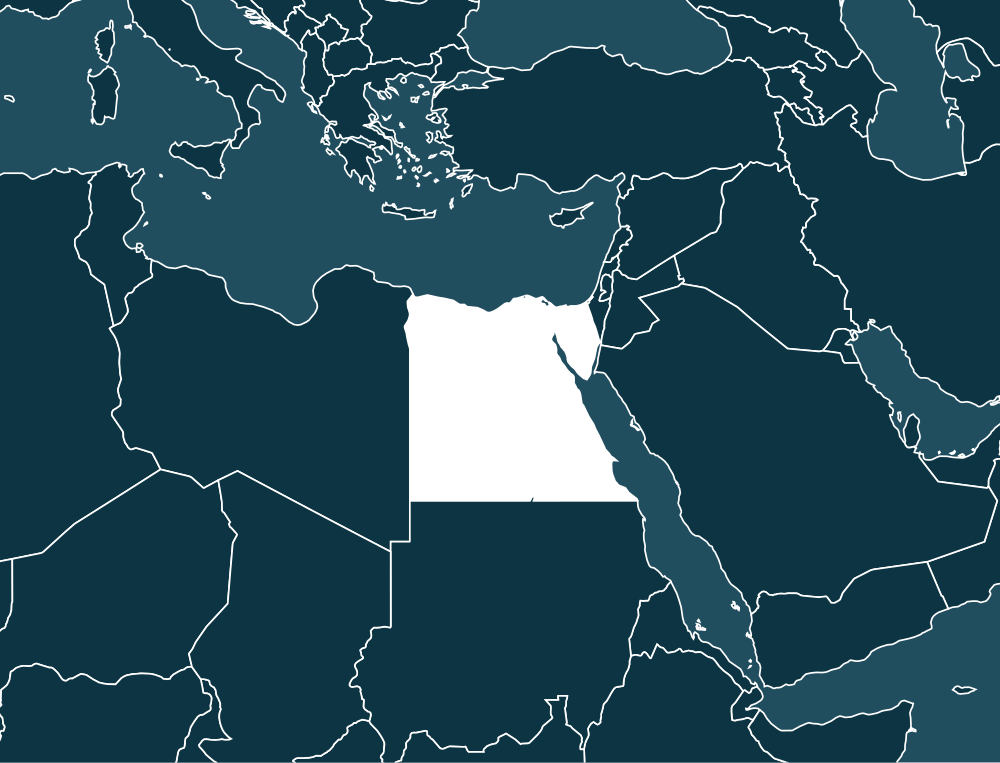
Egypt’s history has been shaped by the Nile, successive empires, and its pivotal position at the Suez Canal, while modern development continues to contend with population growth, limited arable land, and pressure on water and other resources. Political change since the 2011 uprising moved through military administration, Mohamed Morsi’s presidency, and the election and reelection of Abdel Fattah el-Sisi. Large-scale infrastructure, energy cooperation, and efforts to attract foreign investment remain central to the country’s response to these longstanding pressures.
Egypt’s security environment is closely tied to instability along its borders, from Libya’s divided authorities and the sanctioned Libyan Investment Authority to the war between Sudan’s SAF and RSF. The conflict in Gaza has intensified concerns around Sinai, the Rafah crossing, the Philadelphi Corridor, and the movement of people, weapons, and goods. Sanctions, frozen assets, regional financing networks, and porous borders create a complex landscape in which security risks and evasion concerns extend well beyond Egypt’s immediate territory.
AML & Terrorist Financing
Egypt is not identified by FATF as having strategic AML deficiencies, yet its 2025 assessment shows a mixed picture, with broad technical compliance but no highly effective effectiveness ratings and continued enhanced follow-up. A cash-heavy informal economy, cross-border exposure, narcotics and antiquities trafficking, corruption, real estate activity, and electronic transfers create significant laundering and terrorist-financing risks, while investigations, asset tracing, confiscation, beneficial-ownership records, and suspicious transaction reporting remain uneven. The EMLCU, National Security Agency, CBE, FRA, and ACA form a substantial institutional network, but gaps in DNFBP supervision, sanctions dissemination, NPO measures, and international cooperation leave important questions about the consistency and practical impact of enforcement.
Sanctions
Egypt applies UN Security Council measures alongside its autonomous framework, including the List of Terrorist Entities and Local Terrorists maintained through the EMLCU and supported by laws such as Law No. 120 of 1945 and Anti-Money Laundering Law No. 80 of 2002. No comprehensive country-level sanctions currently target Egypt, following the EU’s 2021 termination of its Egypt-specific asset-freeze regime, although Egyptian nationals may still appear on EU, OFAC, or other terrorism-related lists and remain subject to international screening requirements. Attention also surrounds Egypt-linked maritime and trading networks, particularly UAE-based structures moving Iranian petroleum through Gulf, Red Sea, and Suez-related routes, while MENAFATF continues to monitor the effectiveness of Egypt’s targeted financial sanctions controls.
Criminality
Egypt maintains extensive anti-corruption laws and oversight bodies, including the Administrative Control Authority, Central Auditing Authority, and Public Funds Prosecution Department, yet enforcement remains inconsistent and businesses report unofficial payments in areas ranging from public services and customs to permits and procurement. Crime concerns span human trafficking, people smuggling, arms and counterfeit-goods markets, drug trafficking, cyberattacks, and financial crimes, with state-linked, transnational, and private-sector actors appearing across portions of the illicit economy.
Reports
Egypt’s security landscape includes substantial domestic demand for hashish and tramadol, trafficking routes involving fenethylline, and persistent exploitation of children, refugees, migrants, and foreign domestic workers, while the Anti-Narcotics General Administration continues coordinated enforcement and seizures. Terrorist activity and violence in North Sinai declined markedly in 2024 as authorities shifted toward targeted operations, strengthened border and financial controls through measures such as Financial Regulatory Authority Decree No. 161/2024, and continued prevention and social-development initiatives.
Industry/Product Sector Risk
Egypt’s industry risk landscape is shaped by a heavily cash-based economy, extensive cross-border trade, and significant activity involving banks, real estate, casinos, remittance services, precious metals, and transport networks. The Central Bank of Egypt, Financial Regulatory Authority, Ministry of Tourism, Ministry of Supply and Internal Trade, and other supervisory bodies oversee sectors with varying degrees of exposure to corruption, fraud, smuggling, tax evasion, organised crime, and terrorist financing. Particular attention centers on beneficial-ownership transparency, informal operators, cash-intensive transactions, foreign connections, and the ways in which property, trade, corporate structures, and high-value assets may be used to move or integrate illicit proceeds.
Economy & Investment Climate
Egypt is emerging from a period of acute macroeconomic pressure as IMF-supported reforms, a flexible exchange rate, and the Ras El Hekma investment have helped restore foreign-currency access and attract renewed investor interest. Significant opportunities span infrastructure, renewable energy, manufacturing, logistics, and digital finance, though GAFI’s facilitation efforts coexist with bureaucracy, state and military competition, uneven regulation, skills gaps, and continuing exposure to regional shocks.
Cryptocurrency Regulations
Egypt maintains a highly restrictive stance toward cryptocurrency under Law No. 194 of 2020, with the Central Bank of Egypt and the Egyptian Money Laundering and Terrorist Financing Combating Unit shaping an environment in which virtual assets, exchanges, VASPs, and token offerings lack a lawful operating path. Tax treatment, transaction monitoring, ICO disclosures, tokenization, and frameworks such as the Travel Rule or CARF remain largely undefined, leaving significant uncertainty alongside severe penalties for prohibited activity.
Get full access
The information on this page is a brief summary. Get access to EDD country reports, all risk category scores and customisable weightings for 245 jurisdictions.