
Risk Indicators
- FATF/EU Blacklist/Greylist (Lower Concern)
- Terrorism Financing (Lower Concern)
- US Dept of State INCSR
- Proliferation Financing
- Corruption
- Criminality
- Resilience & Governance
- Financial Transparency
- Offshore Finance Centres
- Sanctions
Background
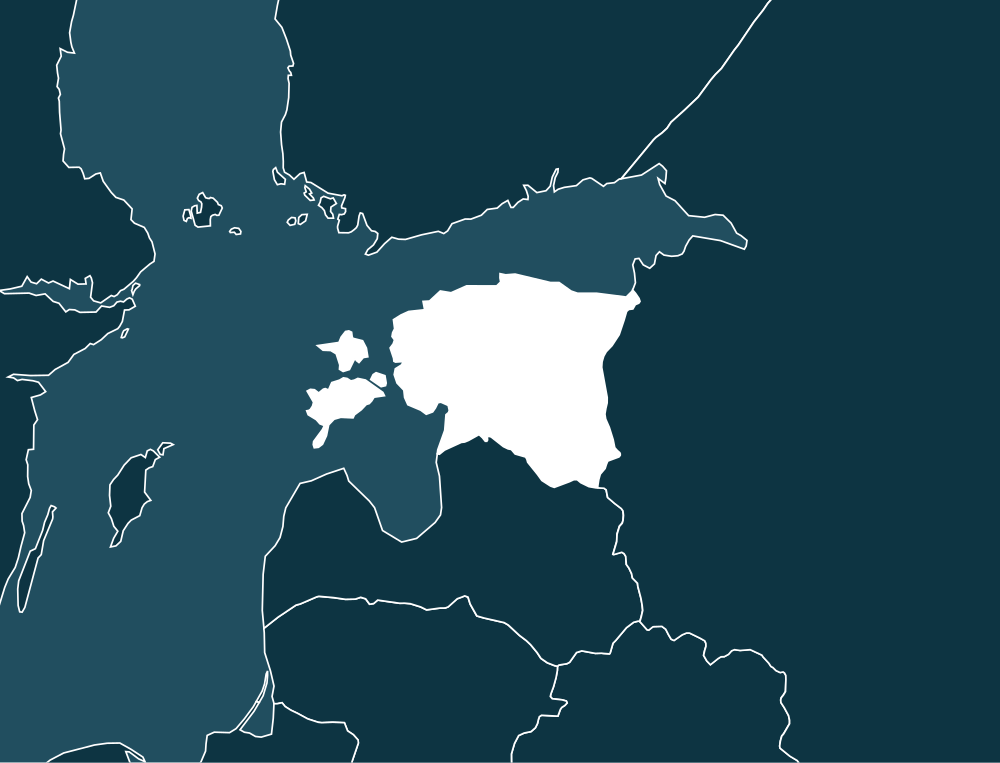
Estonia’s modern identity reflects a history shaped by Danish, Swedish, German, and Russian rule, followed by independence in 1918, Soviet incorporation in 1940, and restored sovereignty in 1991. Since the departure of Russian troops in 1994, it has deepened its Western alignment through NATO, the European Union, the OECD, and adoption of the euro. Its position on the Baltic Sea places it within a regional security environment where historical experience and present-day alliances remain closely connected.
Russia is the most significant source of concern, with the war in Ukraine, military activity, cyber operations, and information warfare contributing to heightened regional risks, while EU, UK, and US sanctions have created continuing exposure to evasion through third countries and shadow fleets. Latvia presents a more complex neighboring challenge involving Russian-speaking minority issues, NATO’s eastern defense, and cases identified by its financial intelligence service involving routes through Central Asia. Finland and Sweden remain comparatively stable partners, with their NATO and EU membership reinforcing Estonia’s broader security setting rather than creating notable direct risks.
AML & Terrorist Financing
Estonia is not identified by FATF as having strategic AML deficiencies, yet it remains under MONEYVAL’s enhanced follow-up process amid continuing efforts to strengthen sanctions, new-technology controls, and virtual asset oversight. Its exposure includes foreign-origin proceeds, cyber and internet fraud, tax offences, legal entities, cash and cross-border flows, with banks, VASPs, company service providers, real estate, and some NPO activity presenting notable vulnerabilities. Although the EFIU, Finantsinspektsioon, KAPO, and other authorities demonstrate substantial coordination, concerns remain around beneficial-owner information, proactive financial intelligence, ML and TF investigations, confiscation, supervisory sanctions, and the practical understanding of terrorist-financing and proliferation-financing risks.
Sanctions
Estonia enforces UN and EU restrictive measures, chiefly affecting Russia and, to a lesser extent, Belarus, across areas such as energy, finance, trade, and controlled goods. Its role is primarily one of implementation and enforcement, with full customs controls at crossings including Narva, Koidula, and Luhamaa, alongside investigations and penalties tracked by the Tax and Customs Board and financial oversight by the Financial Intelligence Unit. No international sanctions are currently in force against Estonia, although the country remains a key frontline jurisdiction for detecting transit schemes involving third countries, layered companies, and cash movements.
Criminality
Estonia has a comparatively well-developed legal framework for addressing corruption, though bribery, conflicts of interest, business-to-business payments, and money laundering remain areas of concern, with the Ministry of Justice coordinating policy and the Internal Security Service pursuing high-level cases. Crime concerns also include trafficking and labour exploitation, synthetic drugs, cyberattacks, financial fraud, illicit timber, and activity by foreign and domestic criminal networks, while the Police and Border Guard Board and Central Criminal Police remain key points of enforcement.
Reports
Estonia remains a Tier 1 country, with increased victim identification, expanded direct services, first-time residence permits for trafficking victims, and enhanced frontline training supported through its Council of Baltic Sea States leadership. Yet the absence of prosecutions or convictions, shortcomings in victim-witness protections, and persistent identification challenges—particularly involving foreign laborers and children—contrast with risks linked to online recruitment, migrant employment, recruitment fees, and refugee displacement.
Industry/Product Sector Risk
Estonia’s financial and DNFBP landscape presents a varied risk picture, with retail banking, virtual asset service providers, correspondent relationships, real estate, casinos and company service providers standing out as particularly exposed to cross-border laundering. Rapidly expanding fintech activity, non-resident business, e-residency, complex corporate structures and cash-intensive transactions create recurring vulnerabilities, while sectors such as insurance, money lending, currency exchange and accounting remain comparatively less significant. The involvement of notaries, banks and other gatekeepers—alongside concerns about beneficial ownership, foreign proceeds, fraud, tax offences, cybercrime and organised crime—offers important insight into how Estonia’s business infrastructure may be misused.
Economy & Investment Climate
Estonia offers a highly open, digitally streamlined investment environment, supported by eurozone membership, transparent regulation, a simple tax structure, and strong protections for property and intellectual rights, while FDI is concentrated in financial services, real estate, and ICT. The Estonian Investment Agency, TTJA’s newer screening framework, advanced e-Business Register, and expanding clean-energy support point to a market balancing accessibility with strategic oversight as demographic pressures, regional security concerns, and energy transition reshape future opportunities.
Cryptocurrency Regulations
Estonia permits cryptocurrency activity within a tightly supervised framework, with the Money Laundering and Terrorist Financing Prevention Act, Financial Intelligence Unit licensing, customer verification, transaction monitoring, and the €1,000 Travel Rule shaping the obligations of virtual asset providers. Tax treatment overseen by the Estonian Tax and Customs Board, substantial penalties for noncompliance, shrinking provider numbers, and the influence of MiCA and the planned 2027 CARF implementation point to a market where regulatory detail matters greatly.
Get full access
The information on this page is a brief summary. Get access to EDD country reports, all risk category scores and customisable weightings for 245 jurisdictions.