
Risk Indicators
- FATF/EU Blacklist/Greylist (Lower Concern)
- Terrorism Financing (Lower Concern)
- US Dept of State INCSR
- Proliferation Financing
- Corruption
- Criminality
- Resilience & Governance
- Financial Transparency
- Offshore Finance Centres
- Sanctions
Background
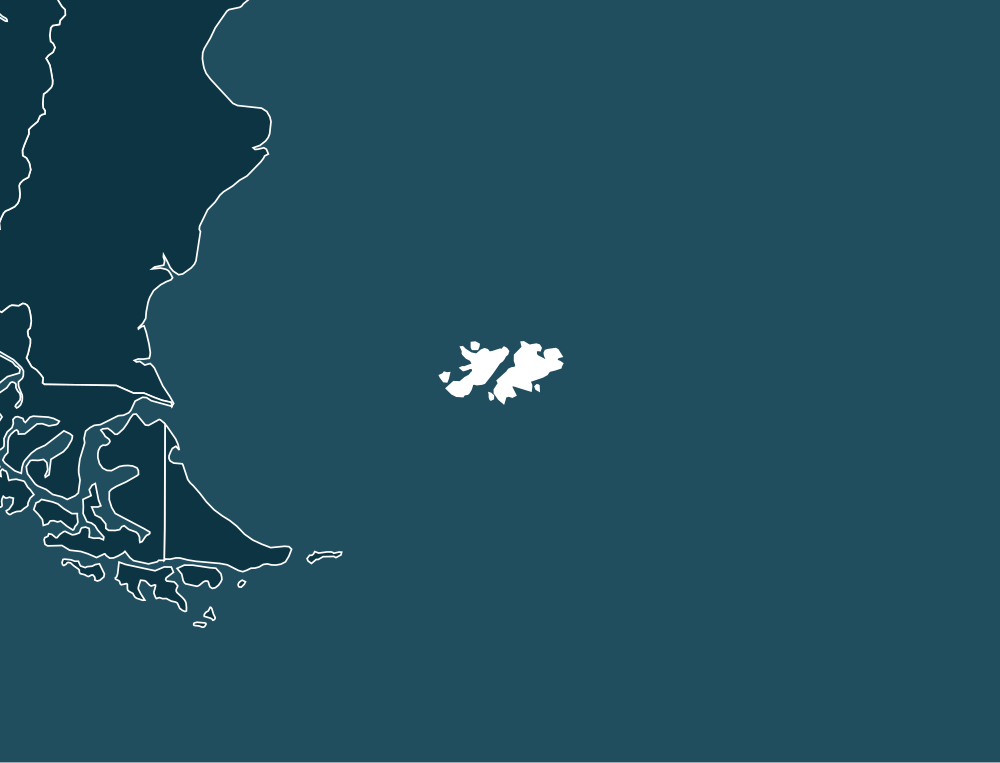
First sighted by an English navigator in 1592 and settled by France in 1764 before passing to Spain, the Falkland Islands (Islas Malvinas) have remained at the center of a territorial dispute involving Britain and Argentina. The conflict culminated in Argentina’s 1982 invasion and surrender on 14 June, after which UK administration resumed, while a 2013 referendum produced a 99.8% vote to remain part of the UK. Their remote South Atlantic position, roughly 480 kilometers from Argentina, leaves Argentina as the only direct neighboring country and the principal source of ongoing political and security tension.
Argentina continues to raise its sovereignty claim internationally, oppose British activity, and use the issue to reinforce nationalist sentiment, while Brazil and other South American states generally support calls for negotiations. Measures including Law 26,659 target unauthorized hydrocarbon exploration in surrounding waters, with foreign companies facing potential operating bans and asset embargoes, and broader concerns over offshore structures and financial opacity add a further layer of complexity. The islands’ ties to the United Kingdom also sit within a wider British setting shaped by parliamentary institutions, global alliances, devolved governance, and the post-2020 consequences of Brexit.
AML & Terrorist Financing
As a British Overseas Territory, the Falkland Islands (Malvinas) operate within the United Kingdom’s broader AML/CFT framework, which is not subject to FATF strategic-deficiency listing and has achieved generally strong compliance ratings. Key risks include exposure to overseas proceeds, high-end and cash-based money laundering, misuse of professional services and corporate structures, while terrorist financing concerns remain comparatively low-level but internationally connected. The UK’s response combines agencies and mechanisms such as the NCA, UKFIU, JMLIT, OFSI, Companies House registers and HMRC oversight, although questions remain around supervisory consistency, SAR effectiveness, FIU capacity and smaller-sector sanctions compliance.
Sanctions
As a British Overseas Territory, the Falkland Islands (Malvinas) operates within the United Kingdom’s sanctions framework, grounded principally in the Sanctions and Anti-Money Laundering Act 2018 and supplemented by export and immigration controls. Measures may include financial, trade, immigration, aircraft, and shipping restrictions, administered through bodies such as the FCDO, OFSI, ECJU, Home Office, and Department for Transport, with particular attention to Russia-related evasion networks and high-risk goods. No international sanctions are currently in force against the territory, while UK enforcement continues to address intermediary routes, concealed ownership, and diversion through locations including the UAE, Türkiye, Central Asia, and China.
Criminality
For the Falkland Islands (Malvinas), the applicable United Kingdom framework indicates that bribery and official corruption are isolated concerns rather than a routine business obstacle, supported by the extraterritorial Bribery Act 2010 and criminal penalties. Broader exposure includes fraud, money laundering, trafficking, drug markets, and cybercrime, with allegations potentially assessed by bodies such as the Serious Fraud Office, National Crime Agency, and City of London Police’s Overseas Anti-Corruption Unit.
Reports
As a British Overseas Territory, the Falkland Islands (Malvinas) are covered through UK-focused information highlighting illicit drug transit and consumption, emerging synthetic opioid concerns, and trafficking risks involving labor, criminality, and vulnerable migrants, with agencies such as the National Crime Agency and Home Office involved in the response. UK security measures also address Islamist and Northern Ireland-related terrorism, online extremist activity, and international cooperation, including MI5 assessments, Terrorgram’s designation, and coordination with U.S. authorities.
Economy & Investment Climate
The Falkland Islands’ small but high-income economy is anchored by fishing, wool-oriented agriculture, tourism, and processing, with oil exploration and improved transport links offering avenues for diversification. Export activity centers on shellfish, fish, wool, and meat, while sustainability concerns—including unlicensed fishing, habitat pressure, and erosion—alongside geopolitical considerations shape the investment outlook under the islands’ self-governing Legislative Assembly.
Cryptocurrency Regulations
Cryptocurrency in the Falkland Islands (Malvinas) occupies an uncertain space, with no clear legal-tender status, dedicated VASP registry, exchange licensing regime, or established tax treatment, while the Falkland Islands pound remains the official currency. Although the territory may look toward UK-aligned practices and FATF expectations for AML, KYC, Travel Rule, and future token-related oversight, local guidance on ICOs, transaction tracking, and consumer protection remains notably limited.
Get full access
The information on this page is a brief summary. Get access to EDD country reports, all risk category scores and customisable weightings for 245 jurisdictions.