
Risk Indicators
- FATF/EU Blacklist/Greylist (Lower Concern)
- Terrorism Financing (Lower Concern)
- US Dept of State INCSR
- Proliferation Financing
- Corruption
- Criminality
- Resilience & Governance
- Financial Transparency
- Offshore Finance Centres
- Sanctions
Background
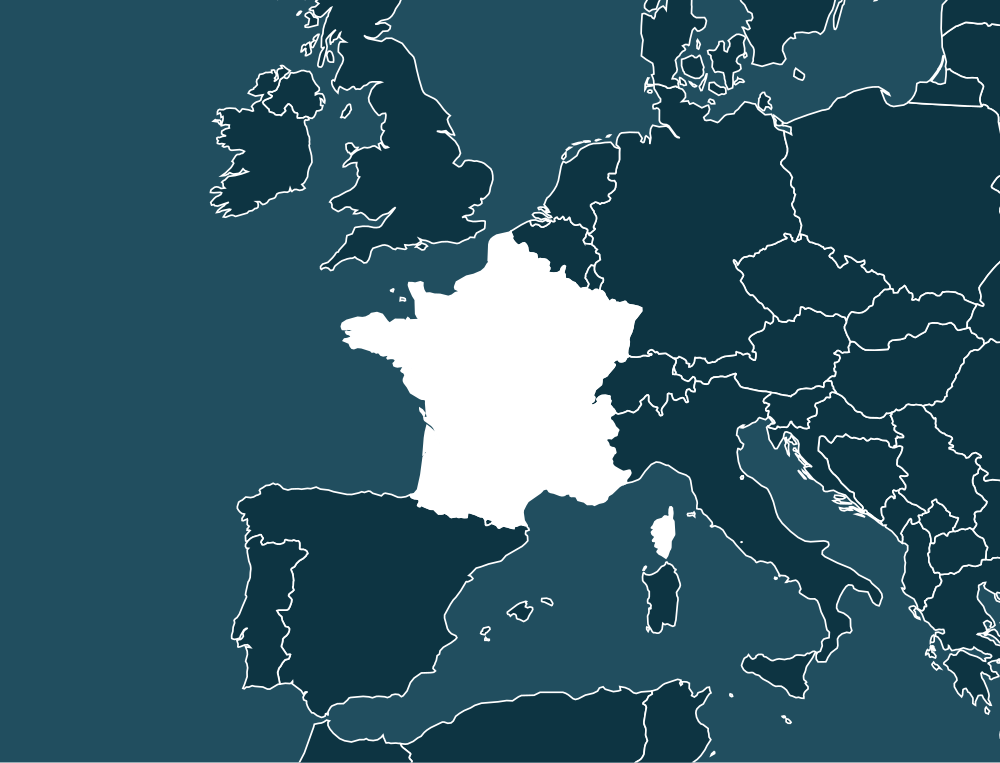
France occupies a prominent position in Europe and globally, combining a hybrid presidential-parliamentary system established in 1958 with influence through the United Nations Security Council, NATO, the G-7, the G-20, and the European Union. Its long-standing cooperation with Germany helped advance European economic integration, including the adoption of the euro in 1999. France’s national framework also encompasses French Guiana, Guadeloupe, Martinique, Mayotte, and Reunion, which became regions of France in the early 21st century.
Its land borders are largely surrounded by stable European states, although regional dynamics remain shaped by the war in Ukraine, sanctions enforcement, and efforts to prevent circumvention by Russia and Belarus. Belgium, Germany, and Switzerland feature in particular discussions of diplomatic tensions, enforcement gaps, and financial or commercial channels, while Italy and Spain face more limited internal political pressures. France and its neighbors broadly coordinate on measures targeting Russia, Belarus, and Iran, even as concerns persist over implementation across borders and financial systems.
AML & Terrorist Financing
France maintains a robust AML/CFT framework and is not listed by FATF as having strategic deficiencies, yet its substantial exposure to tax, customs and social-security fraud, drug trafficking, corruption, scams and cross-border criminal proceeds creates a complex risk environment. TRACFIN, the ACPR, AMF, PNF and AGRASC support effective intelligence, prosecution, confiscation and terrorist-financing disruption, particularly following the 2015 attacks and through cooperation with DGSI and PNAT. Important challenges remain around specialized investigative capacity, beneficial-owner and suspicious-transaction controls, uneven risk-based supervision of DNFBPs—especially real estate, lawyers and notaries—and the consistent application of targeted financial sanctions and controls across vulnerable NPO and proliferation-financing channels.
Sanctions
France enforces UN-transposed, EU-wide, and autonomous restrictive measures, with particular focus on Russia, Belarus, and Iran through asset freezes, travel bans, sectoral restrictions, and controls affecting energy, finance, technology, and military goods. The French Customs Office and financial regulators investigate evasion schemes involving neighboring transit routes, shadow fleets, and third-country intermediaries, while France also participates in the REPO Task Force and has begun legislative work to strengthen criminal penalties. No international sanctions are currently in force against France.
Criminality
France has strengthened its anti-corruption framework through the Sapin II law, the High Authority for Transparency in Public Life, and the Agence Française Anticorruption, with expanded disclosure, whistleblower protections, and compliance oversight. However, questions remain about political probity, prosecutorial independence, and the effectiveness of enforcement, particularly regarding foreign bribery, where past reviews identified limited convictions, unresolved legal obstacles, and insufficient initiative involving French enterprises.
Reports
France continues to meet international standards on trafficking while confronting persistent exploitation of French and foreign victims, including online sex trafficking, forced labor, forced criminality, and vulnerabilities affecting children and migrants on Mayotte. The country remains at its highest terrorism alert level, with Operation Sentinelle, international information-sharing, and French authorities’ disruption of nine planned attacks—including threats to the Olympic and Paralympic Games—reflecting the continuing focus on lone-actor, extremist, and Corsican militant risks.
Industry/Product Sector Risk
France’s financial and professional landscape presents varied exposure to money laundering and terrorist financing, with heightened concerns spanning retail banking, electronic money, remittances, real estate, virtual assets, casinos, wealth management, and cash-intensive activity. Supervisory attention from bodies including TRACFIN, the ACPR, ANJ, SCCJ, AMF, and DGCCRF reflects recurring challenges involving remote onboarding, beneficial ownership, cross-border flows, opaque structures, and cash movement. The underlying risks intersect with tax and social fraud, customs and VAT offences, drug trafficking, corruption, cyber-enabled crime, organised criminality, and terrorist-financing schemes using small or rapidly transferred sums.
Economy & Investment Climate
France combines a highly educated workforce, advanced infrastructure, sophisticated financial markets, and strong innovation capacity with a generally welcoming stance toward foreign investment, particularly in technology, aerospace, clean energy, health, and advanced manufacturing. Yet political gridlock, elevated public debt and deficits, labor-market complexity, social tensions, and expanding national-security screening—alongside evolving incentives under France 2030—create a business environment where the support of agencies such as Business France and Bpifrance can be especially significant.
Cryptocurrency Regulations
France permits cryptocurrency activity within a structured framework, with the PACTE Law, AMF registry, and ACPR oversight shaping how digital asset providers operate while the euro remains the only legal tender. Tax reporting, AML obligations, forthcoming MiCAR and Travel Rule requirements, and emerging tokenization and ICO pathways create a market where innovation is supported but closely monitored by authorities including the AMF and DGFiP.
Get full access
The information on this page is a brief summary. Get access to EDD country reports, all risk category scores and customisable weightings for 245 jurisdictions.