
Risk Indicators
- FATF/EU Blacklist/Greylist (Lower Concern)
- Terrorism Financing (Lower Concern)
- US Dept of State INCSR
- Proliferation Financing
- Corruption
- Criminality
- Resilience & Governance
- Financial Transparency
- Offshore Finance Centres
- Sanctions
Background
Mauritania’s social fabric reflects the legacy of Amazigh and Bafour communities, Sub-Saharan populations from the Senegal River Valley, and descendants of formerly enslaved people. These communities remain shaped by deep ethnic divisions and a strict caste system that influences access to resources and political power. Once a French colony, Mauritania endured decades of authoritarian rule, military coups, and unsettled democratic experiments before the 2019 transfer of power was recognized as a significant step toward democratic consolidation.
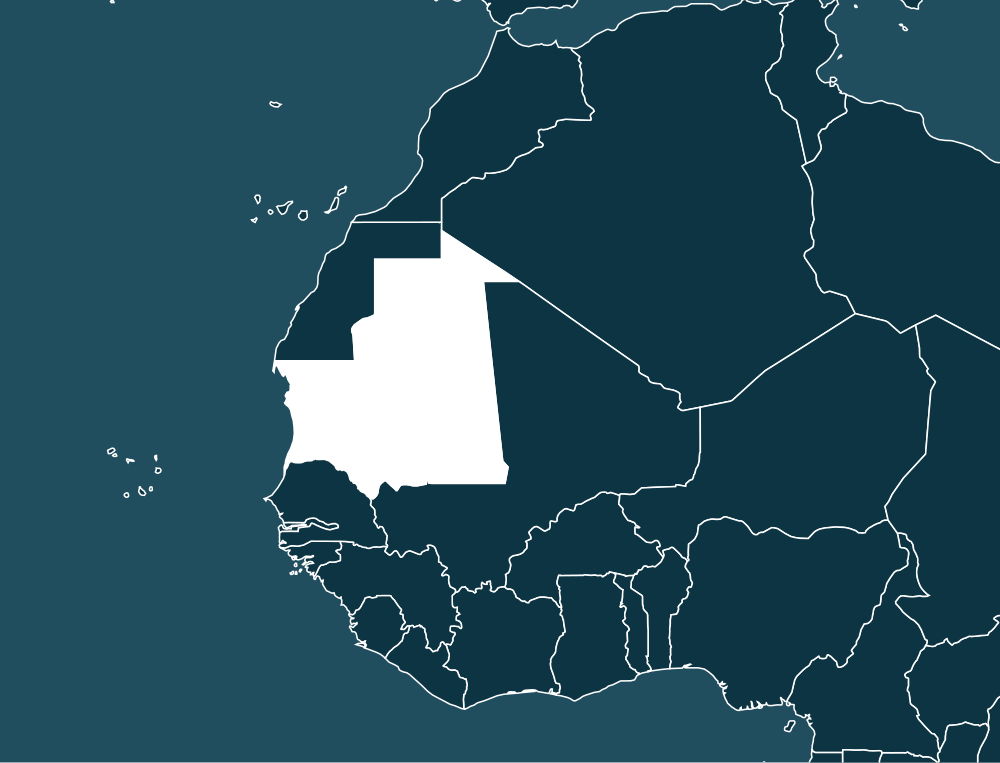
The country continues to confront the hereditary consequences of slavery, formally abolished in 1981 but criminalized only in 2007, while maintaining vigilance against militant activity linked to the wider Sahel. Its position between Senegal, Mali, Western Sahara, and Algeria places it alongside neighbours facing insurgencies, contested borders, political repression, and diplomatic or sanctions-related tensions. Developments involving AQIM, the Alliance of Sahel States, the Polisario Front, and evolving AML/CFT measures in Senegal illustrate the wider regional pressures surrounding Mauritania.
AML & Terrorist Financing
Mauritania is not FATF-listed, yet its 2021 follow-up assessment found a framework with uneven technical compliance and low effectiveness across AML/CFT and proliferation-financing outcomes. Risks remain difficult to assess and coordinate, particularly amid an informal, cash-based economy, porous borders, limited beneficial-ownership transparency, and weaknesses affecting DNFBP supervision, financial investigations, and international cooperation. CANIF’s analytical capacity and reporting flow, together with the implementation of targeted financial sanctions by the Ministry of Finance, BCM-supervised institutions, and other obliged entities, remain areas where important practical gaps persist.
Sanctions
Mauritania supports United Nations sanctions measures, including targeted restrictions administered through Security Council regimes and reflected on the Consolidated List. As of mid-2026, it faces no country-specific sanctions from the UN, European Union, United States, or United Kingdom. At the same time, maritime and overland routes through Mauritania have raised sanctions-evasion concerns involving goods linked to Iran, Russia, Venezuela, North Korea, and Syria, with cooperation from OLAF aimed at strengthening customs controls.
Criminality
Mauritania continues to face corruption involving graft, embezzlement, illicit enrichment, procurement irregularities, and weak oversight, despite reforms such as the Ain complaints platform and proposed legislation expanding asset declarations and establishing an independent anti-corruption authority. Audits by the Court of Accounts have identified mismanagement across ministries, while trafficking, smuggling, counterfeit pharmaceuticals, illicit tobacco, drug transit, illegal fishing, and cyberattacks remain significant concerns, with the Brigade for the Repression of Economic Crimes and other specialized bodies operating alongside the State General Inspectorate.
Reports
Mauritania has expanded its response to trafficking and terrorism, including a special tribunal for hereditary slavery and trafficking cases, an operational national referral mechanism, increased victim-support funding, and strengthened cooperation with the United States, NATO, the UN, and regional partners. Persistent vulnerabilities remain among communities affected by hereditary slavery, migrants, refugees, children, and informal-sector workers, while counterterrorism efforts continue to face coordination and field-authority challenges despite initiatives involving the Ministry of Islamic Affairs, the G-5 Defense College, and eastern-border intelligence networks.
Industry/Product Sector Risk
Mauritania’s financial and wider commercial landscape is marked by substantial cash use, a large informal economy, and uneven AML/CFT controls, with exchange offices, money remitters, banks, real estate, mining, oil and gas, fisheries, and construction presenting varied levels of exposure. Particular concerns arise around cross-border transactions, beneficial ownership, public procurement, trade-based schemes, and the oversight of more than 9,000 registered associations and cooperatives, while MAURIPOST and private MVTS operate alongside informal transfer channels. The Central Bank and other relevant authorities face a complex environment in which corruption, smuggling, tax crimes, trafficking, and terrorist financing risks intersect across both established industries and emerging digital services.
Economy & Investment Climate
Mauritania’s economy is building on its mineral, fisheries, agricultural, and emerging energy base, with 2024 growth remaining positive despite a slowdown in extractive activity, while financial services, mobile banking, and the Greater Tortue Ahmeyim project point to broader opportunities. The revised Investment Code, new PPP framework, APIM’s Guichet Unique, and digital platforms such as Khidmaty signal an increasingly investment-oriented environment, although informality, skills gaps, land and judicial issues, and continued reliance on commodity exports remain important considerations.
Cryptocurrency Regulations
Mauritania takes a cautious, largely undefined approach to cryptocurrency: digital assets are treated as intangible assets for tax purposes, but they are not legal tender, and Central Bank Circular No. 11/M/2020 restricts financial institutions from dealing with virtual assets. While the 2021 FATF evaluation and GIABA membership point toward evolving AML/CFT expectations, the absence of licensed VASPs, exchange rules, ICO requirements, or clearly adopted measures such as the Travel Rule leaves significant questions for users, investors, and businesses.
Get full access
The information on this page is a brief summary. Get access to EDD country reports, all risk category scores and customisable weightings for 245 jurisdictions.