
Risk Indicators
- FATF/EU Blacklist/Greylist (Lower Concern)
- Terrorism Financing (Lower Concern)
- US Dept of State INCSR
- Proliferation Financing
- Corruption
- Criminality
- Resilience & Governance
- Financial Transparency
- Offshore Finance Centres
- Sanctions
Background
Montenegro’s identity emerged in the medieval highlands of Zeta and developed through centuries of Ottoman pressure, ecclesiastical rule, and armed resistance. Recognition as a sovereign principality came at the Congress of Berlin in 1878, followed by incorporation into successive Yugoslav states before independence was restored on 3 June 2006. Its subsequent path has included EU candidate status from 2010 and NATO membership since 2017.
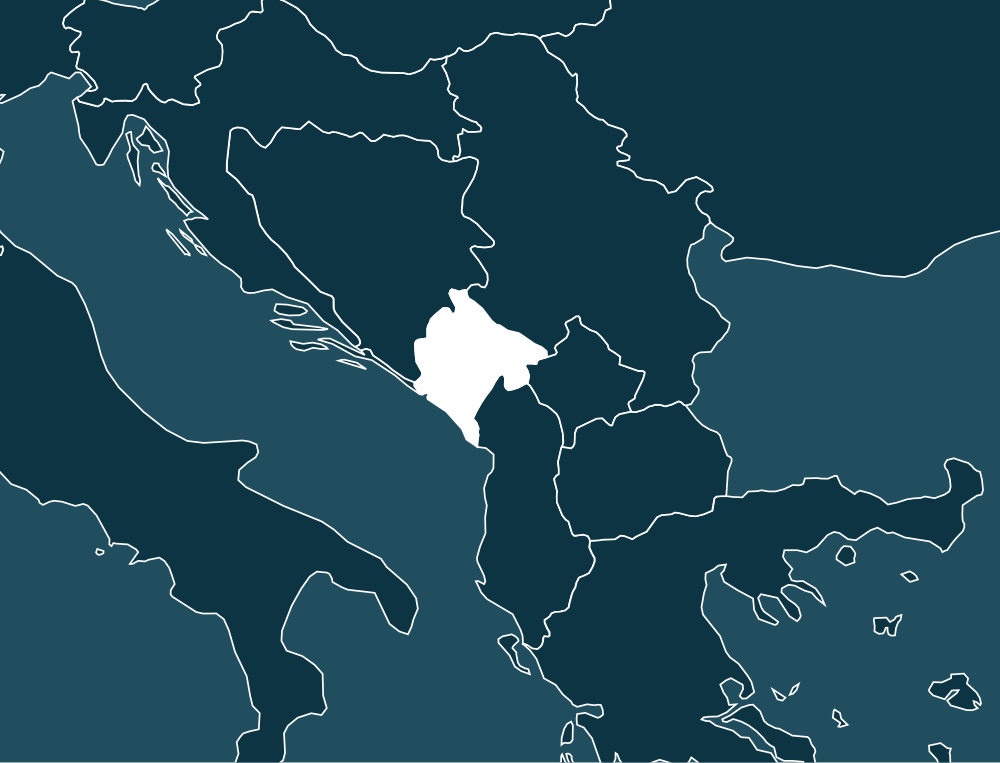
Today, Montenegro sits within a neighborhood shaped by unresolved political disputes, ethnic tensions, institutional fragility, and cross-border security risks. Bosnia and Herzegovina’s crisis under Milorad Dodik, Serbia’s unrest and Russian-linked NIS exposure to U.S. sanctions, and Kosovo’s northern flashpoint illustrate the pressures surrounding the country. Albania and Croatia offer comparatively greater stability, yet the wider region remains vulnerable to sophisticated sanctions-evasion networks involving shell companies and cross-border facilitators.
AML & Terrorist Financing
Montenegro is not subject to FATF strategic-deficiency listing, and MONEYVAL records substantial legal and institutional progress, including upgrades across twelve recommendations, but practical effectiveness remains uneven. Drug trafficking along the Balkan route, cash-intensive activity, corruption, real estate, opaque legal entities, and offshore structures continue to present risks, while the FIU, Central Bank of Montenegro, and other authorities face challenges involving reporting by non-bank sectors, beneficial-ownership information, supervision, financial investigations, prosecutions, and confiscation. Terrorist-financing and proliferation-financing controls are supported by automatic sanctions mechanisms and intelligence-led cooperation, yet medium effectiveness, limited sectoral risk understanding, NPO oversight gaps, technical freezing deficiencies, scarce prosecutions, and weak coordination leave important questions for closer examination.
Sanctions
Montenegro implements United Nations measures and, as an EU candidate, has aligned with European Union restrictions including those concerning Russia, while its own framework has increasingly addressed the movement of restricted goods through its territory. Montenegro is not subject to comprehensive sanctions from the UN, EU, United States, United Kingdom, or other major jurisdictions, although limited legacy claims restrictions linked to Resolution 757 remain in some regimes. Targeted actions by U.S. OFAC against figures such as Miodrag Davidovic, Branislav Micunovic, and Sergey Kokorev and IBC Bar highlight exposure tied to corruption, organized crime, and alleged sanctions-evasion networks involving military and dual-use goods.
Criminality
Corruption remains a significant concern across Montenegro’s public and private sectors, particularly in government procurement, property transactions, privatization, and politically connected financial activity. Although the Special State Prosecutor’s Office has pursued high-level cases and the Agency for the Prevention of Corruption has gained new leadership, organized networks linked to cocaine trafficking, money laundering, cigarette smuggling, and other illicit markets continue to shape the country’s criminal landscape.
Reports
Montenegro remains a significant Western Balkan transit point for marijuana, heroin, cocaine, and synthetic drugs, while its Police Anti-Narcotics Department and international partners—including the DEA, EUROPOL, and Spanish authorities—have pursued major seizures and joint investigations. Human trafficking concerns span sexual exploitation, forced begging, domestic servitude, and labor abuses affecting vulnerable communities and migrant workers, with the Anti-trafficking Unit and TIP office expanding efforts but still facing limited resources and shortcomings in victim protection and prosecution.
Industry/Product Sector Risk
Montenegro’s industry landscape presents a varied AML/CFT exposure, with cash-intensive activity, tourism, real estate, construction, gaming, transport and cross-border finance creating important risk concentrations. The 2020 NRA identifies real estate, virtual assets, lawyers and company-service providers among the more elevated areas, while banks, investment services, money transfer businesses and non-profit organisations face distinct vulnerabilities involving beneficial ownership, foreign funds and complex transactions. Supervisory perspectives from bodies such as the Insurance Supervision Agency and the role of the Post of Montenegro in money transfers add further detail to a market shaped by organised crime, corruption, tax evasion, smuggling and emerging digital-finance risks.
Economy & Investment Climate
Montenegro offers a liberal, euro-based economy advancing toward its ambitious 2028 EU accession target, with 2024 growth, declining public debt, and investment opportunities concentrated in tourism, energy, infrastructure, and agriculture. While the Montenegrin Investment Agency and Europe Now reforms signal an increasingly open business environment, investors must still navigate uneven implementation, municipal regulation, judicial delays, labor shortages, and a sizable informal economy.
Cryptocurrency Regulations
Montenegro’s cryptocurrency landscape remains largely undefined: digital assets are neither banned nor legal tender, dedicated exchange licensing and VASP oversight are absent, and the Central Bank of Montenegro, Ministry of Finance, and Securities Market Commission are involved within broader financial rules. Tax obligations, five-year transaction records, and AML reporting expectations provide some structure, while prospective alignment with EU MiCA and possible CARF adoption points toward more detailed regulation ahead.
Get full access
The information on this page is a brief summary. Get access to EDD country reports, all risk category scores and customisable weightings for 245 jurisdictions.