
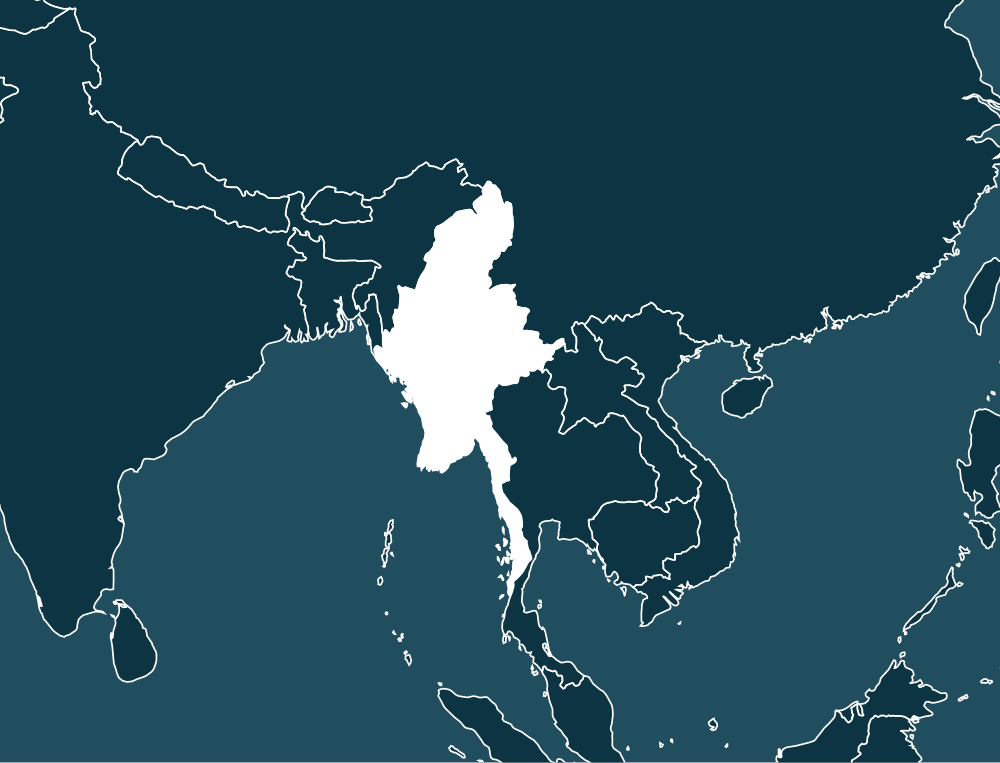
Risk Indicators
- FATF/EU Blacklist/Greylist (Higher Concern)
- Terrorism Financing (Higher Concern)
- US Dept of State INCSR
- Proliferation Financing
- Corruption
- Criminality
- Resilience & Governance
- Financial Transparency
- Offshore Finance Centres
- Sanctions
Background
Myanmar’s modern history has been shaped by colonial rule, military dominance, ethnic resistance, and repeated attempts at political transition. The rejection of the 1990 election, the 2007 Saffron Revolution, and the eventual rise of the National League for Democracy under Aung San Suu Kyi marked pivotal stages in a fragile reform process. The 2021 coup led by General Min Aung Hlaing reversed those gains, while the National Unity Government and People’s Defense Forces joined longstanding ethnic armed organizations in opposing the junta.
The resulting conflict extends beyond Myanmar’s borders through refugee movements, border violence, economic dependencies, and competing regional interests. Thailand, China, India, and Bangladesh each face distinct pressures, while ASEAN members including Laos and Vietnam navigate the crisis with limited direct involvement. International measures targeting military leaders, Myanmar Oil and Gas Enterprise, and state-linked banks have been complicated by intermediaries, neighboring financial networks, and uneven enforcement, leaving the region confronting a crisis that remains difficult to contain.
AML & Terrorist Financing
Myanmar remains subject to FATF enhanced due diligence and European Commission high-risk jurisdiction measures, while its action plan deficiencies could lead to countermeasures after October 2026 and its Section 311 designation continues to shape international financial exposure. Money-laundering risks are amplified by narcotics, gems, timber, trafficking, casinos, online scams, informal remittance networks, cash usage, conflict-affected border regions, and limited oversight of DNFBPs and beneficial ownership. Although the MFIU, BSI, CBM, AMLCB, and other bodies have shown some progress in intelligence use, investigations, and asset recovery, concerns persist around weak analysis and STR reporting, limited prosecutions and confiscation, uneven terrorist-financing controls, and low effectiveness against proliferation-financing risks.
Sanctions
Myanmar is not identified as enforcing a sanctions regime against other nations, while it remains subject to coordinated, targeted measures from the United States, European Union, United Kingdom, Canada, Australia, Switzerland, and aligned jurisdictions. These restrictions generally combine asset freezes, travel bans, arms and dual-use export controls, limits on military cooperation, and pressure on revenue channels such as aviation fuel and oil and gas, with OFAC’s Executive Order 14014, the EU’s 105-person and 22-entity listings, and Switzerland’s designation of MOGE illustrating the level of detail involved. There are no Myanmar-specific UN Security Council sanctions, but enforcement is complicated by banking relocations, shell companies, maritime intermediaries, and cross-border networks spanning places such as Thailand, Singapore, China, and Malaysia.
Criminality
Crime and corruption in Myanmar are pervasive, with the military regime and associated actors linked to politically selective enforcement, conflicts of interest, and illicit economies spanning trafficking, drugs, arms, illegal mining, wildlife, and counterfeit goods. The Anti-Corruption Commission operates amid limited judicial independence, while criminal networks and cross-border actors exploit weak oversight in sectors ranging from procurement and banking to online scams and unregulated financial transfers.
Reports
Myanmar remains a major regional source of opiates and synthetic drugs amid conflict, with the Drug Enforcement Division and Central Committee for Drug Abuse Control operating under severe territorial, staffing, and institutional constraints while UNODC surveys document shifting opium production and extensive trafficking routes. Separately, persistent concerns surround limited transparency regarding past nuclear activity and widespread trafficking—including child recruitment, forced labor, and online scam operations affecting more than 120,000 people—leaving Myanmar at Tier 3 despite limited official interventions.
Industry/Product Sector Risk
Myanmar’s financial and commercial landscape remains heavily cash-based, with especially pronounced exposure in casinos, high-value goods, real estate, retail banking, remittances, trade finance, mining, forestry, construction, and transportation. While the Central Bank and the Directorate of Investment and Company Administration provide elements of formal oversight, weak beneficial ownership transparency, informal value transfer networks, conflict-affected border areas, and limited AML/CFT implementation continue to create vulnerabilities across both regulated and informal sectors. Smaller markets such as insurance, securities, and investment funds appear less material, while politically connected conglomerates, state-linked enterprises, and proceeds associated with narcotics, jade, corruption, smuggling, and environmental crime remain recurring features across the wider economy.
Economy & Investment Climate
Myanmar’s economy has contracted sharply since the 2021 coup, with prolonged conflict, power disruptions, currency weakness, and restrictions affecting production, trade, and investor confidence. Foreign businesses face a complex environment shaped by the Central Bank of Myanmar, the Foreign Exchange Supervisory Committee, DICA, regime-linked enterprises, shifting import rules, and heightened legal, sanctions, and reputational risks.
Cryptocurrency Regulations
Myanmar takes a highly restrictive stance toward cryptocurrency, with the Central Bank of Myanmar’s Notification No. 9/2020 prohibiting transactions involving unregulated digital currencies and leaving exchanges, VASPs, and ICOs without a lawful operating framework. Although tax treatment and token classification remain unclear under existing laws, enforcement actions, potential penalties, and the Anti-Money Laundering Law and Financial Institutions Law create substantial risks for individuals and businesses involved in digital-asset activity.
Get full access
The information on this page is a brief summary. Get access to EDD country reports, all risk category scores and customisable weightings for 245 jurisdictions.