
Risk Indicators
- FATF/EU Blacklist/Greylist (Lower Concern)
- Terrorism Financing (Lower Concern)
- US Dept of State INCSR
- Proliferation Financing
- Corruption
- Criminality
- Resilience & Governance
- Financial Transparency
- Offshore Finance Centres
- Sanctions
Background
North Macedonia emerged peacefully from Yugoslavia in 1991, but its path toward Euro-Atlantic integration was shaped by a prolonged dispute with Greece and periods of democratic backsliding. The 2001 conflict and subsequent Ohrid Framework Agreement reshaped the country’s approach to minority rights, while the Prespa Agreement later enabled NATO membership and the opening of EU accession talks. Relations among ethnic Macedonians and ethnic Albanians, as well as unresolved questions involving Bulgaria, continue to influence the country’s political trajectory.
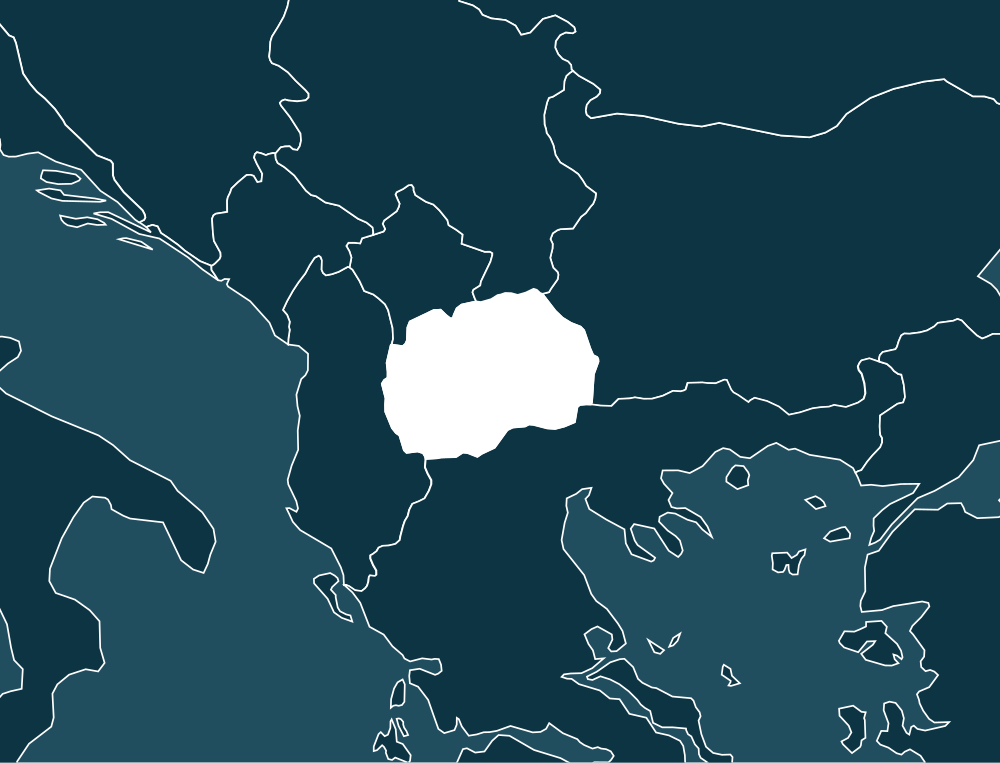
Positioned between Greece, Albania, Bulgaria, Kosovo, and Serbia, North Macedonia remains exposed to wider Western Balkan tensions, organized crime, corruption, and the possibility of cross-border political or ethnic spillover. Domestic security concerns include alleged foreign intelligence and disinformation activity associated with the operation known as Rösselsprung, while the Ministry of Internal Affairs under Oliver Spasovski has worked to counter external influence. Its alignment with EU sanctions on Russia, alongside regional measures involving figures such as Milorad Dodik and protections for agreements including Prespa and Ohrid, underscores the complex security environment surrounding the country.
AML & Terrorist Financing
North Macedonia is not listed by FATF as having strategic AML deficiencies, and its 2025 MONEYVAL follow-up showed broad technical compliance alongside limited effectiveness across most areas. Persistent concerns include uneven risk-based supervision, weak beneficial-ownership data, underuse of Financial Intelligence Office intelligence by prosecutors and law enforcement, modest money-laundering convictions, and inconsistent controls among smaller financial institutions, DNFBPs, and VASPs. Terrorist-financing safeguards remain tested by foreign-terrorist-fighter and Syria-returnee risks, delayed implementation of some national designations, limited NPO monitoring, and the country’s single TF conviction, while proliferation-financing controls and interagency capacity continue to develop.
Sanctions
North Macedonia supports UN sanctions and, as an EU candidate, aligns with EU restrictive measures concerning Russia and Iran, including restrictions affecting Russian aviation. U.S. OFAC authorities under Executive Order 14033—and its 2025 expansion—can target individuals and entities in North Macedonia for conduct involving regional stability, democratic institutions, corruption, human rights abuses, or sanctions circumvention, with blocked property and transaction prohibitions applying to U.S. persons. No broad country-wide sanctions regime against North Macedonia is identified, although the designation of businessman Jordan “Orce” Kamcev illustrates how domestic corruption and money-laundering concerns can trigger measures affecting North Macedonian actors.
Criminality
North Macedonia has a broad anti-corruption framework, but weak enforcement, alleged political influence in the judiciary, problematic public tenders, and credible concerns involving law enforcement and other sectors continue to undermine accountability, despite activity by the State Commission for the Prevention of Corruption and the creation of a new interdepartmental body. Criminal networks remain involved in human trafficking and smuggling, drug and tobacco markets, cybercrime, environmental offenses, and politically connected financial crime, with some illicit activity reportedly facilitated by corrupt officials and business interests.
Reports
North Macedonia is making notable progress against trafficking and terrorism, including more investigations, expanded victim identification, a compensation mechanism, prosecutions of foreign terrorist fighters, and strengthened cooperation with regional and international partners. Persistent concerns include limited resources within the OCCPO, gaps in victim support and screening, exploitation of vulnerable communities and migrants, possible police complicity, online extremist recruitment, and continuing risks linked to returnees from Syria and Iraq.
Industry/Product Sector Risk
North Macedonia’s financial and broader business landscape shows the greatest exposure in cash-intensive activities, including retail banking, casinos, currency exchange, money remittance, hospitality, construction and parts of trade, where informality, cross-border flows and limited suspicious transaction reporting create persistent vulnerabilities. Other areas—such as correspondent banking, insurance, investment funds, real estate, securities, trade finance, virtual assets and professional services—present more varied but still material risks involving beneficial-ownership opacity, corporate structures, mis-invoicing and corruption-linked proceeds. The Financial Intelligence Office, professional chambers and sector supervisors operate within an evolving AML/CFT framework, while the country’s Balkan transit position and National Risk Assessment highlight connections among tax and VAT fraud, public-procurement abuse, smuggling, drug trafficking and potential terrorism-financing channels.
Economy & Investment Climate
North Macedonia offers a strategically located, NATO-aligned platform for investment, supported by incentives in its Technological Industrial Development Zones, competitive labor costs, and opportunities in digitalization, green energy, infrastructure, and automotive components. While the banking system remains resilient and foreign ownership is broadly welcomed, modest growth, labor shortages, regulatory unpredictability, corruption, and lengthy commercial proceedings continue to shape the business environment navigated through institutions such as Invest North Macedonia, TIDZ, and the National Bank.
Cryptocurrency Regulations
North Macedonia is moving from a largely undefined cryptocurrency environment toward AML/CFT oversight, with the Financial Intelligence Office supervising VASPs under 2022 amendments that took effect in 2023, including customer checks, suspicious-transaction reporting, and limits on anonymous assets and cash transactions. Tax treatment, licensing, ICO disclosures, token classifications, and transaction tracking remain unsettled, while proposed legislation and findings from MONEYVAL point to a regulatory framework still being shaped.
Get full access
The information on this page is a brief summary. Get access to EDD country reports, all risk category scores and customisable weightings for 245 jurisdictions.