
Risk Indicators
- FATF/EU Blacklist/Greylist (Higher Concern)
- Terrorism Financing (Medium Concern)
- US Dept of State INCSR
- Proliferation Financing
- Corruption
- Criminality
- Resilience & Governance
- Financial Transparency
- Offshore Finance Centres
- Sanctions
Background
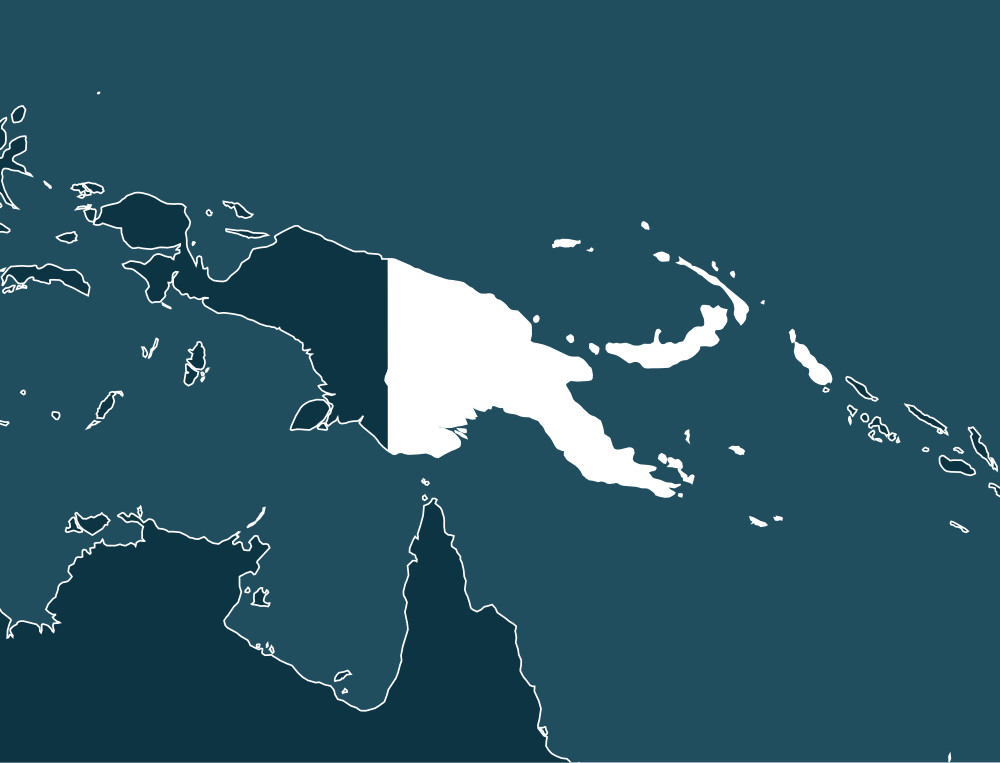
Papua New Guinea occupies the eastern half of New Guinea, where formidable mountains, jungles, and river valleys helped shape exceptional ethnic and linguistic diversity over millennia. Its history encompasses Austronesian settlement, divided German and British colonial administration, Australian rule, wartime upheaval, and independence in 1975. The long Bougainville conflict eventually produced a peace agreement, an Autonomous Bougainville Government, and a later referendum whose independence outcome remains subject to negotiations and parliamentary approval.
PNG’s security environment is influenced by its only land border with Indonesia, where the Free Papua Movement conflict has driven displacement, restricted access, and occasional cross-border pressures. Across the sea, instability and concerns about external influence in the Solomon Islands add a different set of political and security uncertainties, including fragile coalitions and reported pressure linked to China. Australia remains the prominent stabilizing partner through close development and security ties, while wider regional attention includes humanitarian risks, transnational crime, and possible sanctions-evasion activity.
AML & Terrorist Financing
Papua New Guinea remains subject to FATF scrutiny, with significant money-laundering exposure linked to corruption, bribery, fraud against government programs, tax offending, illegal logging and fishing, and proceeds moved abroad. While the Financial Analysis and Supervision Unit (FASU) produces quality intelligence and reforms such as the Investment Promotion Authority’s beneficial-ownership register are developing, limited resources, uneven supervision outside commercial banking, weak asset recovery, and constrained international cooperation continue to impede effective enforcement. Terrorist-financing risk is considered low, but the Royal Papua New Guinea Constabulary and Office of the Public Prosecutor have limited preparedness, while targeted-sanctions screening and proliferation-financing controls remain inconsistent across financial institutions and designated non-financial businesses and professions.
Sanctions
Papua New Guinea is required, as a UN member, to implement Security Council measures such as arms embargoes, travel bans, and financial restrictions, though no sanctions imposed by PNG on other nations are identified. No international sanctions are currently in force against Papua New Guinea, which is instead examined as a potential transit point for evasion involving North Korea, Iran, and Russia. Concerns center on maritime and air routes, trade misdeclaration, extractive industries, and weaknesses addressed by the Financial Analysis and Supervision Unit and other agencies, including through cooperation with Australia.
Criminality
Crime and corruption remain significant concerns in Papua New Guinea, with raskol gangs, state-embedded actors, foreign syndicates, and private-sector interests linked to activities ranging from trafficking and arms dealing to illegal logging, resource exploitation, fraud, and embezzlement. The Ombudsman Commission, Independent Commission Against Corruption PNG, and Transparency International PNG provide avenues for reporting, while cyberattacks, illicit trade, drug markets, and environmental offences add further complexity.
Reports
Papua New Guinea remains classified at Tier 3, with limited investigations and prosecutions, no reported trafficker convictions or victim identifications, and anti-trafficking training only beginning to enter investigator and prosecutor curricula. Exploitation spans domestic service, sex trafficking, illegal mining, logging and fishing camps, and maritime labor, with unregistered children, displaced communities, foreign workers, and people targeted through debt, fraudulent documents, corruption, or “sorcery” accusations facing particular risks.
Industry/Product Sector Risk
Papua New Guinea’s industry landscape reflects substantial exposure to money laundering risks, particularly across retail banking, cash-intensive businesses, real estate, professional gatekeepers, forestry, fisheries, mining, politics, and public works, while smaller sectors such as insurance, securities, and virtual assets present comparatively limited vulnerabilities. The country’s cash-based economy, porous borders, complex extractive and trade flows, and governance challenges create opportunities for proceeds linked to corruption, fraud, tax offences, environmental crime, and drug trafficking to be concealed or moved offshore. Oversight involving bodies such as the Bank of Papua New Guinea, the National Gaming Control Board, the Accountants Registration Board, the PNG Law Society, and the Securities Commission provides important sectoral touchpoints, although licensing, supervision, beneficial ownership transparency, and informal activity remain significant areas of interest.
Economy & Investment Climate
Papua New Guinea presents substantial potential in petroleum, mining, agriculture, fisheries, and expanding telecommunications, with government projections pointing to continued growth and initiatives such as Connect PNG, Special Economic Zones, and the National Trade Policy supporting a more export-oriented economy. At the same time, investors face a landscape shaped by foreign-exchange constraints, customary land arrangements, uneven regulatory transparency, security disruptions, and the evolving oversight of institutions including the Bank of PNG, Investment Promotion Authority, and Securities Commission of PNG.
Cryptocurrency Regulations
Cryptocurrency in Papua New Guinea remains outside legal-tender status and operates in a largely undefined space, with the Bank of Papua New Guinea and its Financial Analysis and Supervision Unit addressing broader financial-crime risks without dedicated virtual-asset rules. The absence of registered VASPs, exchange licensing, tax guidance, Travel Rule obligations, and clear treatment of tokens or offerings leaves substantial uncertainty, even as a 2023 assessment identified medium money-laundering and terrorist-financing risks.
Get full access
The information on this page is a brief summary. Get access to EDD country reports, all risk category scores and customisable weightings for 245 jurisdictions.