
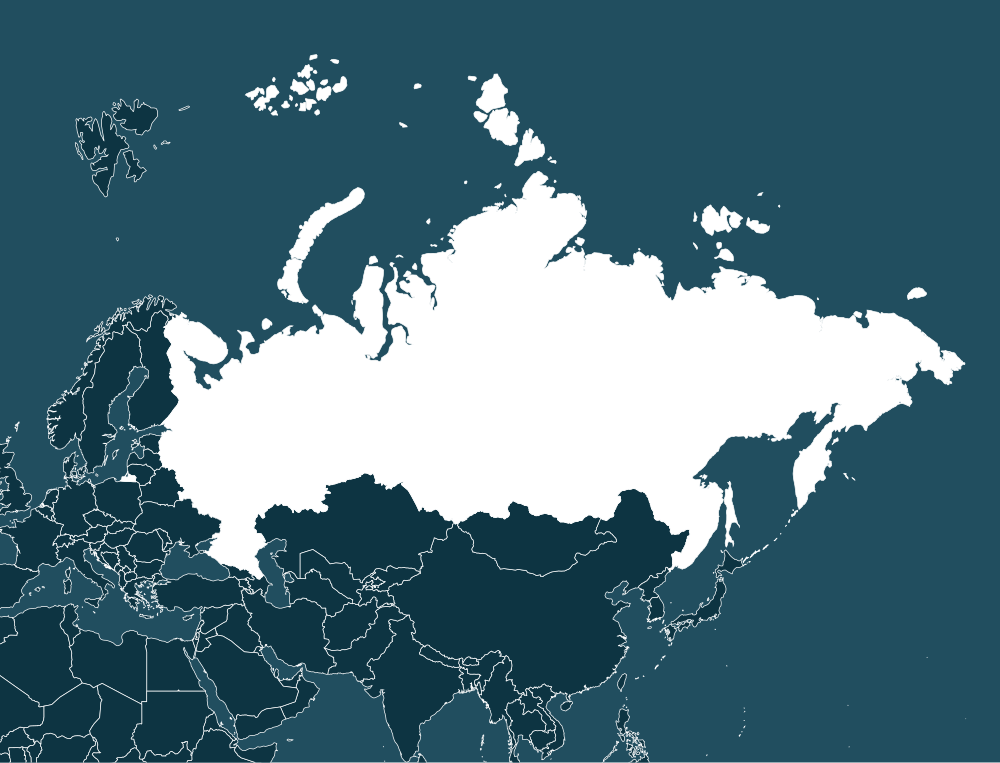
Risk Indicators
- FATF/EU Blacklist/Greylist (Higher Concern)
- Terrorism Financing (Medium Concern)
- US Dept of State INCSR
- Proliferation Financing
- Corruption
- Criminality
- Resilience & Governance
- Financial Transparency
- Offshore Finance Centres
- Sanctions
Background
Russia’s history spans the rise of Muscovy, imperial expansion under the Romanovs and Peter I, the upheavals of 1917, and the formation and eventual dissolution of the USSR. After the Soviet collapse in 1991, the country moved from the instability of the Yeltsin era toward the centralized system associated with Vladimir Putin, combining managed elections, nationalist appeals, geopolitical ambitions, and commodity-based growth. The legacies of Stalin’s rule, the Cold War, and Gorbachev’s glasnost and perestroika continue to shape the country’s political and strategic outlook.
Relations with neighbouring states are marked by military pressure, contested borders, sanctions, and increasingly complex networks of external support. Russia’s war against Ukraine, including its unrecognized claims over Crimea and four Ukrainian oblasts, remains central, while Belarus provides operational alignment and Finland monitors military developments along its extensive border. North Korean weapons and personnel, Iranian drones and missiles, Chinese payment and technology channels, Türkiye-linked barter arrangements, and the so-called shadow fleet illustrate the broader mechanisms surrounding Russia’s regional posture.
AML & Terrorist Financing
Российская Федерация сохраняет формально развитую AML/CFT-инфраструктуру, в которой ключевую роль играет Росфинмониторинг, однако её международное положение осложнено приостановлением членства в FATF и усилением внимания к рискам, связанным с обходом ограничительных мер, киберактивностью и сотрудничеством с КНДР. Европейская комиссия отнесла Россию к юрисдикциям высокого риска, указав, в частности, на недостаточную независимость финансовой разведки, ограниченную прозрачность бенефициарного владения и несоответствие регулирования криптоактивов стандартам FATF, тогда как оценки эффективности по отдельным направлениям остаются неоднородными. В сфере финансирования терроризма действуют значительные правовые и правоохранительные механизмы, включая преследование и замораживание активов, но сохраняются вопросы к своевременности целевых финансовых санкций, охвату обязательств и контролю рисков распространения оружия массового уничтожения.
Sanctions
Russia has imposed counter-sanctions linked to the Russo-Ukrainian War, including export bans on more than 200 Western goods, restrictions on foreign bond interest payments, and limits on payments to overseas shareholders, alongside measures against Ukraine dating from 2018. Against Russia, the United States through OFAC, the EU through 21 sanctions packages, and partners including the UK, Canada, Japan, Australia, New Zealand, and Switzerland have applied extensive asset freezes, financial and technology controls, trade restrictions, energy measures, and shadow-fleet designations. The broader framework includes limited UN action, designations involving entities such as Keremet Bank, and continuing efforts to address circumvention through China, Kyrgyzstan, Türkiye, Belarus, Iran, Central Asia, and alternative maritime routes.
Criminality
Corruption remains pervasive in the Russian Federation, particularly in public procurement, permits, inspections, utilities, defense, and media, despite enforcement actions by the Prosecutor General’s Office that have produced thousands of convictions and substantial asset recoveries. Criminal activity also spans bribery, embezzlement, financial fraud, trafficking, illicit trade, drugs, environmental offenses, and cybercrime, while limited whistleblower protection and the involvement of state-embedded actors continue to complicate accountability.
Reports
Russia faces scrutiny across arms control, biological weapons, security transparency, narcotics, trafficking, and counterterrorism, including concerns over Novaya Zemlya, the modernization of the 48th Central Scientific Research Institute in Sergiyev Posad, and failures to provide Vienna Document information. Wider findings describe drug routes through Saint Petersburg and Black Sea ports, persistent forced labor and sex trafficking vulnerabilities affecting Ukrainians, North Korean workers, migrants, and children, and the use of counterterrorism authorities by the Ministry of Justice and Prosecutor General’s Office to target opposition and civil society.
Industry/Product Sector Risk
Russia’s industry landscape presents a varied AML/CFT risk profile, with banking, trade finance, wealth management, cash-intensive activity, and politically exposed persons standing out among the more sensitive areas. Oversight is distributed across institutions including the Bank of Russia, Rosfinmonitoring, the Federal Tax Service, the Federal Customs Service, and the Assay Chamber, reflecting the breadth of financial, professional, commercial, and strategic-sector exposures. Across sectors, recurring concerns involve beneficial-ownership opacity, complex corporate structures, cash movement, cross-border transactions, procurement, and the laundering of proceeds linked to corruption, fraud, tax offences, smuggling, and organised crime.
Economy & Investment Climate
Russia’s economy combines a broad industrial and resource base with significant state involvement, while trade remains centered on energy and other commodities and increasingly oriented toward partners such as China and India. Investment prospects are shaped by programs administered by the Ministry of Economic Development, RDIF, and Ministry of Industry and Trade, but also by strategic-sector approvals, localization rules, sanctions, uneven regulation, and concerns surrounding the courts and Federal Antimonopoly Service.
Cryptocurrency Regulations
Cryptocurrency in the Russian Federation occupies a tightly controlled property-like status rather than serving as legal tender, with Federal Law No. 115-FZ, Federal Law No. 259-FZ, and oversight from the Bank of Russia, Rosfinmonitoring, and the Federal Tax Service shaping obligations for exchanges, miners, and users. Tax treatment, Travel Rule reporting above 60,000 rubles, the FTS miner registry, and a forthcoming licensing framework taking effect in September 2026 point to a rapidly formalizing environment whose details extend into token offerings and real-world asset tokenization.
Get full access
The information on this page is a brief summary. Get access to EDD country reports, all risk category scores and customisable weightings for 245 jurisdictions.