
Risk Indicators
- FATF/EU Blacklist/Greylist (Lower Concern)
- Terrorism Financing (Lower Concern)
- US Dept of State INCSR
- Proliferation Financing
- Corruption
- Criminality
- Resilience & Governance
- Financial Transparency
- Offshore Finance Centres
- Sanctions
Background
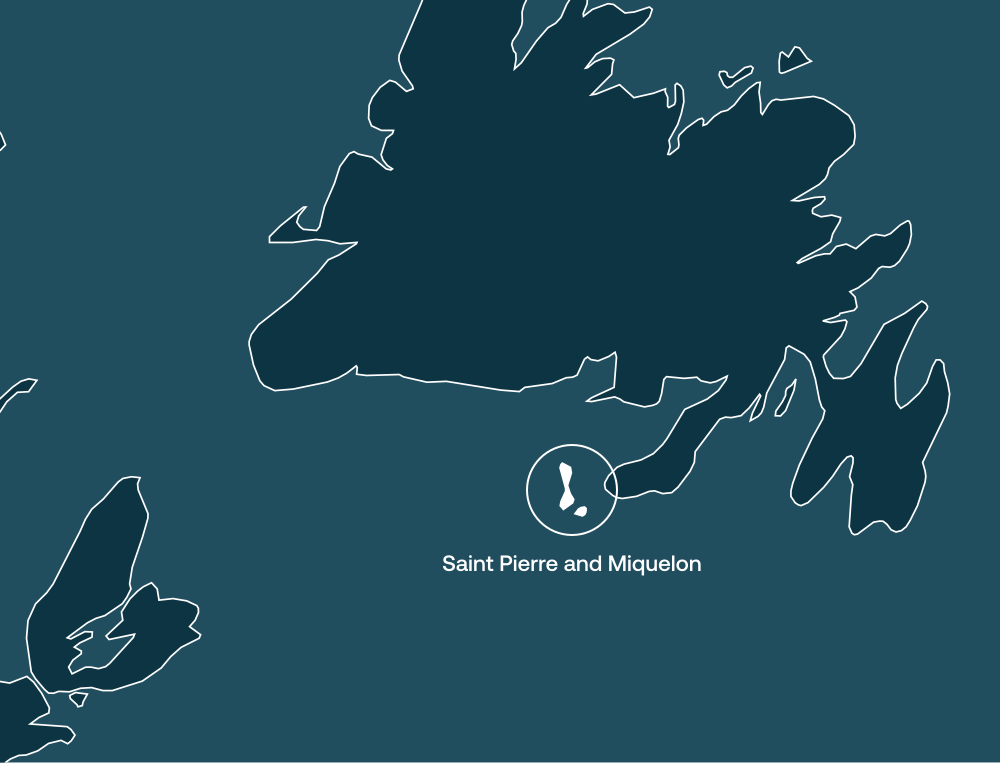
First settled by the French in the early 17th century, Saint Pierre and Miquelon remains the sole surviving trace of France’s once extensive North American possessions. Its history reflects a continuing French presence in the region, distinct from the later evolution of France’s other overseas entities. In 2003, the islands attained the status of an overseas collectivity.
Saint Pierre and Miquelon is connected to a France that plays a prominent role through institutions including the United Nations Security Council, NATO, the G-7, the G-20, and the European Union. The constitutional framework established in 1958 created a hybrid presidential-parliamentary system, while cooperation with Germany helped shape European integration and the adoption of the euro in 1999. The islands’ place within this wider French structure offers important context for understanding their distinctive status and development.
AML & Terrorist Financing
Saint Pierre and Miquelon falls within France’s AML/CFT framework, which the 2022 FATF evaluation found broadly robust, supported by institutions such as TRACFIN, ACPR, AMF, PNF and AGRASC. Key risks span cross-border proceeds, tax and customs fraud, drug trafficking, corruption, scams and human trafficking, while terrorist-financing concerns include micro-financing, fundraisers, prepaid cards and virtual assets. Nevertheless, varying DNFBP risk awareness, delays in suspicious transaction and targeted-sanctions obligations, beneficial-owner identification challenges and uneven supervision—particularly in real estate and related professional sectors—leave important areas for closer attention.
Sanctions
Saint Pierre and Miquelon, as a self-governing overseas collectivity of France, applies France’s EU- and UN-aligned sanctions framework, including targeted asset freezes, travel bans, sectoral restrictions, and arms embargoes affecting countries such as Russia, Belarus, and Iran. French Customs and financial regulators investigate evasion through raids, asset freezes, prosecutions, and participation in the REPO Task Force, with particular attention to shadow fleets, neighboring-country transit routes, and intermediaries linked to China, the UAE, and Turkey. No international sanctions are currently in force against Saint Pierre and Miquelon, while France is advancing measures under EU Directive 2024/1226 to strengthen criminal penalties for sanctions violations.
Criminality
Saint Pierre and Miquelon falls within France’s anti-corruption framework, which includes the Sapin II law, the High Authority for Transparency in Public Life, and protections for whistleblowers, although questions remain about political probity and institutional trust. French authorities have expanded investigations and assigned roles to the Agence Française Anticorruption, the National Financial Prosecutor, and OCLCIFF, while longstanding assessments have identified gaps in foreign-bribery enforcement, prosecution, confiscation, and investigative independence.
Reports
Saint Pierre and Miquelon falls within France’s framework, where the U.S. State Department’s 2025 assessment recognized Tier 1 anti-trafficking efforts alongside persistent gaps in victim referral, compensation, investigations, and protections for vulnerable people. France also maintained its highest terrorism alert level, deployed Operation Sentinelle, and reported that law enforcement and intelligence services had disrupted nine planned attacks in 2024, including threats linked to the Olympic and Paralympic Games.
Economy & Investment Climate
Saint Pierre and Miquelon’s economy remains centered on fishing, fish processing, and tourism, with French support providing stability while quota disputes, overfishing, and a shrinking fishing fleet underscore its vulnerabilities. Its position as a French overseas collectivity supports access to European markets and investment in infrastructure, tourism, aquaculture, and possible oil and gas development, even as trade patterns and heavy reliance on imports reveal a narrowly based economic structure.
Cryptocurrency Regulations
Cryptocurrency in Saint Pierre and Miquelon follows France’s framework, where digital assets are not legal tender and service providers may face registration, AML, and customer-verification obligations through authorities such as the AMF and ACPR. Tax treatment, ICO disclosures, transaction monitoring, and the likely application of the Travel Rule reflect French and FATF-aligned principles, although documented local exchanges, enforcement actions, and territory-specific risk assessments appear limited.
Get full access
The information on this page is a brief summary. Get access to EDD country reports, all risk category scores and customisable weightings for 245 jurisdictions.