
Risk Indicators
- FATF/EU Blacklist/Greylist (Lower Concern)
- Terrorism Financing (Lower Concern)
- US Dept of State INCSR
- Proliferation Financing
- Corruption
- Criminality
- Resilience & Governance
- Financial Transparency
- Offshore Finance Centres
- Sanctions
Background
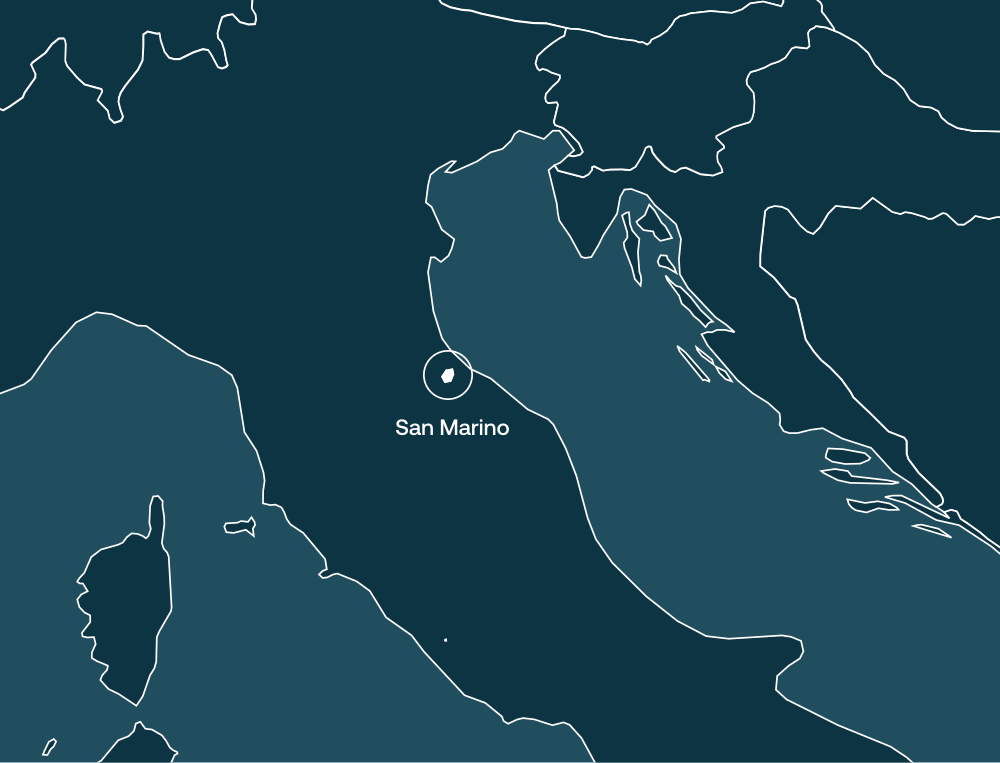
San Marino is a microstate in Europe, distinguished by its claim to be the world’s oldest republic and by a founding tradition linked to the Christian stonemason MARINUS in A.D. 301. Its foreign policy broadly follows the European Union while it remains outside the bloc, with an Association Agreement intended to deepen participation in the internal market and related cooperation. Social and political developments also tend to reflect those of neighboring Italy.
Encircled by Italy, San Marino is situated alongside a range of regional concerns involving migration, reproductive rights, policing, emergency security legislation, and sanctions enforcement. Italy’s implementation of EU measures—including major asset freezes—has been accompanied by continuing attention to evasion risks involving Russian-linked media, subsidiaries, and offshore structures, as well as coordination through the G7. These dynamics have implications for regional stability, even as San Marino maintains neutrality on sanctions.
AML & Terrorist Financing
San Marino is not listed by FATF as having strategic AML deficiencies, and MONEYVAL’s 2024 follow-up noted progress, including the re-rating of Recommendation 35 after 2023 legislative amendments, although effectiveness remains uneven across areas of the framework. The Financial Intelligence Agency (FIA), Central Bank of San Marino (CBSM), law-enforcement bodies and Investigating Judges cooperate effectively in many respects, but limited analytical and supervisory resources, uneven reporting by some DNFBPs, weaknesses in beneficial-ownership verification, and gaps in private-sector understanding continue to present challenges in a regional financial-centre context. Terrorist-financing risk is assessed as low and no TF prosecutions have occurred, yet implementation of targeted financial sanctions and proliferation-financing controls remains less consistently understood outside banks and certain larger or affiliated institutions, with the CRM and FIA still providing important points of coordination.
Sanctions
San Marino implements United Nations Security Council measures, including targeted restrictions reflected on the UN Consolidated List, while no international sanctions are currently in force against the country itself. Attention has nevertheless focused on possible evasion through San Marino-flagged vessels, including the MS ANGIA, WHITE SHARK, and DOUBLE IN, with U.S. OFAC designations linked to Iranian oil transfers and related shipping structures. The San Marino Ship Register’s action concerning DOUBLE IN, alongside continuing concerns over AIS manipulation, foreign-registered managers, and T1/T2SM customs procedures, highlights why its sanctions controls remain closely scrutinized.
Criminality
San Marino’s compact scale keeps many conventional illicit markets limited, but concerns persist around cannabis distribution, money laundering, tax-related offenses, online scams, and links between foreign criminal networks and local business or political figures. The country has strengthened financial-crime legislation and relies on a law-enforcement unit addressing organized crime, corruption, and money laundering, while reported cases involving cocaine proceeds, banking vulnerabilities, and possible state-embedded actors point to areas requiring closer scrutiny.
Industry/Product Sector Risk
San Marino’s financial landscape is concentrated around a small, cross-border banking sector, with wealth management, fiduciary services, investment products, insurance, gaming, and high-value goods presenting varied exposure to foreign tax offences and fraud, particularly involving Italian-linked activity. Cash flows, beneficial ownership structures, non-resident clients, and professional gatekeepers remain recurring themes, while the Anti-Money Laundering Archive and the State-majority gaming house provide distinctive indicators of the jurisdiction’s control environment. Emerging technology is being watched through San Marino Innovation, alongside broader institutional concerns reflected in the Conto Mazzini case, GRECO-related reforms, and the roles of the Congress of State and other public bodies.
Economy & Investment Climate
San Marino’s compact, affluent economy is anchored by services, banking, tourism, and a substantial industrial base spanning electronics, ceramics, textiles, and wine, while agriculture remains limited but distinctive through products such as grapes, olives, and cheese. Low taxation, political stability, and its EU monetary arrangement supporting euro use help attract investment, although the economy remains closely tied to Italy and European trade networks and faces pressures including water shortages, urbanization, and air pollution.
Cryptocurrency Regulations
San Marino permits cryptocurrency within a developing framework shaped by Law No. 92, Law No. 132, and the 2024 delegated decree, with oversight divided between the Banca Centrale della Repubblica di San Marino, the FIA, and San Marino Innovation. While crypto-assets are not legal tender, exchanges, token offerings, and related businesses face registration, white-paper, AML, and reporting expectations, alongside an evolving tax regime that includes an 8% individual substitute tax and upcoming CARF implementation.
Get full access
The information on this page is a brief summary. Get access to EDD country reports, all risk category scores and customisable weightings for 245 jurisdictions.