
Risk Indicators
- FATF/EU Blacklist/Greylist (Lower Concern)
- Terrorism Financing (Lower Concern)
- US Dept of State INCSR
- Proliferation Financing
- Corruption
- Criminality
- Resilience & Governance
- Financial Transparency
- Offshore Finance Centres
- Sanctions
Background
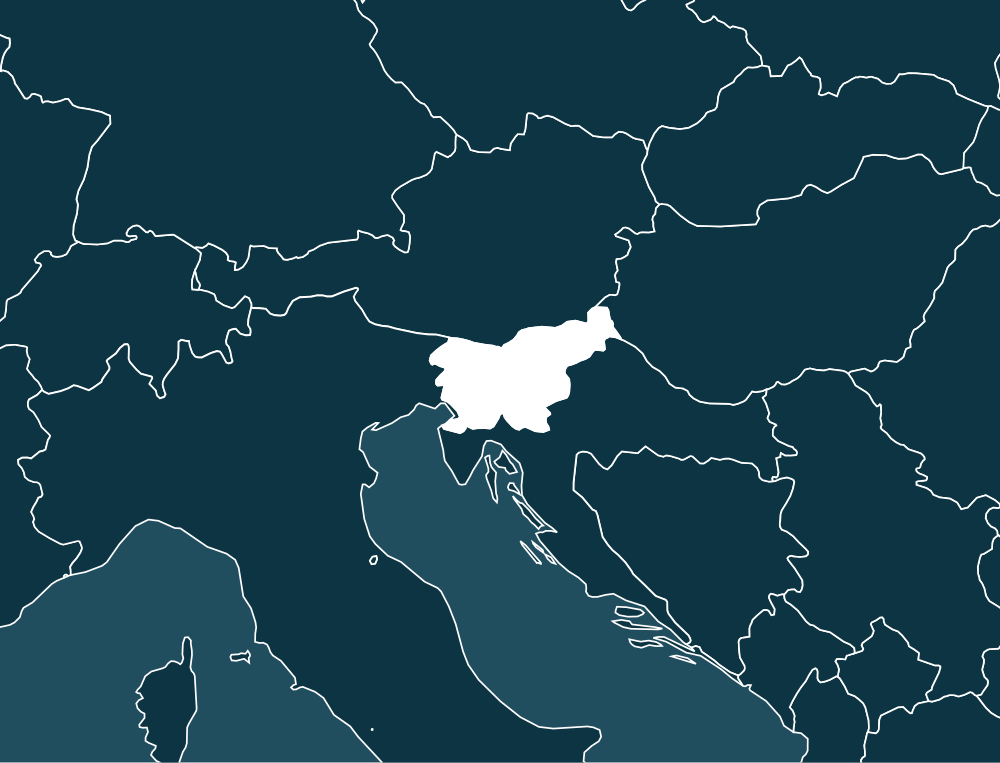
Slovenia’s modern identity was shaped by its passage from the Austro-Hungarian Empire through the Kingdom of Serbs, Croats, and Slovenes and socialist Yugoslavia to independence after the brief 10-day war of 1991. Its first multiparty elections and independence referendum marked a decisive political transition. Integration followed swiftly, with NATO and EU accession in 2004 and entry into the euro zone and Schengen Area in 2007.
The country’s regional setting remains influenced by migration pressures, energy dependencies, sanctions policy, and instability in nearby Bosnia and Herzegovina. Croatia’s treatment of sanctions evasion as an administrative offense contrasts with Hungary’s criminal penalties, while both countries present distinct complications for EU policy and border management. Austria and Italy appear less exposed to the specific conflicts and sanctions-related concerns highlighted in Slovenia’s immediate neighborhood.
AML & Terrorist Financing
Slovenia has a broadly established AML/CFT framework and is not listed by FATF as having strategic deficiencies, yet significant weaknesses remain in national strategy, risk-based supervision, inter-agency information sharing, and the oversight of designated non-financial businesses and professions. The Office for Money Laundering Prevention and Bank of Slovenia demonstrate stronger capabilities, while beneficial ownership data, financial intelligence resourcing, asset tracing, confiscation, and sanctions raise continuing effectiveness concerns, particularly amid exposure to fraud, corruption, organised crime, and cross-border laundering. Terrorist-financing risks are assessed as low, but proactive detection remains limited, all 16 pre-investigations since 2020 were dismissed, and deficiencies in communicating and documenting targeted financial sanctions—alongside fragmented monitoring of non-profits and DNFBPs—leave important questions around practical implementation.
Sanctions
Slovenia enforces UN and EU restrictive measures through ZOUPAMO, with the Ministry of Foreign and European Affairs coordinating implementation and Banka Slovenije-supervised institutions freezing assets and rejecting transactions involving designated parties. Its framework covers targeted measures and sectoral restrictions connected to regimes involving countries such as Russia, Belarus, Iran, North Korea, Syria, and others, while enforcement efforts include cooperation with Eurojust and EU partners and monitoring of potential transit and financial-evasion routes. The United States’ OFAC authorities under Executive Order 14033 include Slovenia within the defined Western Balkans region, allowing designations tied to specified conduct there, although the available information indicates targeted restrictions rather than broad sanctions imposed on Slovenia as a country.
Criminality
Slovenia’s corruption is generally limited in prevalence but remains an ongoing concern, particularly through non-transparent public procurement, preferential treatment, incumbent-vendor advantages, and alleged cronyism among closely connected political and economic elites. The State Prosecutor’s Office faces difficulties obtaining evidence in bribery cases, while the Commission for the Prevention of Corruption has identified numerous municipal procurement violations amid persistent trafficking, financial fraud, cybercrime, and money-laundering activity.
Reports
Slovenia was elevated to Tier 1 after recording its first trafficker convictions in four years, expanding investigations and labor-trafficking prosecutions, strengthening official training, and adopting a 2025–2026 National Action Plan. Yet vulnerabilities remain among migrant workers, asylum-seekers, Ukrainian refugees, Roma communities, and unaccompanied minors, with exploitation spanning forced labor, begging, domestic servitude, and sex trafficking, including recruitment through online platforms.
Industry/Product Sector Risk
Slovenia’s financial and business landscape presents a varied risk profile, with particular exposure associated with retail banking, casinos and gaming, money remittance, real estate, virtual currencies, legal services and trust and company structures. Cross-border activity, especially involving the Western Balkans and neighbouring jurisdictions, combines with cash-intensive operations, beneficial-ownership opacity, foreign criminal proceeds and vulnerabilities in sectors such as construction, healthcare, logistics and public procurement. At the same time, smaller markets such as insurance, securities and investment funds show more contained exposure, while emerging channels and uneven risk awareness create areas requiring closer examination.
Economy & Investment Climate
Slovenia combines a highly educated workforce, modern infrastructure, eurozone access, and strong trade links with Central Europe and the Balkans, supporting a developed, export-oriented economy despite slower growth amid inflation and elevated energy costs. Bank of Slovenia data point to substantial and rising foreign investment, while SPIRIT promotes new opportunities alongside challenges involving state ownership, bureaucracy, labor shortages, taxation, and regulatory complexity.
Cryptocurrency Regulations
Slovenia permits cryptocurrency activity but places it within a detailed framework shaped by ZPPDFT-2, MiCA, and oversight from bodies including the OMLP, ATVP, and Bank of Slovenia. With mandatory registration, expanding transaction-reporting duties, evolving tax treatment from 2026, and specific requirements for exchanges and token offerings, the country presents a regulated environment whose finer obligations depend heavily on the nature of the crypto activity.
Get full access
The information on this page is a brief summary. Get access to EDD country reports, all risk category scores and customisable weightings for 245 jurisdictions.