
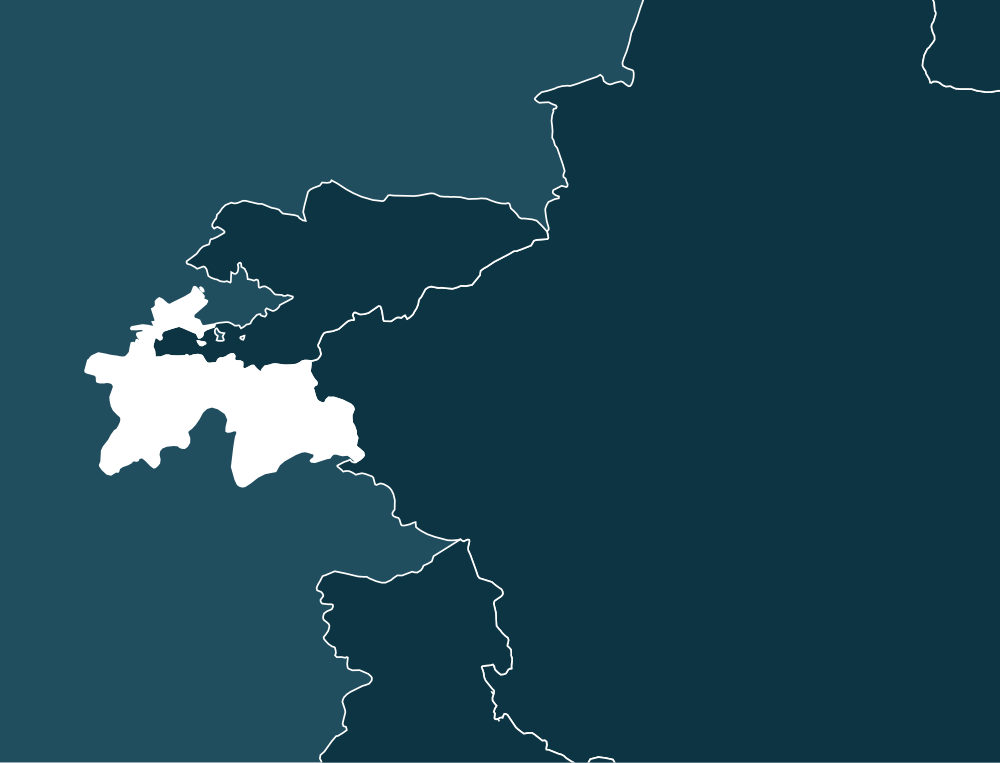
Risk Indicators
- FATF/EU Blacklist/Greylist (Lower Concern)
- Terrorism Financing (Lower Concern)
- US Dept of State INCSR
- Proliferation Financing
- Corruption
- Criminality
- Resilience & Governance
- Financial Transparency
- Offshore Finance Centres
- Sanctions
Background
Tajikistan emerged from Russian imperial and Soviet rule into independence in 1991, following a turbulent history that included the basmachi resistance and a civil war lasting from 1992 to 1997. Its political system remains dominated by President Emomali Rahmon, whose constitutional status and the rise of his son Rustam Emomali point to an unusually concentrated succession framework. Elections are held regularly, but observers have described them as affected by significant irregularities, while the country remains the poorest of the former Soviet republics despite joining the WTO in 2013.
Economic pressures include reliance on migrant remittances, corruption, the opiate trade, and insecurity linked to Afghanistan, alongside a record of violence in areas such as the Rasht Valley and Gorno-Badakhshan. The 1,300-kilometre Afghan frontier remains central to concerns involving terrorism, arms and drug trafficking, with CSTO-supported reinforcement adding a wider security dimension. Relations with Kyrgyzstan, Uzbekistan, and China reveal a shifting regional balance, from the fragile implementation of the 2025 border settlement to Uzbekistan’s mediating role and growing Chinese economic influence, while sanctions-evasion networks involving neighbouring states add further complexity.
AML & Terrorist Financing
Tajikistan faces significant money-laundering and terrorist-financing risks linked to corruption, drug trafficking across its Afghan border, cash-intensive activity, remittances, and the shadow economy, while terrorist-financing concerns are heightened by regional instability and terrorist activity. Although the country has strengthened its AML/CFT framework and is no longer subject to FATF monitoring, its 2024 follow-up findings and continuing enhanced follow-up with the Eurasian Group point to uneven implementation, including weaknesses in supervision, beneficial ownership, confiscation, targeted sanctions, and substantive money-laundering enforcement. The Financial Monitoring Department, State Committee for National Security, General Prosecutor’s Office, Anti-Corruption Agency, Drug Control Agency, and Ministry of Internal Affairs contribute to detection and investigation, but challenges remain in proving TF cases, monitoring nonprofit organizations, applying proliferation-financing sanctions, and converting financial intelligence into effective prosecutions.
Sanctions
Tajikistan supports United Nations sanctions measures, but no international sanctions are currently in force against the country itself. Its companies and trade channels have nevertheless drawn targeted attention from the United States, European Union, and G7 over suspected facilitation of restricted goods and financial flows to Russia, including activity associated with Kafolati Komil LLC. Routes involving the Southern Transport Corridor, CIS trade links, and partners such as the UAE, China, and Central Asian states have intensified scrutiny of aviation components, microelectronics, industrial machinery, and other dual-use technology.
Criminality
Tajikistan has anti-corruption laws and the Agency for State Financial Control and Combating Corruption, yet enforcement is widely described as politically influenced and ineffective, with reported risks in procurement, licensing, customs, taxation, and dispute settlement. Criminal activity includes trafficking in persons, Afghan heroin transit, counterfeit goods, embezzlement, money laundering, and other financial crimes, while state-linked figures and entrenched networks appear to play a significant role in illicit markets; in 2024, the agency identified 2,323 related offenses involving 1,180 people.
Reports
Tajikistan faces interconnected pressures from Afghan-linked narcotics routes, extremist threats, labor and sex trafficking, and vulnerabilities affecting migrants, refugees, women, and children, while authorities have increased seizures, victim assistance, prevention activities, and efforts to reinforce the Tajik-Afghan border. The Drug Control Agency, UBNON, the National Trafficking in Persons Center, and international partners are active across these challenges, but limited institutional capacity, corruption concerns, uneven prosecutions, and allegations of coercive labor practices continue to complicate progress.
Industry/Product Sector Risk
Tajikistan’s financial landscape is bank-dominated and highly cash-intensive, with 17 banks, migrant remittance channels, currency exchange, and trade finance exposed to corruption, tax crime, drug trafficking, and smuggling risks. Beyond banking, vulnerabilities extend across precious-metals dealers, real estate, legal professionals, construction, telecommunications, and transport, while the Ministry of Finance, Pochtai Tojik, and other supervisory bodies play important roles in a framework marked by uneven controls and limited reporting from DNFBPs. The country’s position along routes connected to Afghanistan, combined with governance challenges, incomplete beneficial-ownership and PEP measures, and potential terrorist-financing abuse of NPOs overseen by the Ministry of Justice, creates a complex risk environment with significant areas warranting closer examination.
Economy & Investment Climate
Tajikistan is pursuing investment-led growth in minerals, energy, digital infrastructure, and telecommunications, supported by incentives, Free Economic Zones, and the National Development Strategy to 2030, while agriculture, industry, and remittance-supported consumption remain central to the economy. Although 2024 FDI rose substantially, investors must contend with state-owned enterprise dominance, opaque regulation, currency constraints, limited banking depth, and uneven implementation by bodies such as the State Committee on Investments and State Property Management and the National Bank of Tajikistan.
Cryptocurrency Regulations
Tajikistan treats cryptocurrency as a high-risk virtual asset rather than legal tender, with oversight divided between the National Bank of Tajikistan and the Agency for Innovation and Digital Technologies under the Technological Park regime. Law No. 967, Presidential Decree No. 798, the emerging Travel Rule, and the reported Bitcom.tj framework point to increasing controls, while licensing, taxation, token offerings, and broader compliance requirements remain unsettled.
Get full access
The information on this page is a brief summary. Get access to EDD country reports, all risk category scores and customisable weightings for 245 jurisdictions.