
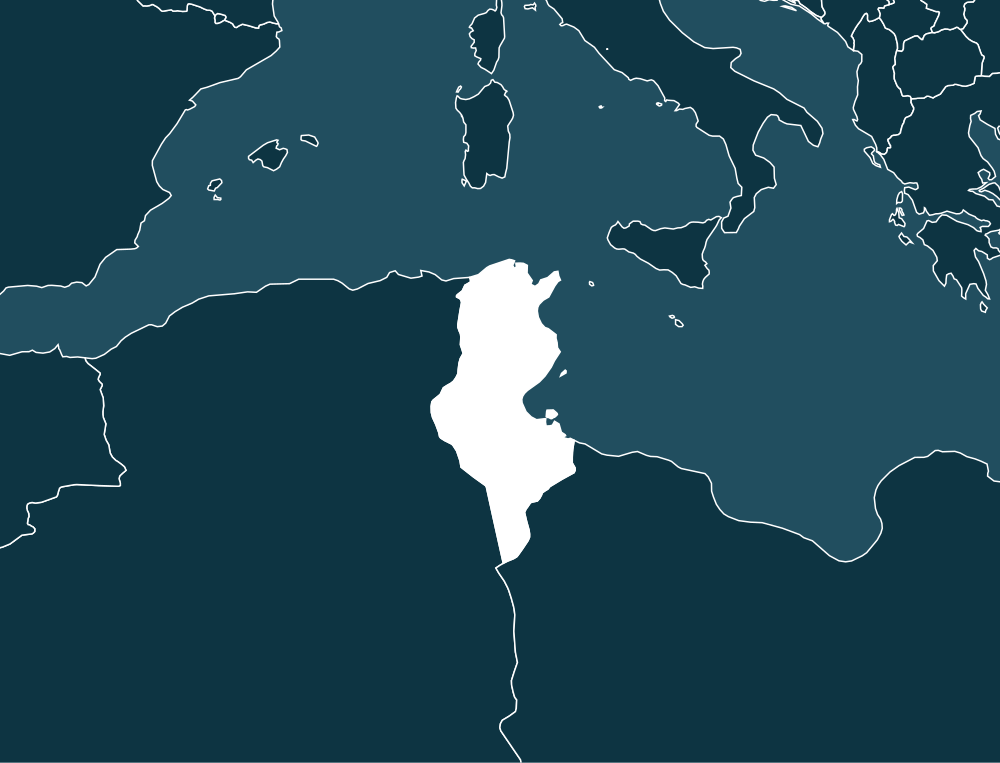
Risk Indicators
- FATF/EU Blacklist/Greylist (Lower Concern)
- Terrorism Financing (Medium Concern)
- US Dept of State INCSR
- Proliferation Financing
- Corruption
- Criminality
- Resilience & Governance
- Financial Transparency
- Offshore Finance Centres
- Sanctions
Background
Tunisia’s history reflects successive rule by Phoenician, Carthaginian, Roman, Arab, Berber, Ottoman, and French powers before independence in 1956. The post-independence era was shaped first by Habib Bourguiba’s long one-party presidency and then by Zine el Abidine Ben Ali, whose departure followed the unrest that helped spark the Arab Spring. Subsequent constitutional change, elections, and political crises culminated in Kais Saied’s expanded executive authority and the adoption of a new constitutional framework in 2022.
Today, Tunisia’s stability is closely linked to conditions along its borders with Libya and Algeria, where conflict, militancy, migration, and informal trade create persistent pressures. The southeastern frontier, including the Ras Jedir area, has featured both heightened security measures and disruptions to communities dependent on cross-border commerce, while mountainous areas near Kasserine and Kef remain vulnerable to militant and smuggling activity. Regional rivalries, Libya-related sanctions and evasion risks, and past Tunisian asset freezes add further complexity to the country’s political, economic, and security environment.
AML & Terrorist Financing
Tunisia has made notable AML/CFT advances, including its 2019 removal from FATF monitoring and expanded roles for the CTAF, Central Bank of Tunisia, and beneficial ownership register. Nevertheless, exposure remains linked to terrorism financing, border smuggling, informal value transfer, corruption, and vulnerabilities involving associations and opaque ownership structures. Earlier assessments highlighted low effectiveness in terrorist-financing and proliferation-related outcomes, limited convictions and confiscations, and persistent challenges in supervision, investigations, sanctions, and implementation across banks and DNFBPs.
Sanctions
Tunisia is expected to implement United Nations Security Council sanctions, but no independent Tunisian sanctions regime against other countries is identified. Measures affecting Tunisia are largely targeted rather than country-wide, including EU restrictions under Council Decision 2011/72/CFSP, Canadian asset freezes, and OFAC SDN designations tied to extremist or terrorist activity, with similar measures mirrored by Norway, Iceland, and Liechtenstein. At the same time, Tunisia is described as a potential transit and financial node for sanctions-evasion activity involving Russian, Iranian, and Chinese-linked networks, despite the absence of a broad trade or arms embargo against the Tunisian state.
Criminality
Crime and corruption in Tunisia affect both routine business procedures and major public tenders, with customs, transportation, bureaucracy, and procurement remaining vulnerable despite legal safeguards and electronic systems overseen by HAICOP. The Tunisian Financial Analysis Committee recorded a notable rise in suspicious-transaction reports, while the continued nonoperation of INLUCC and the involvement of networks and state-embedded actors point to broader concerns spanning illicit finance, trafficking, smuggling, drugs, counterfeit goods, and growing cybercrime.
Reports
Tunisia remained on Tier 2 for human trafficking, with authorities recording more convictions and expanding training and international cooperation, while children, migrants, refugees, and women from West Africa remained vulnerable to forced labor, domestic servitude, and sexual exploitation. Counterterrorism efforts included a new national strategy, strengthened Interior–Defense coordination, border operations, asset freezes by the National Commission for Counterterrorism, and arrests of 28 suspects, although regional instability and incidents in Kasserine continued to underscore ongoing security risks.
Industry/Product Sector Risk
Tunisia’s financial and business landscape presents a varied risk picture, with banks, real estate, money remitters, legal professionals, charities, politics, and transportation standing out amid broader concerns involving corruption, embezzlement, smuggling, and terrorist financing. The banking sector generates most suspicious transaction reporting, while institutions such as the CTAF, CGA, CMF, and the Central Bank of Tunisia operate within a framework where supervision, beneficial-ownership checks, and risk-based controls remain uneven. From high-volume remittances and informal cash activity to cross-border trade, corporate structures, and foreign-funded associations, the country’s vulnerabilities often emerge where formal systems intersect with less transparent channels.
Economy & Investment Climate
Tunisia’s economy combines strategic access to European and African markets, a well-educated workforce, and expanding activity in tourism, exports, remittances, and selected manufacturing sectors, yet growth remained modest at 1.4 percent in 2024 amid inflation, unemployment, public debt, and financing pressures. Investment prospects are supported by FIPA, TIA, APII, free-trade zones, and rising FDI, while state-owned enterprises, informality, bureaucratic restrictions, concentrated coastal infrastructure, banking vulnerabilities, and the still-pending update to the 1976 foreign exchange code continue to shape the business environment.
Cryptocurrency Regulations
Tunisia maintains a highly restrictive cryptocurrency environment, with the Central Bank of Tunisia’s May 2018 directive treating unauthorized virtual-currency activity as unlawful and offering no licensing path for exchanges or VASPs. Although Organic Law No. 26 of 2015, amended by Organic Law No. 9 of 2019, and oversight by the Tunisian Financial Analysis Committee provide broader AML controls, crypto taxation, token offerings, Travel Rule obligations, and CARF adoption remain largely undefined, while a BCT sandbox permits only limited blockchain experimentation.
Get full access
The information on this page is a brief summary. Get access to EDD country reports, all risk category scores and customisable weightings for 245 jurisdictions.