
Risk Indicators
- FATF/EU Blacklist/Greylist (Lower Concern)
- Terrorism Financing (Lower Concern)
- US Dept of State INCSR
- Proliferation Financing
- Corruption
- Criminality
- Resilience & Governance
- Financial Transparency
- Offshore Finance Centres
- Sanctions
Background
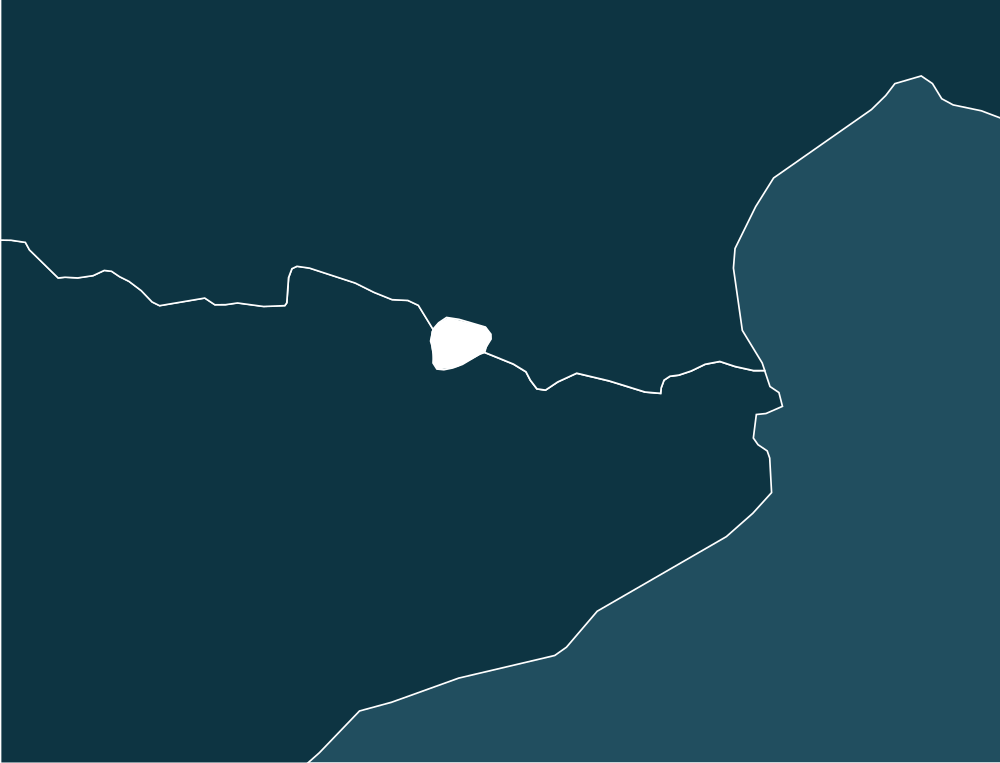
Nestled in the Pyrenees between France and Spain, Andorra is a small landlocked principality with roots reaching back to Charlemagne’s Hispanic March states. Its distinctive co-principality endured for centuries before the 1993 Constitution established a parliamentary democracy while retaining the co-princes as titular heads of state. Tourism, duty-free commerce, banking, low taxes, and the euro underpin its modern prosperity, alongside a special relationship with the European Union.
Andorra’s surrounding environment is shaped by two stable democratic neighbors that face significant pressures without being engaged in armed conflict. France continues to manage political uncertainty, fiscal strain, cyber threats, and changing security priorities, while Spain confronts migration pressures, deaths at sea, social-rights concerns, and intense political polarization. These developments, including debates involving the International Criminal Court and European cooperation, provide important context for Andorra’s regional outlook.
AML & Terrorist Financing
Andorra has strengthened its AML/CFT framework and is not identified by FATF as having strategic deficiencies, with UIFAND financial intelligence supporting investigations and close cooperation with Spain, France, and other partners. Nevertheless, its exposure to foreign proceeds—particularly through banking and private banking—alongside cash-smuggling risks, limited supervisory resources, lengthy proceedings, and modest conviction outcomes leaves important vulnerabilities. Terrorist-financing and proliferation controls appear broadly established but remain less tested in practice, with questions surrounding NPO oversight, recognition of regional sanctions designations, DNFBP awareness, export controls, and coordination among relevant authorities.
Sanctions
Andorra supports UN Security Council sanctions and, since March 2022, has adopted and updated restrictive measures aligned with EU responses to Russia’s invasion of Ukraine. Its implementation has drawn attention to financial-sector vulnerabilities, including the BPA affair, FinCEN’s 2015 designation and subsequent withdrawal, and later proceedings involving former bank executives and assets linked to Russian, Belarusian, Venezuelan, and Chinese networks. No international sanctions are currently in force against Andorra, although its financial system and non-banking sectors remain subject to scrutiny over sanctions-evasion risks.
Criminality
Andorra has developed a broad legal and institutional framework addressing corruption, money laundering, terrorist financing, and related offenses, including the Unit for the Prevention and the Fight Against Corruption (UPLC) and the independent UIFAND. Although trafficking and most illicit markets appear limited in scale, tobacco smuggling, cannabis activity, and the use of Andorra by foreign criminal networks for tax evasion and concealing funds remain notable concerns.
Industry/Product Sector Risk
Andorra’s financial and commercial landscape is shaped by internationally focused private banking, wealth management, investment funds, and correspondent relationships, with non-resident clients and cross-border activity creating significant exposure. The FIU has issued targeted guidance concerning foreign exchange relationships, while sectors such as real estate, high-value goods, professional services, and construction present varied vulnerabilities linked to cash, corporate structures, and beneficial-ownership opacity. Beyond finance, tourism, hospitality, transport routes, tobacco smuggling, and certain nonprofit activities add further dimensions to the country’s money-laundering and terrorism-financing risk profile, including patterns highlighted by cases such as “Sunbird.”
Economy & Investment Climate
Andorra’s affluent, services-led economy combines tourism, commerce, and a sophisticated financial sector, while extensive digital infrastructure and euro-based integration support its role as a compact international business center. Alongside broad foreign-investment access, initiatives from Andorra Business and Andorra Research and Innovation are encouraging fintech, sports tech, e-sports, and biotech, even as recent reforms place greater scrutiny on real estate investment and the country considers deeper alignment with the EU single market.
Cryptocurrency Regulations
Andorra permits cryptocurrency activity under its Digital Assets Act, with the Andorran Financial Authority overseeing licensing, AML/KYC obligations, transaction records, and evolving requirements for exchanges and token offerings, while the euro remains the only legal tender. Digital assets are treated as intangible assets for tax purposes, with a 10% capital-gains rate subject to a €3,000 exemption, and public token offerings may require white papers as the country gradually develops its approach to classifications, DeFi, and real-world asset tokenization.
Get full access
The information on this page is a brief summary. Get access to EDD country reports, all risk category scores and customisable weightings for 245 jurisdictions.