
Risk Indicators
- FATF/EU Blacklist/Greylist (Higher Concern)
- Terrorism Financing (Medium Concern)
- US Dept of State INCSR
- Proliferation Financing
- Corruption
- Criminality
- Resilience & Governance
- Financial Transparency
- Offshore Finance Centres
- Sanctions
Background
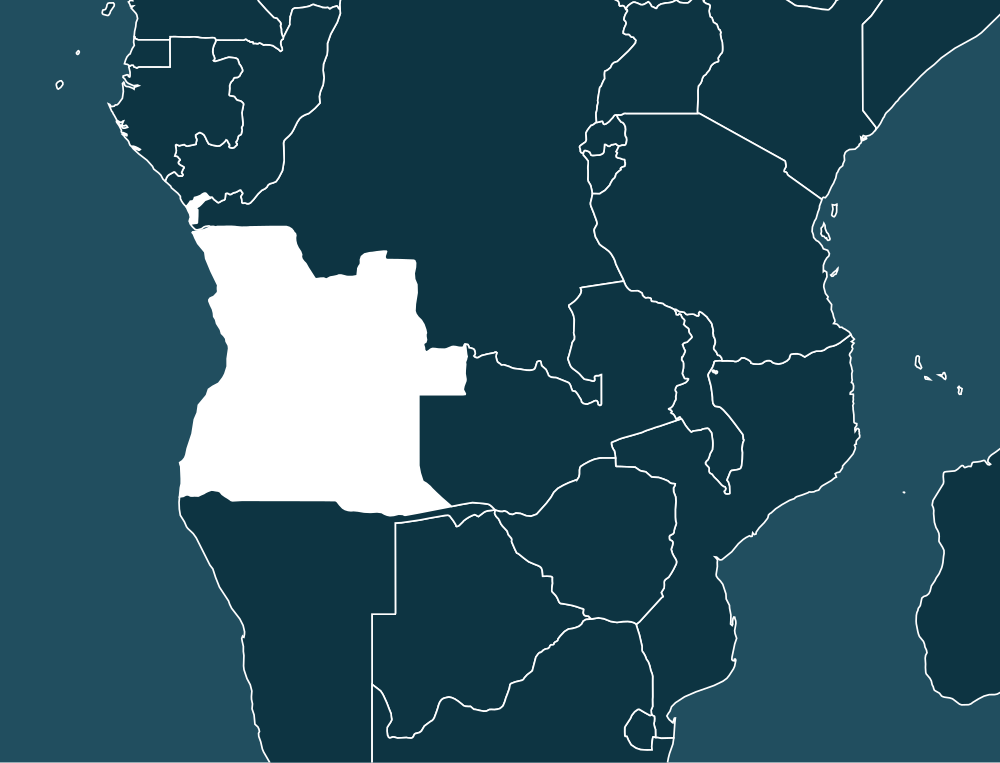
Angola’s history reaches from the Bantu kingdoms of Kongo and Ndongo to Portuguese coastal rule, Christianity, and a devastating role in the transatlantic slave trade. Figures such as Nzingha Mbande and King Pedro V reflect the varied forms of resistance, diplomacy, and accommodation that shaped the territory before Portugal imposed direct colonial control. Independence in 1975 gave way to a Cold War-era struggle between the MPLA and UNITA, leaving deep demographic and social consequences.
Since Jonas SAVIMBI’s death ended UNITA’s insurgency in 2002, the MPLA has retained power through the presidencies of Jose Eduardo DOS SANTOS and Joao LOURENCO, while oil-funded reconstruction has not eliminated low human-development outcomes. Angola’s regional setting remains significant, particularly because neighboring Democratic Republic of the Congo faces armed conflict, displacement, and sanctions imposed by the UN, EU, UK, and US. By contrast, the Republic of the Congo, Zambia, and Namibia present more limited or distinct political and security concerns, ranging from organized crime and corruption to residual tensions linked to the Caprivi region.
AML & Terrorist Financing
Angola remains under increased international scrutiny, with FATF and European Commission listings reflecting continuing strategic deficiencies despite recent efforts to strengthen its AML/CFT framework. Key challenges include risk-based supervision of DNFBPs, beneficial ownership transparency, limited money-laundering investigations and prosecutions, and uneven implementation of targeted financial sanctions. While the UIF, BNA, SIC, and PGR provide an evolving institutional foundation, terrorist-financing detection, proliferation-financing controls, and the practical use of financial intelligence remain areas requiring closer attention.
Sanctions
Angola is required to implement United Nations sanctions measures, but no international sanctions are currently in force against the country itself, and no specific sanctions imposed by Angola on other nations are identified. Its ports, land corridors, and financial networks have nevertheless featured in alleged sanctions-evasion activity involving Hizballah-linked financiers, North Korean interests, and conflict-diamond networks associated with UNITA. The 18 April 2023 OFAC designations, the former UN 1718 Committee’s findings, and Angola’s continued FATF grey-list status point to deeper enforcement and compliance concerns.
Criminality
Corruption remains a significant obstacle to business in Angola despite a strengthened legal framework, asset-recovery efforts, and initiatives such as the 2024–2027 ENAPREC strategy, with prominent allegations involving former officials and the “Dino” and “Kopelipa” trial. Crime concerns extend across public-fund misappropriation, fraud, trafficking, illicit goods, wildlife offenses, drug transit, cybercrime, and organized networks, with state-linked and private-sector actors featuring prominently in financial misconduct.
Reports
Angola remains on Tier 2 as authorities increase convictions, victim identification, labor inspections, and training, while significant gaps persist in prosecutions, victim shelters, and accountability for official complicity. Trafficking risks span child labor, sexual exploitation, domestic service, mining, migration routes, and restricted-worksite conditions, with vulnerabilities intensified by drought and food insecurity and reportedly affecting Cuban medical professionals, teachers, and other workers.
Industry/Product Sector Risk
Angola’s industry landscape presents a varied but interconnected exposure to money laundering and terrorist financing, with especially pronounced vulnerabilities in oil and gas, mining, politics, public works, transportation, casinos, real estate, and other cash-intensive activities. Across both formal and informal markets, cash usage, porous borders, complex ownership structures, trade mis-invoicing, and developing supervision can enable proceeds linked to corruption, embezzlement, smuggling, fraud, tax offences, and illicit resource trading to move through banks, businesses, property, and cross-border channels. The role of politically exposed persons, state-linked enterprises, foreign contractors, unregistered operators, and oversight bodies including the social affairs ministry points to a complex risk environment whose deeper sector-specific patterns merit closer examination.
Economy & Investment Climate
Angola’s economy is anchored by petroleum and other extractive industries, while the National Development Plan 2023–2027 and initiatives involving AIPEX, PROPRIV, and the Lobito Corridor point toward broader opportunities in infrastructure, agriculture, energy, and critical minerals. Growth is tempered by elevated inflation, currency pressure, debt-servicing demands, limited financial inclusion, and institutional challenges, even as agencies such as the ANPG and BODIVA support efforts to attract and structure new investment.
Cryptocurrency Regulations
Angola is moving from a largely undefined cryptocurrency environment toward formal oversight following Parliament’s December 2023 digital-assets and mining law, with the National Bank of Angola and Capital Markets Commission expected to shape supervision while cryptocurrencies remain outside legal-tender status. Important details are still unsettled, including VASP registration, the Travel Rule, exchange controls, ICO requirements, and how the 15% income-tax and 10% capital-gains treatment will apply as the framework develops.
Get full access
The information on this page is a brief summary. Get access to EDD country reports, all risk category scores and customisable weightings for 245 jurisdictions.