
Risk Indicators
- FATF/EU Blacklist/Greylist (Lower Concern)
- Terrorism Financing (Medium Concern)
- US Dept of State INCSR
- Proliferation Financing
- Corruption
- Criminality
- Resilience & Governance
- Financial Transparency
- Offshore Finance Centres
- Sanctions
Background
Australia’s history extends from Aboriginal societies established at least 60,000 years ago through Dutch exploration, British colonization, and the development of penal colonies in New South Wales and Tasmania. The gold rushes, colonial self-government, and the 1901 federation transformed the country, while wartime service, post-war growth, and reforms ending racially restrictive immigration helped shape its modern identity. The consequences of dispossession, disease, land clearance, and the forced removal of Aboriginal children remain an important part of this history.
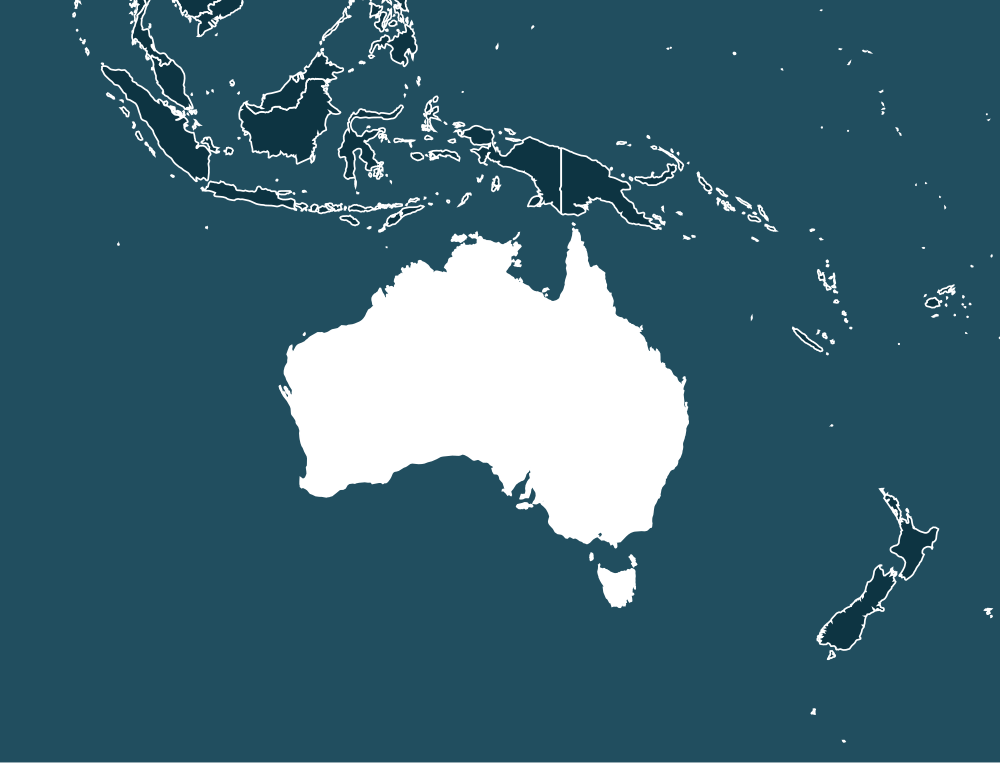
Today, Australia is an advanced market economy closely connected to East and Southeast Asia, although its political landscape experienced notable instability between 2010 and 2018. Its regional setting places it near countries facing varied challenges, including the Papua conflict and maritime tensions involving Indonesia, tribal violence and political volatility in Papua New Guinea, and intermittent unrest in Solomon Islands and Timor-Leste. Relations with more stable neighbors such as New Zealand, as well as exposure to sanctions-related financial risks involving Vanuatu, add further context to Australia’s regional security environment.
AML & Terrorist Financing
Australia is not identified by FATF as having strategic AML deficiencies, yet its 2024 evaluation still reflects a mixed compliance and effectiveness profile, with several recommendations requiring further attention. Money laundering risks remain linked to drugs, fraud, tax evasion, foreign proceeds entering real estate, complex corporate structures, money remitters and emerging money-mule networks, while gaps have been noted around beneficial ownership, certain professional sectors, supervision, confiscation outcomes and the use of AUSTRAC intelligence. Terrorist financing controls have produced investigations, convictions and disruption, but implementation questions persist in areas such as private-sector sanctions oversight and vulnerable non-profit organisations, placing AUSTRAC, the AFP, ACIC, the Serious Financial Crime Taskforce and Fintel Alliance at the centre of Australia’s continuing response.
Sanctions
Australia enforces a broad sanctions framework combining United Nations obligations with autonomous measures covering jurisdictions and conduct ranging from Russia, Iran, North Korea and Ukraine to terrorism, cyber incidents, corruption and serious human rights abuses, including recent Afghanistan and Israel/West Bank designations. Oversight involves the Australian Sanctions Office, AUSTRAC, Australian Border Force and the Australian Federal Police, with particular attention to shadow fleets, third-country financial intermediaries, cryptocurrency channels and other evasion methods identified through the RRIFS Working Group. No international sanctions are currently in force against Australia, while domestic enforcement continues to evolve through proposed asset-confiscation powers, proactive designations and expanded attention to maritime and virtual-asset loopholes.
Criminality
Australia has a comprehensive anti-corruption framework, with the National Anti-Corruption Commission and state bodies such as NSW ICAC, Victoria’s IBAC, and the Queensland and Western Australian Corruption and Crime Commissions addressing public-sector integrity. Crime concerns include human trafficking, counterfeit goods, illicit tobacco, drug markets, money laundering, and increasingly damaging ransomware and online financial fraud, with outlaw motorcycle gangs and other organized networks implicated in some activity.
Reports
Australia maintains strong formal commitments to combating human trafficking, with increased victim identification, investigations, prosecutions, and targeted visa initiatives, while vulnerabilities remain among migrant workers, international students, domestic workers, and others exposed to forced labor or sexual exploitation. Its counterterrorism framework also expanded through new legislation, international cooperation, and AUSTRAC-led financial disruption efforts, amid no reported terrorist attacks in 2023 and continued concern about violent extremism.
Industry/Product Sector Risk
Australia’s financial and wider commercial landscape presents concentrated money-laundering and terrorism-financing exposure across major banks, remitters, casinos, currency exchange, real estate, high-value goods, cash-intensive businesses and professional gatekeepers, with risks often involving cross-border flows, opaque ownership and complex transactions. AUSTRAC’s supervisory focus, the National Threat Assessment and related national and State-level arrangements point to evolving vulnerabilities in digital payments, virtual currencies, trade finance, construction, charities and resource-linked activity, alongside uneven coverage for certain operators and professions. The underlying risk picture spans drug trafficking, fraud, tax evasion, corruption, organised crime and terrorist financing, with the most significant insights resting in the detailed sector distinctions, typologies and regulatory gaps.
Economy & Investment Climate
Australia presents a stable, open, and highly developed investment environment, supported by strong institutions, a robust banking system, AAA credit ratings, and a services-led economy with significant mining and agricultural exports. Foreign investors generally receive broad access, though the Foreign Investment Review Board applies national-interest and national-security screening, while agencies such as Austrade, the Australian Treasury, and the Australian Competition and Consumer Commission shape opportunities across priority industries, clean technology, and critical supply chains.
Cryptocurrency Regulations
Australia permits cryptocurrency activity under a structured framework rather than recognizing it as legal tender, with AUSTRAC registration, customer due diligence, Travel Rule obligations, and ASIC oversight shaping how virtual asset businesses operate. The ATO treats crypto as a CGT asset and uses data matching to monitor transactions, while evolving rules for token offerings, real-world assets, and OECD CARF reporting signal increasingly detailed compliance expectations.
Get full access
The information on this page is a brief summary. Get access to EDD country reports, all risk category scores and customisable weightings for 245 jurisdictions.