
Risk Indicators
- FATF/EU Blacklist/Greylist (Lower Concern)
- Terrorism Financing (Lower Concern)
- US Dept of State INCSR
- Proliferation Financing
- Corruption
- Criminality
- Resilience & Governance
- Financial Transparency
- Offshore Finance Centres
- Sanctions
Background
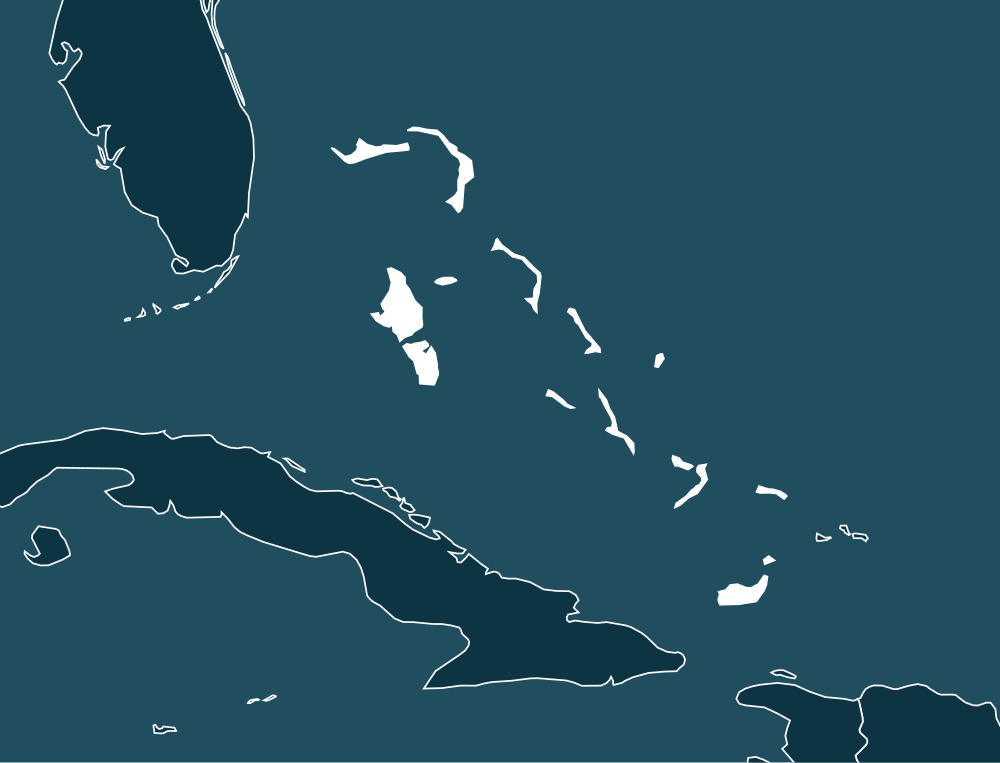
The Bahamas’ history stretches from Lucayan settlement and British colonization to independence from the United Kingdom in 1973, with piracy once flourishing along nearby shipping routes. Its modern prosperity is closely tied to tourism, international banking, and investment management, while its proximity to Florida gives it an outsized role in regional maritime activity. That same geography has made the islands a transshipment point for illicit trafficking, prompting close cooperation with the Drug Enforcement Administration, US Coast Guard, and US Customs and Border Protection through OPBAT.
The country’s wider security environment is shaped by nearby Cuba and Haiti, where political repression, economic hardship, gang violence, and humanitarian pressures carry implications beyond their borders. Cuba remains subject to a longstanding US embargo and is associated with alternative trading and financial channels, while Haiti faces UN sanctions, weapons smuggling, and persistent instability. Against this backdrop, the Bahamas occupies a strategically significant position between the United States, the Caribbean, and European-bound routes, with regional developments affecting its security and compliance landscape.
AML & Terrorist Financing
The Bahamas has been removed from FATF increased monitoring after significant reforms, although CFATF enhanced follow-up continues and the December 2022 assessment found limited effectiveness across several outcomes. Key concerns include exposure through private banking, trusts, legal persons, securities, real estate, gaming and virtual assets, alongside unverified banking facilities, limited suspicious transaction reporting, uneven risk assessments and restrained use of sanctions and asset forfeiture. Terrorist-financing capabilities remain largely untested, with no reported investigations or convictions and continuing gaps in targeted-financial-sanctions and proliferation-financing measures, despite the roles of the Financial Intelligence Unit, Central Bank of The Bahamas and Royal Bahamas Police Force Financial Crimes Unit.
Sanctions
The Bahamas is required to implement United Nations Security Council sanctions, including measures reflected on the UN Consolidated List and covering areas such as arms, travel, finance, commodities, and counter-terrorism. No international sanctions are currently in force against the Bahamas itself, although its offshore financial sector, Freeport Free Trade Zone, maritime routes, and virtual-asset channels present potential exposure to evasion linked to Russia, Venezuela, Iran, and North Korea. Regulatory concerns include beneficial-ownership opacity, limited prosecutions, delayed adjudications, and uneven enforcement against proliferation financing despite substantial administrative penalties.
Criminality
The Bahamas faces persistent corruption risks involving public contracts, law enforcement, and politically connected individuals, with cases involving the Royal Bahamas Police Force, a former minister, and a former parliamentarian still unfolding. Drug transshipment, human trafficking, firearms, financial fraud, and rising cybercrime add to the pressure, while delayed oversight reforms—including the Independent Commission of Investigations, Freedom of Information, and asset-disclosure mechanisms—leave important accountability gaps.
Reports
The Bahamas faces persistent drug-trafficking and gang-related pressures across its 700-island geography, prompting expanded cooperation among the RBPF, RBDF, U.S. agencies, and regional partners through OPBAT and NOCSS, alongside seizures of cocaine and marijuana and plans for a transnational criminal investigation unit. Although it remains Tier 1 for trafficking protections and has increased prosecutions and victim-support funding, concerns remain regarding convictions, official complicity, corruption, vulnerable migrant communities, and labor arrangements involving Cuban workers.
Industry/Product Sector Risk
The Bahamas presents a varied financial and commercial landscape in which tourism, offshore services, cash-based activity, and cross-border transactions shape exposure across casinos, real estate, investment funds, wealth management, trust and company services, and transportation. Vulnerabilities frequently relate to complex ownership structures, foreign-origin funds, cash-intensive channels, and the use of professional intermediaries, with predicate risks ranging from fraud, tax evasion, corruption, and drug trafficking to smuggling and human trafficking. Oversight by bodies including the Central Bank, the Securities Commission, the Insurance Commission, the Compliance Commission, and the Registrar General provides important context for understanding where controls and sector-specific risks may warrant closer attention.
Economy & Investment Climate
The Bahamian economy is highly service-oriented, anchored by tourism and financial services, with a strong U.S. connection reflected in visitor flows, trade, and investment. Opportunities are expanding in renewable energy, digital technology, infrastructure, and specialized tourism, although investors still contend with approval delays, labor constraints, property-registration difficulties, and uneven implementation of transparency reforms involving institutions such as the Bahamas Investment Authority and Central Bank of The Bahamas.
Cryptocurrency Regulations
The Bahamas permits and regulates cryptocurrency under the DARE Act, with the Securities Commission of The Bahamas overseeing exchanges, token offerings, registrations, and compliance measures aligned with FATF standards, while the SandDollar remains the country’s recognized digital legal tender. The framework also reaches customer verification, transaction monitoring, public registers, and the treatment of digital assets for tax purposes, revealing a jurisdiction that combines openness to innovation with detailed supervisory expectations.
Get full access
The information on this page is a brief summary. Get access to EDD country reports, all risk category scores and customisable weightings for 245 jurisdictions.