
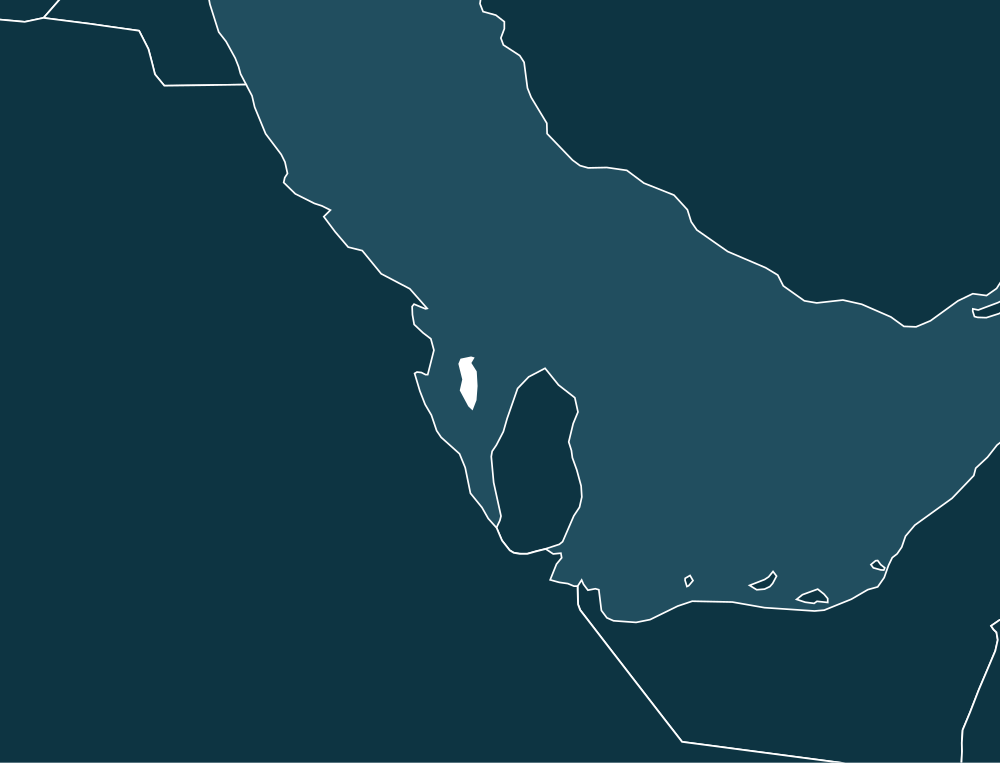
Risk Indicators
- FATF/EU Blacklist/Greylist (Lower Concern)
- Terrorism Financing (Lower Concern)
- US Dept of State INCSR
- Proliferation Financing
- Corruption
- Criminality
- Resilience & Governance
- Financial Transparency
- Offshore Finance Centres
- Sanctions
Background
Bahrain’s modern political identity reflects the long rule of the Sunni Al-Khalifa family, nineteenth-century treaties with the United Kingdom, and independence in 1971. As oil production and reserves declined, the archipelago pursued diversification through refining, aluminum, hospitality, retail, and a prominent role in Islamic finance. Its strategic position between larger Gulf powers and near Iran has encouraged careful diplomacy, generally aligned with Saudi Arabia and the UAE, while its designation as a major non-NATO ally in 2022 underscored deepening ties with the United States.
Domestic governance has also been shaped by enduring tensions between the Sunni royal family and the Shia-majority population, including the government response to 2011 reform protests and subsequent sporadic unrest. Bahrain’s regional posture is further influenced by the Gulf Cooperation Council, the Abraham Accords with Israel, and the 2023 Comprehensive Security Integration and Prosperity Agreement with the United States. Security and sanctions concerns surrounding Saudi Arabia, Qatar, Iran, and Yemen—including the war in Yemen, Iran-linked regional tensions, and evolving evasion networks—add complexity to Bahrain’s financial and geopolitical environment.
AML & Terrorist Financing
Bahrain is not listed by FATF as having strategic AML deficiencies, yet its 2022 follow-up assessment left the country in enhanced follow-up with a mixed pattern of compliance and only medium effectiveness across key outcomes. Its evolving risk picture includes cross-border proceeds, investment fraud, cash smuggling, fundraising and NPO-related terrorist financing concerns, while implementation gaps remain particularly visible among DNFBPs, in beneficial-ownership controls, suspicious transaction reporting and timely sanctions screening. The Central Bank of Bahrain, the Anti-Money Laundering Department and the Ministry of Industry and Commerce form the core institutional response, but questions surrounding proactive TF investigations, notification delays and the practical use of domestic designations add important complexity.
Sanctions
Bahrain is obligated to implement United Nations Security Council measures, including targeted financial, travel, arms, and commodity restrictions. Its financial and geographic infrastructure has nevertheless been associated with sanctions-evasion activity involving Iran, including the Future Bank scheme, wire stripping, maritime transfers, and links to networks connected with Syria and Yemen. International pressure and recent prosecutions have prompted stronger oversight, while no specific foreign sanctions imposed directly against Bahrain are identified.
Criminality
Bahrain maintains a formal anti-corruption framework, including the National Audit Office, the Ministry of Interior’s Anti-Corruption and Economic and Electronic Security Directorate, and criminal penalties for bribery and embezzlement, though conflict-of-interest rules may not be fully enforced. Crime concerns include significant human trafficking risks affecting migrant workers, synthetic drugs and counterfeit goods, illicit wildlife trade, and widespread phishing and online banking scams, with criminal activity generally linked to loose networks and foreign connections rather than entrenched mafia-style organizations.
Reports
Bahrain maintained strong anti-trafficking performance, with increased prosecutions, targeted victim screening, expanded shelter assistance, and a new labor-trafficking coordination task force, while passport retention, wage abuse, and limited protections for domestic workers remained concerns. Its security institutions also pursued regional counterterrorism cooperation through the Public Prosecution Office, Ministry of Interior, and international partners, including financial-crime seizures, an extradition, sanctions coordination, and enhanced maritime data sharing, amid no reported terrorist attacks.
Industry/Product Sector Risk
Bahrain’s regional financial hub presents significant exposure across retail and correspondent banking, money remittance, currency exchange, real estate, trade finance, and wealth management, with cross-border activity, cash, complex structures, and foreign proceeds recurring as key themes. The CBB framework, Sijilat beneficial-ownership records, and measures involving the Real Estate Regulatory Authority and Ministry of Industry, Commerce and Tourism reflect an evolving supervisory landscape spanning financial institutions, DNFBPs, digital channels, and high-value goods. Emerging concerns include virtual assets, NPO oversight, PEP-related corruption, trade-based laundering, fraud, smuggling, and the potential misuse of professional or corporate structures—offering only a glimpse of the sector-specific risk distinctions and control gaps identified for Bahrain.
Economy & Investment Climate
Bahrain offers a relatively stable, business-friendly economy that is gradually broadening beyond hydrocarbons through financial services, manufacturing, logistics, ICT, tourism, and other priority sectors supported by the Bahrain Economic Development Board and Mumtalakat. At the same time, state-owned enterprises remain influential, while fiscal pressures, evolving tax measures, labor-market requirements overseen by the LMRA, and ambitious Vision 2030 infrastructure plans create a landscape where opportunity is closely linked to regulation and government priorities.
Cryptocurrency Regulations
Bahrain permits cryptocurrency activity under the Central Bank of Bahrain’s Crypto Assets Module, with licensed VASPs subject to governance, risk management, AML/CFT controls, customer due diligence, and Travel Rule obligations, while digital assets remain outside the status of legal tender. Its framework also distinguishes token types and addresses exchanges, offerings, and asset-related taxation, creating a regulated but evolving environment shaped by investor-protection and international compliance considerations.
Get full access
The information on this page is a brief summary. Get access to EDD country reports, all risk category scores and customisable weightings for 245 jurisdictions.