
Risk Indicators
- FATF/EU Blacklist/Greylist (Lower Concern)
- Terrorism Financing (Lower Concern)
- US Dept of State INCSR
- Proliferation Financing
- Corruption
- Criminality
- Resilience & Governance
- Financial Transparency
- Offshore Finance Centres
- Sanctions
Background
Belarus emerged from the dissolution of the USSR in 1991 while maintaining unusually close political and economic ties with Russia, including a 1999 framework for a two-state union whose deeper implementation remains contested. Under Alyaksandr Lukashenka, who has led the country since 1994, power has become increasingly centralized as restrictions on political freedoms, civil society, media, assembly, and religion have persisted. The disputed 2020 presidential election intensified these pressures, with opposition protests suppressed and Lukashenka remaining in power.
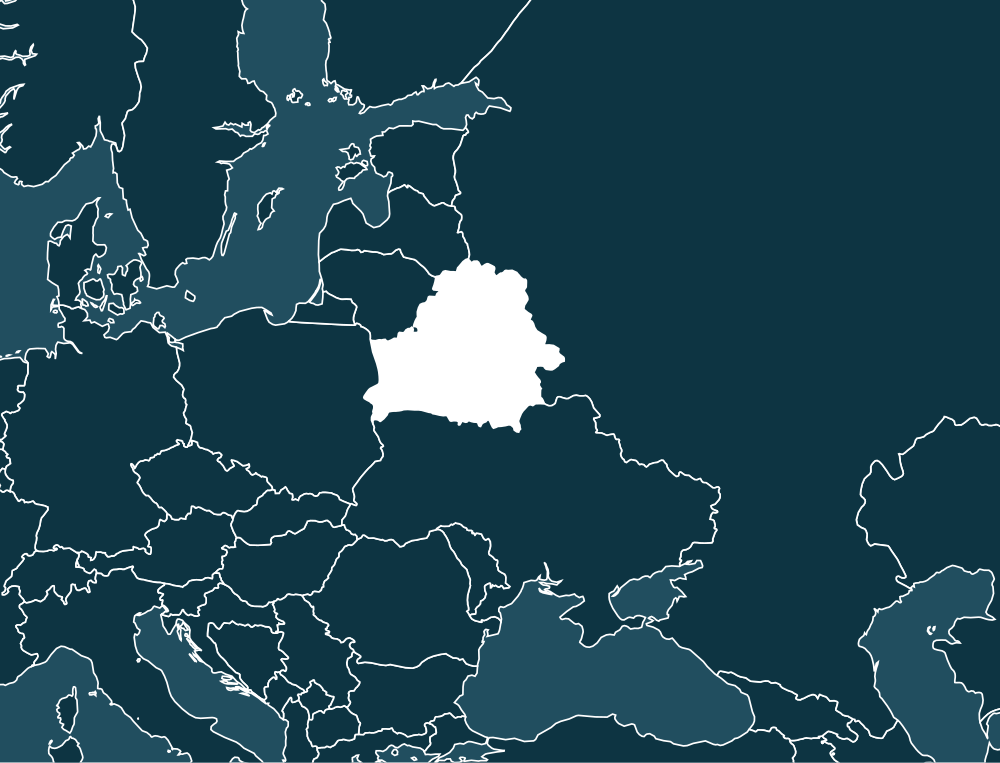
Positioned between Russia, Ukraine, Poland, Lithuania, and Latvia, Belarus occupies a strategically sensitive space shaped by the war in Ukraine, militarized borders, migration pressures, and widening sanctions. Its territory and commercial networks have supported Russia’s military operations and, according to Western authorities, contributed to the movement of restricted goods and dual-use technology. As EU and US measures target repression, electoral abuses, and war support, neighboring EU and NATO members have responded with tighter border controls and anti-circumvention efforts.
AML & Terrorist Financing
Belarus has a broadly established AML/CFT framework and is not listed by FATF as having strategic deficiencies, yet significant concerns remain around the quality of risk assessments, beneficial ownership transparency, cross-border threats, and the effectiveness of supervision and enforcement. The Department of Financial Monitoring, National Bank, and other authorities demonstrate strong access to financial intelligence and coordination, while gaps persist in statistics, confiscation outcomes, DNFBP controls, and the prevention of legal-entity abuse amid risks linked to corruption, tax offenses, shell companies, narcotics, and information-technology crimes. Terrorist-financing risks are considered low and authorities have developed effective preventive and targeted-sanctions mechanisms, but limited risk-based oversight and awareness within the NPO sector, along with uneven implementation among certain DNFBPs, remain notable vulnerabilities.
Sanctions
Belarus is described as implementing United Nations sanctions measures while also serving as a transit and facilitation hub for Russian sanctions evasion, rather than imposing a distinct set of country-specific sanctions of its own. Against Belarus, the United States—through OFAC—targeted 24 individuals and entities tied to the defense and financial sectors in February 2022, later redesignated Alyaksandr Lukashenka and designated his wife, while the EU, UK, and Canada expanded measures concerning human rights and democratic repression. The restrictions include asset blocking and transaction prohibitions, with related enforcement concerns involving Belarusian banks, ports, airports, EAEU trade routes, and the UK National Crime Agency’s warnings about diversion of high-priority goods through Belarus toward Russia.
Criminality
Belarus faces persistent corruption concerns, particularly in state administration, procurement, and state-run enterprises, while GRECO has cited failures to implement core safeguards and courts recorded 709 corruption-related convictions in 2024. Criminal activity also includes human trafficking, drug and counterfeit-goods markets, cyber-dependent offenses, money laundering, and networks linked to organized crime, although the true scale is difficult to assess amid limited judicial and institutional independence.
Reports
Belarus remains a Tier 3 country, with authorities reportedly subjecting at least 10,852 people—including individuals with addictions and political prisoners—to forced labor in “labor therapy centers,” while civil society support remains heavily restricted. Trafficking risks also affect Belarusian men working abroad, women recruited into the adult entertainment and hotel industries, Ukrainian children transferred to Belarus, and migrants moving through the country, with online scams and livestreamed exploitation emerging concerns amid limited official enforcement.
Industry/Product Sector Risk
Belarus’s industry landscape combines state-linked agriculture, manufacturing, infrastructure and transit activity with a banking system that holds roughly four-fifths of financial-sector assets, creating varied exposure across domestic and cross-border flows. The most pronounced concerns center on cash-intensive activity, retail banking, information technology, politics, public works and transportation, while the National Bank, the Security Council’s Interagency Commission for military-technical cooperation and export control, and the Ministry of Communications and Informatization feature in the supervisory and control environment. Across sectors, recurring themes include corruption, tax offences, smuggling, cyber-enabled fraud, opaque beneficial ownership, shell companies, trade mispricing and the movement of funds through cash, property, correspondent banking and regional logistics networks.
Economy & Investment Climate
Belarus’s economy achieved stronger-than-expected growth in 2024, supported by price controls and exports oriented largely toward Russia, but remains vulnerable to sanctions, Russian economic conditions, and global uncertainty. While the National Agency of Investments and Privatization promotes opportunities in areas ranging from advanced manufacturing to technology, state dominance, restricted capital movement, banking-sector pressures, and concerns highlighted by Moody’s and the U.S. Special 301 framework continue to shape the investment climate.
Cryptocurrency Regulations
Belarus permits cryptocurrency ownership, mining, trading, and token issuance under Presidential Decree No. 8, while the High Technologies Park and Department of Financial Monitoring oversee a framework emphasizing AML/CFT controls, KYC, recordkeeping, and client-fund segregation. A notably favorable tax regime and defined operating requirements coexist with unresolved areas—including Travel Rule adoption, VASP registration details, risk assessments, and limited consumer protections—leaving important practical questions for market participants.
Get full access
The information on this page is a brief summary. Get access to EDD country reports, all risk category scores and customisable weightings for 245 jurisdictions.