
Risk Indicators
- FATF/EU Blacklist/Greylist (Lower Concern)
- Terrorism Financing (Lower Concern)
- US Dept of State INCSR
- Proliferation Financing
- Corruption
- Criminality
- Resilience & Governance
- Financial Transparency
- Offshore Finance Centres
- Sanctions
Background
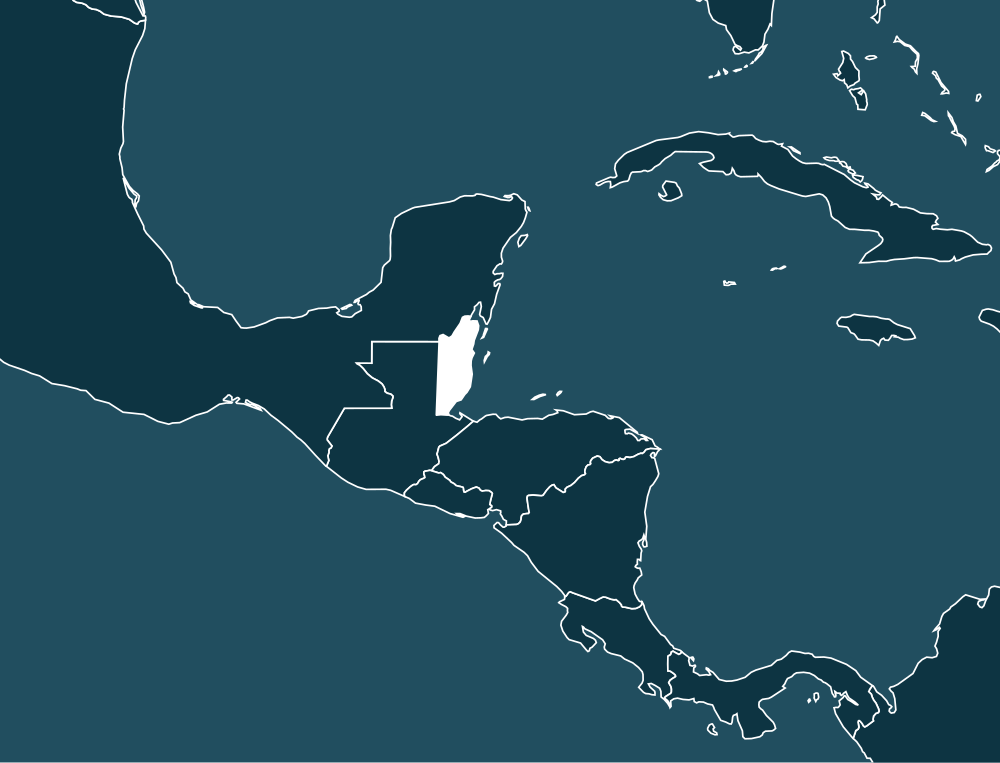
Belize’s history reaches from the era of Mayan city states through competing British and Spanish claims and its period as British Honduras. Independence in 1981 followed prolonged territorial tensions involving the United Kingdom and Guatemala, which did not formally recognize Belize until 1992 and remains engaged in a border dispute. Tourism now anchors the economy, alongside persistent pressures linked to foreign debt, crime, unemployment, demographics, drug trafficking, and HIV/AIDS.
Belize’s regional setting connects it to Mexico and Guatemala, neighboring states facing distinct but overlapping security and governance challenges. Mexico’s cartel activity, including operations associated with the Jalisco New Generation Cartel and Sinaloa Cartel, has drawn U.S. sanctions and continuing concerns about illicit trade and evasion. Guatemala’s democratic strain, corruption, judicial interference, and threats to civic actors have prompted targeted European Union measures, adding complexity to Belize’s surrounding political and security environment.
AML & Terrorist Financing
Belize has built a broadly comprehensive AML/CFT framework, reflected in its strong 2025 CFATF ratings, updated beneficial ownership requirements, and expanding powers under the Civil Asset Recovery and Unexplained Wealth Act. Yet important implementation challenges remain, including limited money-laundering prosecutions, uneven risk-based supervision by the FIU and FSC, underreporting of suspicious transactions in several sectors, and vulnerabilities involving real estate, free trade zones, cash businesses, and international financial services. Terrorist-financing and proliferation-financing controls are supported by simulation exercises, sanctions-screening mechanisms, and coordination among bodies such as the FIU, CBB, FSC, NTFSTF, and IMMARBE, although the absence of tested TF cases and the need for deeper inspections and practical training leave significant detail beneath the surface.
Sanctions
Belize supports United Nations Security Council sanctions regimes and implements measures associated with the Consolidated List, while no international sanctions are currently in force against Belize itself. At the same time, Belize is identified as a potential sanctions-evasion hub involving networks connected to Russia, North Korea, and, less directly, Iran and Venezuela. Offshore trusts, shell companies, the Corozal Free Zone, Belize’s maritime registry, and entities such as FFIN Belize and CILTrust International are cited among the structures and channels that may facilitate concealed finance, transshipment, and falsified trade activity.
Criminality
Belize faces persistent concerns involving public-sector corruption, limited enforcement, and criminal markets spanning trafficking, drugs, smuggling, and financial crime, with allegations frequently centered on procurement, political influence, and the use of shell corporations. The Office of the Ombudsman, Auditor General, Financial Intelligence Unit, and Integrity Commission provide avenues for oversight, though their capacity and the follow-through on investigations remain important areas of concern.
Reports
Belize is strengthening counter-narcotics operations through the Belize Police Department’s Anti-Narcotics Unit, the Mobile Interdiction Team, the Belize Coast Guard, and the Financial Intelligence Unit, with improved seizures, prosecutions, surveillance, and cooperation with the United States despite remote borders, limited resources, and coordination challenges. Human trafficking vulnerabilities remain widespread across tourism, agriculture, migration, and informal commercial activity, while the National Anti-Trafficking in Persons Committee has expanded victim support and planning but continues to face concerns involving official complicity, labor recruitment oversight, victim screening, and accountability.
Industry/Product Sector Risk
Belize’s industry risk landscape is shaped by cross-border finance, cash-intensive activity, and sectors linked to real estate, tourism, transportation, and professional services, with drug trafficking, fraud, corruption, tax evasion, and smuggling recurring concerns. Higher exposure appears in remittance services, currency exchange, securities, real estate, virtual assets, hospitality, and transportation, while the CBB, FIU, FSC, and OSIPP apply differing degrees of supervision and risk-based oversight. Recent measures—including the 2023 DNFBP and NPO frameworks, expanded supervisory efforts, and the VASP prohibition following targeted risk assessments—signal an evolving control environment with notable information and implementation gaps that merit closer examination.
Economy & Investment Climate
Belize’s compact, tourism-led economy expanded strongly in 2024, with services, business process outsourcing, and commerce helping offset weaker agricultural output, while a stable currency and improving banking access support international activity. The government is courting foreign investment through BELTRAIDE and related incentives, though investors still encounter a small market, high operating costs, administrative friction, land-title concerns, corruption, and exposure to external shocks.
Cryptocurrency Regulations
Belize is taking a cautious, evolving approach to cryptocurrency, with the Financial Services Commission restricting virtual asset activities and no licenses expected to be issued until December 31, 2025, while the Financial Intelligence Unit remains central to AML/CFT oversight. Although crypto is not legal tender and detailed rules for exchanges, token offerings, and taxation remain limited, developments such as the November 2023 National Risk Assessment and planned 2027 adoption of CARF suggest a gradual move toward greater transparency and international alignment.
Get full access
The information on this page is a brief summary. Get access to EDD country reports, all risk category scores and customisable weightings for 245 jurisdictions.