
Risk Indicators
- FATF/EU Blacklist/Greylist (Higher Concern)
- Terrorism Financing (Lower Concern)
- US Dept of State INCSR
- Proliferation Financing
- Corruption
- Criminality
- Resilience & Governance
- Financial Transparency
- Offshore Finance Centres
- Sanctions
Background
Bolivia emerged from Spanish rule in 1825 under the legacy of Simón Bolívar, later enduring repeated coups before civilian democratic rule took hold in 1982. Its political development has been shaped by persistent poverty, social unrest, illegal drug production, and the rise of Evo Morales and the Movement Toward Socialism. After a disputed path toward Morales’s attempted 2019 reelection, an interim administration under Jeanine Añez Chávez oversaw elections that brought Luis Alberto Arce Catacora to the presidency.
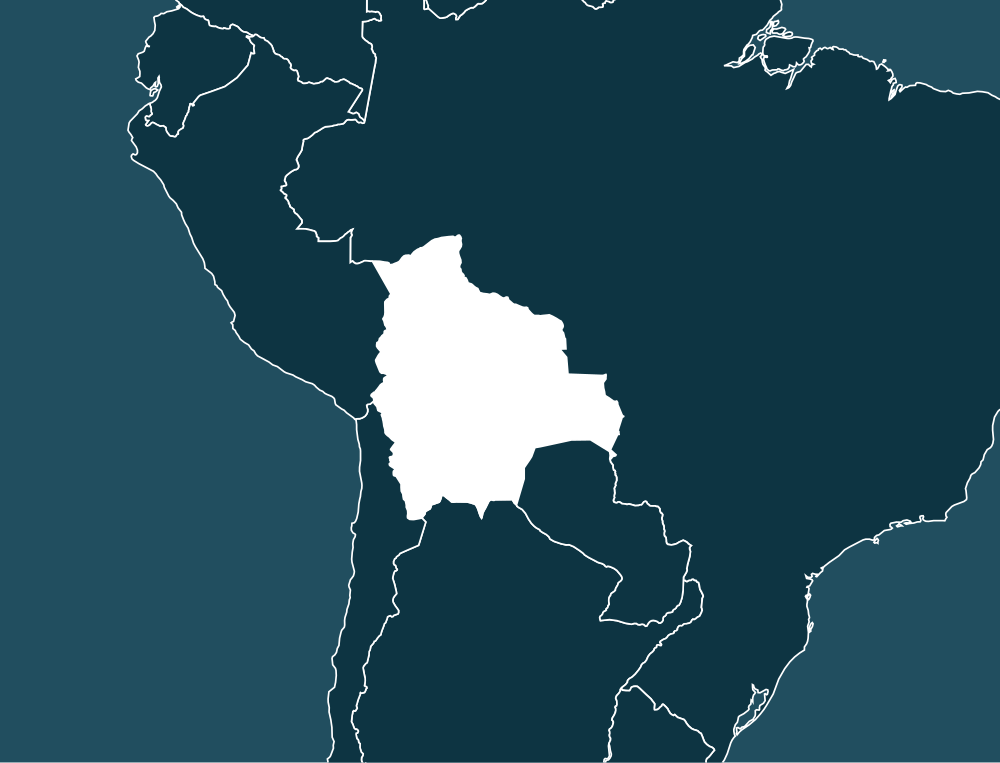
Today, Bolivia faces intense political rivalry, economic strain, and institutional uncertainty, with consequences extending across its borders with Argentina, Brazil, Chile, Paraguay, and Peru. Concerns range from protests, migration pressures, drug trafficking, and illicit financial flows to Argentina’s unease over Bolivia’s security relationship with Iran and Brazil’s exposure to cross-border money laundering. Bolivia’s opposition to U.S. sanctions on Cuba, Venezuela, and Nicaragua, together with its broader regional alignments, adds another layer to its complicated relations with neighboring states and international partners.
AML & Terrorist Financing
Bolivia remains subject to FATF scrutiny and was added to the European Commission’s high-risk jurisdictions list in January 2026, despite ongoing efforts through FATF and GAFILAT. Money-laundering exposure is linked to drug trafficking, corruption, smuggling, illegal gold mining, environmental and tax crimes, informal currency exchange, porous borders, and emerging virtual-asset activity, while beneficial-ownership transparency and oversight of certain DNFBPs remain uneven. The UIF, ASFI, police, and Public Ministry have developed important coordination and reporting mechanisms, yet gaps in investigative tools, institutional capacity, judicial effectiveness, terrorist-financing safeguards, and the pursuit of complex laundering cases continue to shape Bolivia’s risk profile.
Sanctions
Bolivia is required to implement United Nations sanctions measures, although no international sanctions are currently in force against Bolivia itself. Its potential role in sanctions evasion has drawn attention through YPFB’s brief 2025 cryptocurrency-payment initiative, later prohibited by Executive Order 5399, and reported links involving Venezuelan entities such as PDVSA. Regional trade corridors, including Chilean ports and overland routes through Peru and Brazil, add complexity, though documented evidence of evasion through these pathways remains limited.
Criminality
Corruption remains a serious national challenge in Bolivia, with the GIEI and IACHR identifying persistent political interference, due-process concerns, and limited accountability for pro-government officials despite formal protections and the involvement of the Ministry of Justice and Institutional Transparency. Criminal markets—including trafficking, illegal mining, contraband, procurement fraud, and drug activity—are facilitated by weak institutions, compromised public contracting, and limited investigative capacity, while the judiciary, police, and security forces continue to face distrust and significant operational shortcomings.
Reports
Bolivia remains a major coca and cocaine production and transit hub, with FELCN reporting substantial seizures and laboratory destruction alongside continued concerns over excess cultivation, criminal exploitation of legal coca markets, corruption, and limited disruption of high-level trafficking networks. Trafficking risks span forced labor and sexual exploitation at home and abroad, particularly affecting Indigenous, rural, displaced, migrant, and mining-community populations, while scarce victim services, official complicity, and gaps in prosecution contributed to a Tier 2 Watch List designation.
Industry/Product Sector Risk
Bolivia’s financial and broader commercial landscape presents significant exposure to money laundering through cash-intensive activity, cross-border transfers, trade, real estate, mining, construction and transportation, with drug trafficking, smuggling, corruption, tax offences and fraud recurring as key drivers. The framework includes oversight by the FIU, financial and securities supervisors, and the Gaming Supervisory Authority, although coverage, beneficial-ownership transparency and risk-based supervision remain uneven across sectors. Emerging digital channels, informal businesses, public contracting and resource-based industries add further complexity, while the country’s porous borders and substantial informal economy create avenues for illicit proceeds to enter, move through and blend into legitimate activity.
Economy & Investment Climate
Bolivia’s economy is navigating severe foreign-exchange and fuel shortages, rising inflation, depleted reserves, and fiscal pressure, within a state-led model dominated by subsidies and more than 60 state-owned enterprises. While agriculture, lithium, mining, energy, and related technologies offer potential, investors must weigh dollar-access constraints, informal-market distortions, regulatory and judicial uncertainty, and the oversight roles of institutions such as the BCB, ASFI, AEMP, SEPREC, and SENAPI.
Cryptocurrency Regulations
Bolivia’s June 2024 shift from prohibition to permitting crypto transactions through electronic payment channels places digital assets in a cautiously emerging framework, with the Boliviano retaining exclusive legal-tender status and the Central Bank of Bolivia, ASFI, and UIF overseeing broader compliance concerns. With no dedicated VASP registry, explicit Travel Rule, comprehensive token or ICO rules, or specialized crypto-tax tracking system, treatment currently relies heavily on general AML and tax principles—including a 25% rate for mining and trading income—while further regulatory development remains possible.
Get full access
The information on this page is a brief summary. Get access to EDD country reports, all risk category scores and customisable weightings for 245 jurisdictions.