
Risk Indicators
- FATF/EU Blacklist/Greylist (Lower Concern)
- Terrorism Financing (Lower Concern)
- US Dept of State INCSR
- Proliferation Financing
- Corruption
- Criminality
- Resilience & Governance
- Financial Transparency
- Offshore Finance Centres
- Sanctions
Background
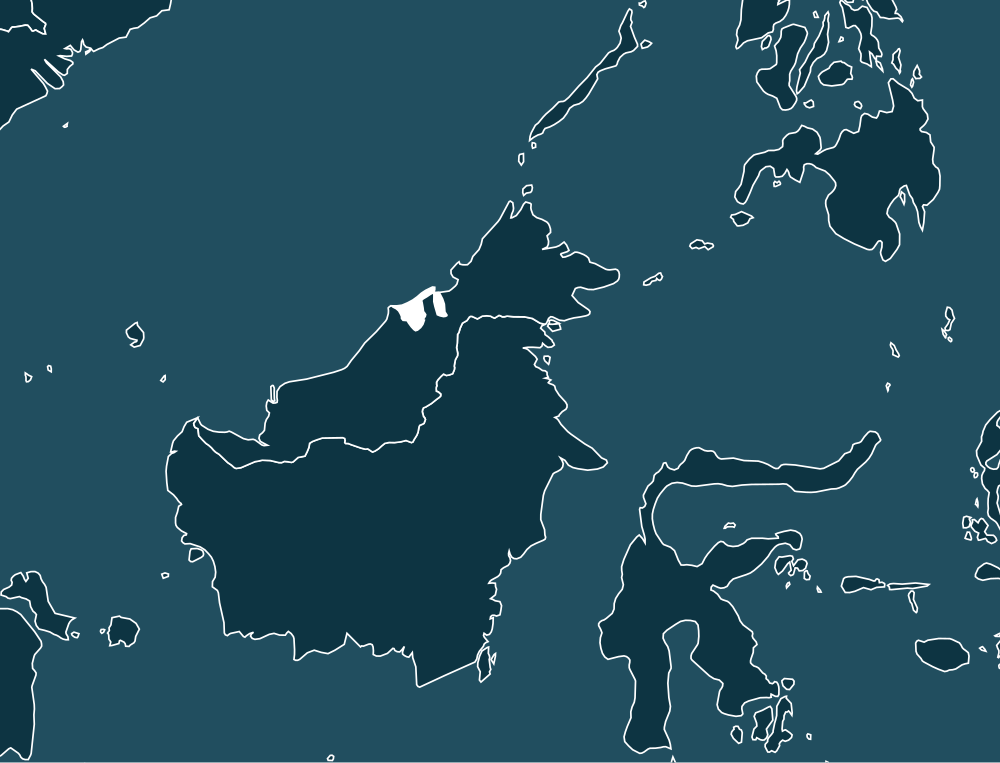
Brunei Darussalam’s historical influence once extended across parts of northwest Borneo and the southern Philippines before succession disputes, European expansion, and piracy ushered in a period of decline. After becoming a British protectorate in 1888, it achieved independence in 1984, while the same ruling family has remained in power for more than six centuries. Petroleum and natural gas reserves underpin one of the world’s highest per-capita GDP levels, alongside the enduring prominence of Sultan Hassanal Bolkiah.
Politically stable and largely insulated from direct security threats, Brunei borders Malaysia by land and sea and China by sea, with final aspects of its Malaysian boundary demarcation expected by 2034. Conditions in neighboring Malaysia include political polarization, ethnic and religious tensions, Sabah-based militant and kidnapping risks, and activity associated with the Eastern Sabah Security Zone. The surrounding maritime environment also features sanctions-evasion concerns involving Russia and Iran, including transshipment networks, although Brunei itself has not been directly implicated.
AML & Terrorist Financing
Brunei Darussalam is not identified by FATF as having strategic AML deficiencies, and its 2023 assessment found a generally strong framework supported by the BDCB, FIU, and NAMLC, although effectiveness varies across key areas. Regional exposure to illicit financial flows, higher-risk banking and remittance activity, emerging virtual-asset services, and challenges involving beneficial-ownership transparency and DNFBP supervision remain relevant concerns. Terrorist-financing prevention and targeted sanctions are comparatively well supported despite no investigations to date, while proliferation-financing controls remain a notable weakness pending the full implementation of the relevant framework.
Sanctions
Brunei Darussalam implements United Nations sanctions, including targeted financial measures related to terrorism, but maintains no autonomous sanctions list or additional international regimes. Oversight involves the Financial Intelligence Unit and Brunei Darussalam Monetary Authority under frameworks including the Anti-Terrorism (Terrorist Financing) Regulations 2013, with no documented state-enabled sanctions-evasion networks or transit routes. No international sanctions are currently in force against Brunei, although its 2024 U.S. Tier 3 human-trafficking designation reflects separate compliance concerns and could carry non-humanitarian consequences.
Criminality
Brunei Darussalam reports generally low levels of corruption, supported by the Prevention of Corruption Act and the Anti-Corruption Bureau, though recent fraudulent investment schemes, bribery cases involving public officials, and limited financial transparency remain areas of concern. Criminal activity is more evident in illicit markets involving methamphetamine, trafficking and exploitation of migrant workers, smuggled excise goods, counterfeit products, illegal fishing, and occasional foreign-linked syndicates.
Reports
Brunei Darussalam has strengthened its anti-trafficking response, including through an updated National Action Plan, expanded investigations, victim services, and cooperation to repatriate vulnerable individuals, prompting an upgrade to Tier 2 Watch List. Yet persistent concerns remain around the absence of convictions under the anti-trafficking law, limited victim identification and screening, and exploitation risks affecting migrant workers through recruitment debt, wage withholding, passport retention, forced labor, and sex trafficking.
Industry/Product Sector Risk
Brunei Darussalam’s industry risk landscape is shaped by a largely cash-based economy, with retail banks, money-changing and remittance businesses, high-value dealers, real estate, and trade finance presenting varied exposure to fraud, corruption, smuggling, and cross-border financial flows. BDCB, the FIU, and ROCBN feature in a framework that also considers emerging virtual-asset activity, beneficial-ownership transparency, charitable transfers, and the distinctive risks associated with oil and gas, public works, and politically exposed environments. The most notable themes involve movement of value across borders, the use of companies and property to obscure ownership, and evolving controls for technology-enabled finance and higher-risk sectors.
Economy & Investment Climate
Brunei Darussalam combines substantial hydrocarbon wealth, a stable political environment, strong infrastructure, and generous citizen benefits with an economy still highly concentrated in petroleum, natural gas, and petrochemicals. Diversification initiatives led by the Brunei Economic Development Board, streamlined business registration, foreign-ownership flexibility, and emerging opportunities across technology, construction, agribusiness, and services are balanced by regulatory opacity, state-linked dominance, labor controls, and limited transparency surrounding the Brunei Investment Agency.
Cryptocurrency Regulations
In Brunei Darussalam, cryptocurrency remains outside legal-tender status, while the Brunei Darussalam Central Bank (BDCB) develops a framework for licensing and supervision amid limited specific rules for exchanges, tokens, and virtual asset providers. Existing AML/CFT obligations, Financial Intelligence Unit scrutiny, and an uncertain approach to transaction taxation—including a potential 10% capital-gains treatment—signal a cautious environment shaped by consumer-protection concerns and evolving international standards.
Get full access
The information on this page is a brief summary. Get access to EDD country reports, all risk category scores and customisable weightings for 245 jurisdictions.