
Risk Indicators
- FATF/EU Blacklist/Greylist (Higher Concern)
- Terrorism Financing (Lower Concern)
- US Dept of State INCSR
- Proliferation Financing
- Corruption
- Criminality
- Resilience & Governance
- Financial Transparency
- Offshore Finance Centres
- Sanctions
Background
Bulgaria’s history reflects successive periods of state formation, imperial pressure, national independence, and Soviet-aligned rule before its transition toward multiparty democracy and a market economy in 1990. The country’s modern development has been shaped by efforts to address inflation, unemployment, corruption, and crime while deepening ties with NATO, the European Union, and the Schengen Area. Its strategic position in the Balkans continues to connect domestic security concerns with wider regional developments.
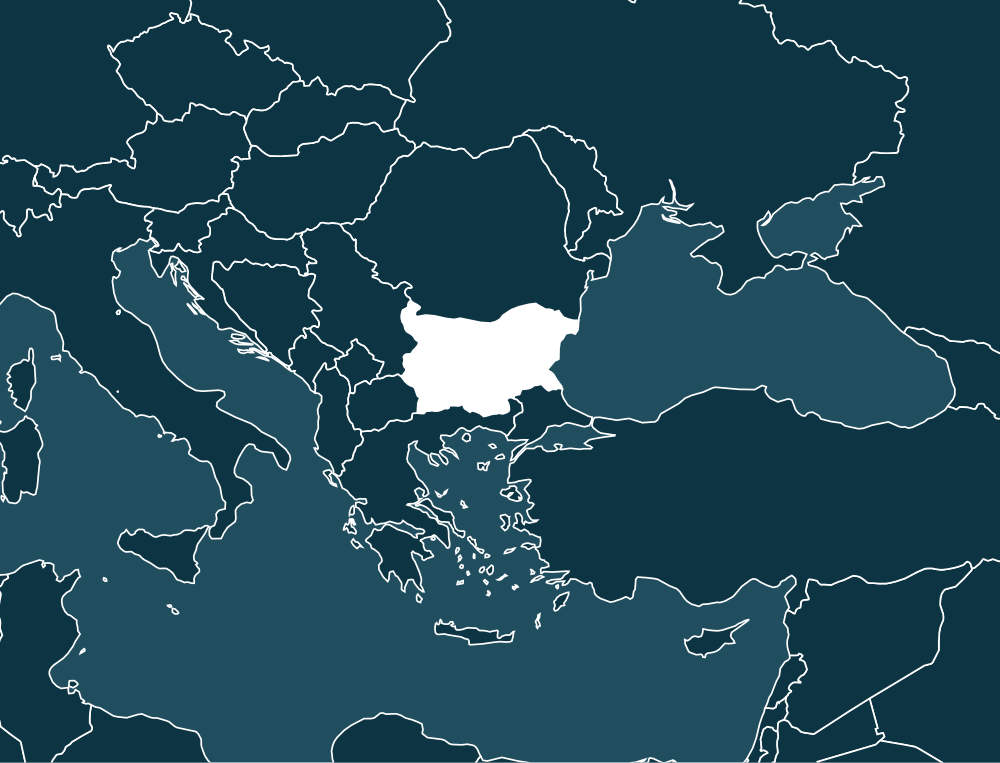
Bulgaria borders a mix of generally stable and more unsettled environments, with Western Balkan tensions, Russian influence, migration pressures, and hybrid threats contributing to a complex security landscape. Regional trade routes also create exposure to sanctions-evasion risks involving Russia and Belarus, including cases concerning dual-use goods and organized networks moving through neighboring states. Serbia, North Macedonia, Turkey, Romania, and Greece each present distinct political, security, or compliance considerations that can affect Bulgaria.
AML & Terrorist Financing
Bulgaria remains under FATF scrutiny for strategic AML deficiencies, despite recent MONEYVAL follow-up findings that recognize progress in technical compliance and reforms under a national action plan. Persistent concerns include limited risk data and TF understanding, uneven risk-based supervision, weak or low-quality suspicious transaction reporting, beneficial ownership accuracy, and modest results in complex money-laundering investigations, prosecutions, and confiscation. SANS and its Financial Intelligence Directorate, alongside the BNB and other supervisors, face continuing challenges involving organized crime, corruption, cash-based activity, non-bank sectors, NPO vulnerabilities, and proliferation-financing sanctions implementation.
Sanctions
Bulgaria applies UN and EU restrictive measures domestically, including asset freezes, travel bans, sectoral controls, and arms-related restrictions, while facing scrutiny over enforcement and sanctions-evasion risks linked to Russia and Iran. U.S. action under Executive Order 14024 designated Lukoil’s Bulgarian entities, including Lukoil Neftochim Burgas AD and Lukoil Bulgaria EOOD, while the UK’s OFSI issued a general licence permitting continued operations with those companies through 13 August 2026. No international sanctions are currently in force against Bulgaria as a country, although the European Commission began infringement proceedings over delayed implementation of Directive 2024/1226 and U.S. measures have targeted Bulgarian-linked networks such as U-Stone Limited EOOD and certain individuals.
Criminality
Corruption remains persistent in Bulgaria, with inconsistent enforcement of asset-declaration and conflict-of-interest rules, few convictions of senior officials, and prolonged uncertainty surrounding the leadership of the restructured Anti-Corruption Commission. Concerns remain especially pronounced in public procurement, politically sensitive prosecutions, and illicit financial flows, while the OECD and FATF have identified weaknesses in asset recovery and anti-money-laundering controls; civic investigators such as the Anti-Corruption Fund also face reported threats and intimidation.
Reports
Bulgaria remained on Tier 2 as the National Commission for Combating Trafficking in Human Beings expanded investigations, victim services, funding, and prevention initiatives, even as suspended sentences, limited shelter support, and inconsistent screening continued to raise concerns amid widespread sex and labor trafficking risks. Terrorist activity remained low with no reported attacks, while Bulgarian authorities strengthened border controls, biometric screening, and international information-sharing to address foreign-fighter transit and smuggling networks, though capability gaps and unresolved repatriation issues persisted.
Industry/Product Sector Risk
Bulgaria’s financial and non-financial sectors present a varied risk landscape, with particularly pronounced exposure in retail banking, casinos, currency exchange, money remittance, real estate, trade finance, fuel trading, construction, and transport, while cash use, cross-border activity, shell companies, and beneficial-ownership weaknesses recur across multiple areas. The Bulgarian National Bank, National Revenue Agency, Financial Supervision Commission, FID-SANS, and Communications Regulation Commission each play roles in oversight, though the maturity and reach of risk-based supervision differ significantly between sectors. Further detail reveals how corruption, VAT and customs fraud, organised crime, cyber-enabled scams, public-fund diversion, and potential terrorism-financing channels intersect with Bulgaria’s trade routes, shadow economy, digital services, and infrastructure spending.
Economy & Investment Climate
Bulgaria combines relatively low operating costs, 10 percent flat corporate and income tax rates, expanding public investment, and incentives administered through the Invest Bulgaria Agency, with a growing manufacturing, services, automotive, and technology base. Yet labor shortages, demographic decline, inflation, uneven regulatory enforcement, and persistent concerns surrounding the judiciary and intellectual-property protection create a complex investment environment as the country moves toward its stated 2026 Eurozone goal and continues OECD accession reforms.
Cryptocurrency Regulations
Bulgaria permits cryptocurrency activity while treating digital assets as financial assets rather than legal tender, with the National Revenue Agency, Financial Supervision Commission, and Bulgarian National Bank sharing important supervisory roles. VASPs face registration, AML/KYC, record-keeping, and taxation obligations, while developments involving the Travel Rule, MiCA, the draft BCAM, and Bulgaria’s planned 2027 adoption of CARF point toward more structured oversight.
Get full access
The information on this page is a brief summary. Get access to EDD country reports, all risk category scores and customisable weightings for 245 jurisdictions.