
Risk Indicators
- FATF/EU Blacklist/Greylist (Medium Concern)
- Terrorism Financing (Medium Concern)
- US Dept of State INCSR
- Proliferation Financing
- Corruption
- Criminality
- Resilience & Governance
- Financial Transparency
- Offshore Finance Centres
- Sanctions
Background
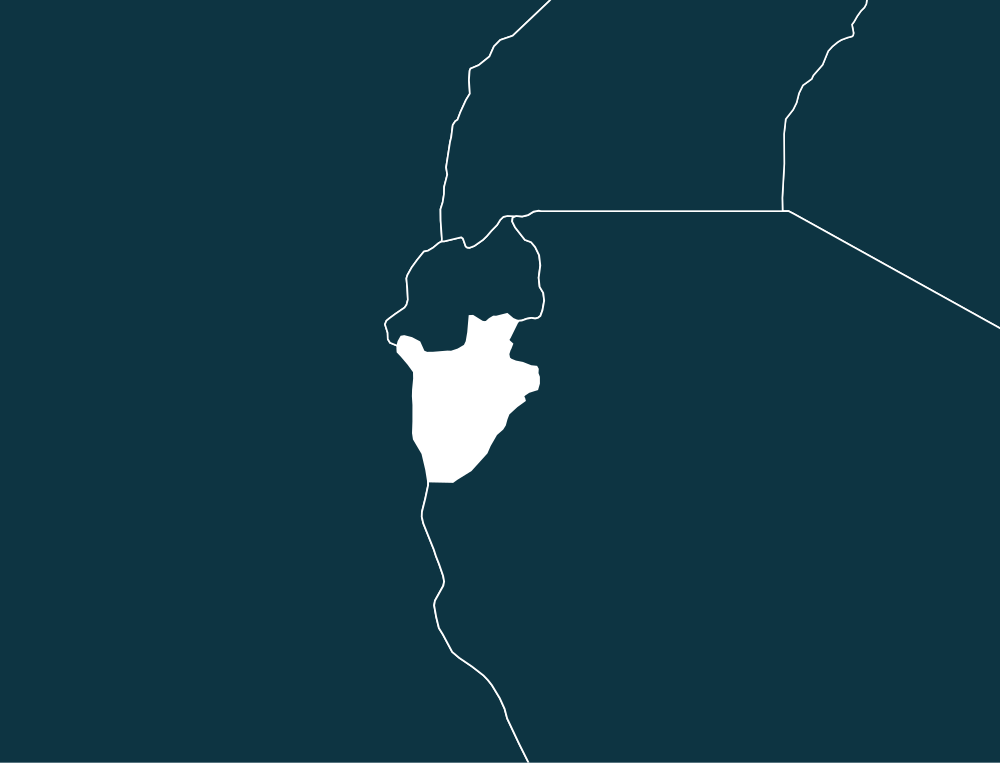
Established in the 1600s, the Burundi Kingdom retained borders resembling those of modern Burundi while developing a complex social structure shaped by regional, class, and clan distinctions. Colonial administration, the murder of Louis RWAGASORE, and successive crises involving Hutu and Tutsi political and military forces contributed to decades of instability, including the upheavals of 1972 and 1993. The Arusha Agreement and later cease-fires helped end the civil war, followed by the presidencies of Pierre NKURUNZIZA and Evariste NDAYISHIMIYE.
Burundi’s contemporary security environment remains closely linked to its neighbors, especially the escalating conflict in eastern DRC, refugee movements, and strained relations with Rwanda. Tanzania continues to have a regional role through mediation and refugee hosting, while border areas involving all three neighbors remain vulnerable to armed activity, illicit trade, and smuggling. Targeted EU sanctions, past regional pressure, and the stated improvements of the Burundi Revenue Authority offer further insight into the country’s political and economic challenges.
AML & Terrorist Financing
Burundi is not currently identified by FATF as having strategic AML deficiencies, but it has not completed a mutual evaluation and practical safeguards remain difficult to assess. Although the Bank of the Republic of Burundi, the CNRF, the Financial Crime Unit, and OLUCOME have defined roles, limited resources, weak enforcement, corruption concerns, and uncertain operational capacity have constrained investigations and reporting. A largely unbanked population increasingly using mobile remittances, alongside restricted beneficial-ownership transparency and limited evidence of terrorist-financing controls, adds complexity to the country’s financial-crime risk landscape.
Sanctions
Burundi is not identified as imposing autonomous sanctions on other nations, although it is obligated as a UN member to implement applicable Security Council measures. External pressure has largely receded: OFAC terminated its program in November 2021, the UK revoked its regime in May 2024, and no UN, Canadian, Australian, Japanese, New Zealand, Arab League, or comparable measures are active. The EU framework remains formally in force through 31 October 2026 under Council Decision (CFSP) 2025/1941, with Switzerland and several European states aligned, yet the EU–Burundi designated-persons list was empty as of 22 September 2025 following the removal of Mathias-Joseph Niyonzima.
Criminality
Burundi faces entrenched corruption involving political elites, connected businesses, public officials, and customs authorities, with opaque licensing, concessions, procurement, and cross-border trade frequently linked to bribery, favoritism, embezzlement, and illicit financial transfers. Although laws criminalize corruption, money laundering, and influence peddling, enforcement remains uneven, while bodies such as the Central Bureau for Criminal Investigations and Fighting Corruption, the CNRF, and OLUCOME operate amid allegations of trafficking, illegal gold mining, smuggling, and collusion between state and private-sector actors.
Reports
Burundi is making notable progress against human trafficking, including increased investigations, convictions, victim identification, funding, and restitution, while persistent vulnerabilities affect children, refugees, rural women, and migrants across domestic, agricultural, fishing, and overseas labor and sex-trafficking routes. At the same time, the Judicial Police and a small multi-agency counterterrorism unit face limited resources, porous borders, corruption, and weak financial oversight, with regional security commitments continuing alongside unresolved institutional gaps.
Economy & Investment Climate
Burundi’s economy remains heavily dependent on subsistence agriculture, with modest growth, declining traditional exports, and significant potential in agriculture, mining, energy, and regional infrastructure. Yet severe foreign-exchange shortages, rapidly rising inflation, limited electrification, corruption, and the January 2025 end of the IMF program continue to complicate business, even as the Burundi Development Agency and other institutions pursue investment and industrialization initiatives.
Cryptocurrency Regulations
Burundi maintains a firm prohibition on cryptocurrencies, anchored by statements from the Bank of the Republic of Burundi in September 2019 and a conventional AML framework under Law No. 1/23 of June 23, 2014, with no licensed exchanges, VASPs, or applicable Travel Rule obligations. Beyond the ban, significant uncertainty surrounds taxation, token offerings, transaction monitoring, and future alignment with initiatives such as CARF, leaving digital-asset activity outside the country’s established financial oversight structure.
Get full access
The information on this page is a brief summary. Get access to EDD country reports, all risk category scores and customisable weightings for 245 jurisdictions.