
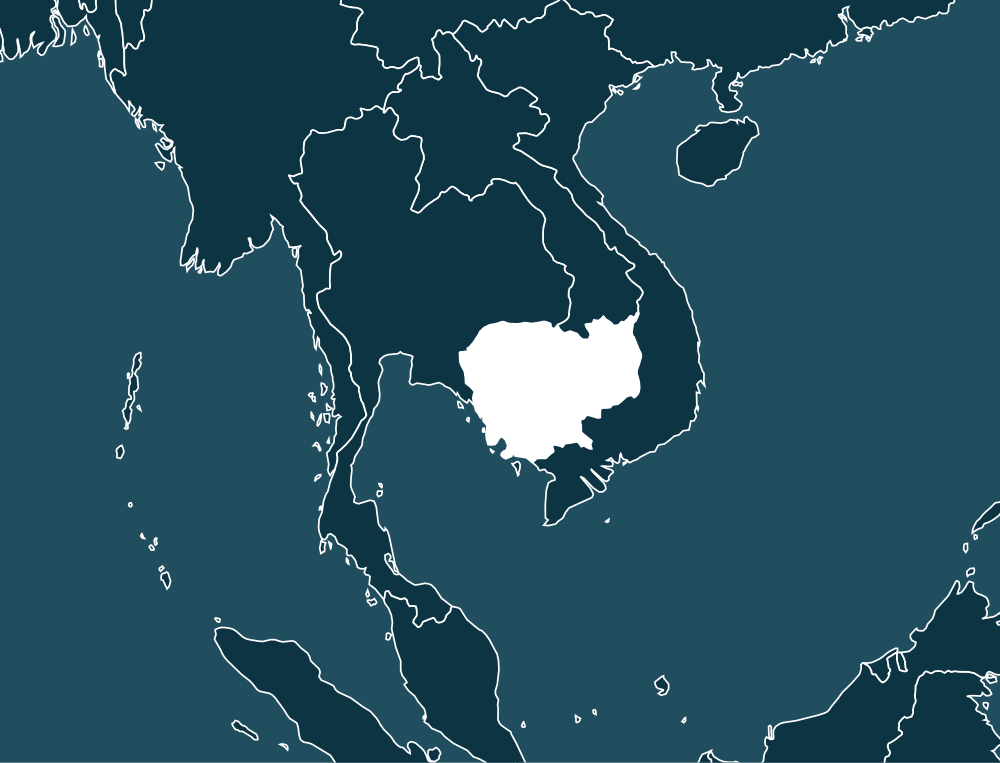
Risk Indicators
- FATF/EU Blacklist/Greylist (Lower Concern)
- Terrorism Financing (Lower Concern)
- US Dept of State INCSR
- Proliferation Financing
- Corruption
- Criminality
- Resilience & Governance
- Financial Transparency
- Offshore Finance Centres
- Sanctions
Background
Cambodia’s modern identity is rooted in the Khmer legacy of the Angkor Empire, but its history also reflects colonial rule, devastating conflict, and a difficult transition toward constitutional monarchy and multi-party politics. The Khmer Rouge era, the Vietnamese occupation, and the UN-backed tribunal that concluded with three convictions continue to shape the country’s political and social landscape. Since Hun Sen’s transfer of the premiership to Hun Manet in 2023, the Cambodian People’s Party has remained central to power amid concerns involving governance, civil society, media freedom, and economic dependence.
Cambodia’s regional environment is influenced by its borders with Thailand, Vietnam, and Laos, each presenting a distinct combination of political, security, and economic considerations. Sensitive sites such as Preah Vihear and Ta Moan Thom, lingering border questions with Vietnam, and the generally quieter frontier with Laos illustrate the varied nature of these relationships. At the same time, scrutiny of sanctions, transshipment, and alleged evasion networks involving neighboring states adds a less visible dimension to Cambodia’s regional risk landscape.
AML & Terrorist Financing
Cambodia has made significant AML/CFT progress and exited FATF increased monitoring, yet APG enhanced follow-up continues amid uneven effectiveness across supervision, financial intelligence, investigations, prosecutions, and confiscation. Serious vulnerabilities remain linked to casinos, real estate, banking, remittance, special economic zones, cash smuggling, fraud, corruption, trafficking, drugs, and trade-based laundering, with CAFIU facing challenges in producing and disseminating actionable intelligence. The roles of CAFIU, the National Bank of Cambodia, the Anti-Corruption Unit, and the Ministry of Commerce are central, particularly as beneficial-ownership transparency, DNFBP oversight, terrorist-financing controls, and proliferation-financing sanctions remain areas requiring close attention.
Sanctions
Cambodia is required to implement UN sanctions and has taken enforcement action, including the 2020 seizure of the tanker Courageous over suspected North Korea-related ship-to-ship transfers. No international sanctions are currently in force against Cambodia as a country, and the U.S. defense trade embargo was lifted in late 2025, although military end-use restrictions remain. Foreign authorities have nevertheless targeted Cambodia-linked individuals, companies, and financial networks—including designations by OFAC and the UK, and FinCEN’s Section 311 action against Phnom Penh-based Huione Group—amid concerns involving forced-labor scam compounds, money laundering, and sanctions evasion.
Criminality
Corruption in Cambodia is described as endemic, with opaque processes and informal payments affecting business dealings, particularly in the judiciary, customs services, and tax authorities, despite the Anti-Corruption Unit’s investigative and educational role. Organized criminal activity spans trafficking, online fraud, illegal resource exploitation, drug transit, and money laundering through casinos and special economic zones, with local complicity and official protection repeatedly cited as concerns.
Reports
Cambodia remains a significant regional center for methamphetamine, ketamine, and other illicit drugs, with the National Authority for Combating Drugs recording dramatic increases in several seizure categories and thousands of treatment admissions dominated by methamphetamine use. Human trafficking concerns are especially acute in online scam compounds linked to organized crime, while migrant labor, debt bondage, sexual exploitation, and forced labor in sectors ranging from fishing to brick kilns continue to affect Cambodian and foreign nationals amid limited accountability and victim protection.
Industry/Product Sector Risk
Cambodia’s financial and commercial landscape presents a varied risk profile, shaped by a highly cash-based economy, cross-border activity, and expanding sectors such as casinos, real estate, construction, remittances, and telecommunications. While commercial banks and certain internationally connected firms show more developed controls, significant gaps remain among smaller casinos, money changers, mobile payment agents, DNFBPs, and informal businesses, with supervision by bodies including the NBC, CAFIU, MEF, and SECC still developing unevenly. The resulting exposure spans corruption, fraud and scams, drug and human trafficking, illegal logging, wildlife crime, and goods and cash smuggling, creating a complex environment in which property, trade, transport, corporate structures, and cash-intensive channels may all play a role.
Economy & Investment Climate
Cambodia’s economy is expanding on the back of recovering tourism, hospitality, manufacturing, and substantial foreign investment, with the World Bank projecting 5.5 percent growth in 2025 and the National Bank of Cambodia anticipating somewhat higher inflation. The Council for the Development of Cambodia continues to offer broad investment incentives and facilitate special economic zones, while regulatory opacity, infrastructure costs, skills shortages, financial-sector vulnerabilities, and the concentration of FDI from China remain important features of the business environment.
Cryptocurrency Regulations
Cambodia maintains a cautious and largely restrictive cryptocurrency environment, with the National Bank of Cambodia’s December 2024 framework permitting limited engagement with stablecoins and tokenized traditional assets while unbacked assets remain prohibited and oversight by the NBC and SECC continues to evolve. The General Department of Taxation treats crypto as intangible property, including a 20% tax on gains, yet the absence of a comprehensive compliance registry, explicit Travel Rule or CARF adoption, and clear VASP and ICO procedures leaves important details unresolved.
Get full access
The information on this page is a brief summary. Get access to EDD country reports, all risk category scores and customisable weightings for 245 jurisdictions.