
Risk Indicators
- FATF/EU Blacklist/Greylist (Higher Concern)
- Terrorism Financing (Medium Concern)
- US Dept of State INCSR
- Proliferation Financing
- Corruption
- Criminality
- Resilience & Governance
- Financial Transparency
- Offshore Finance Centres
- Sanctions
Background
Cameroon emerged from powerful precolonial chiefdoms, German rule as Kamerun, and the post–World War I division between French and British mandates. Independence, reunification with the southern portion of British Cameroon, and the 1972 transition from federation to a unitary state shaped its modern political structure. Agriculture, transport, and petroleum have supported relative stability, while unrest in the two western English-speaking regions and the continued dominance of President Paul BIYA point to unresolved tensions.
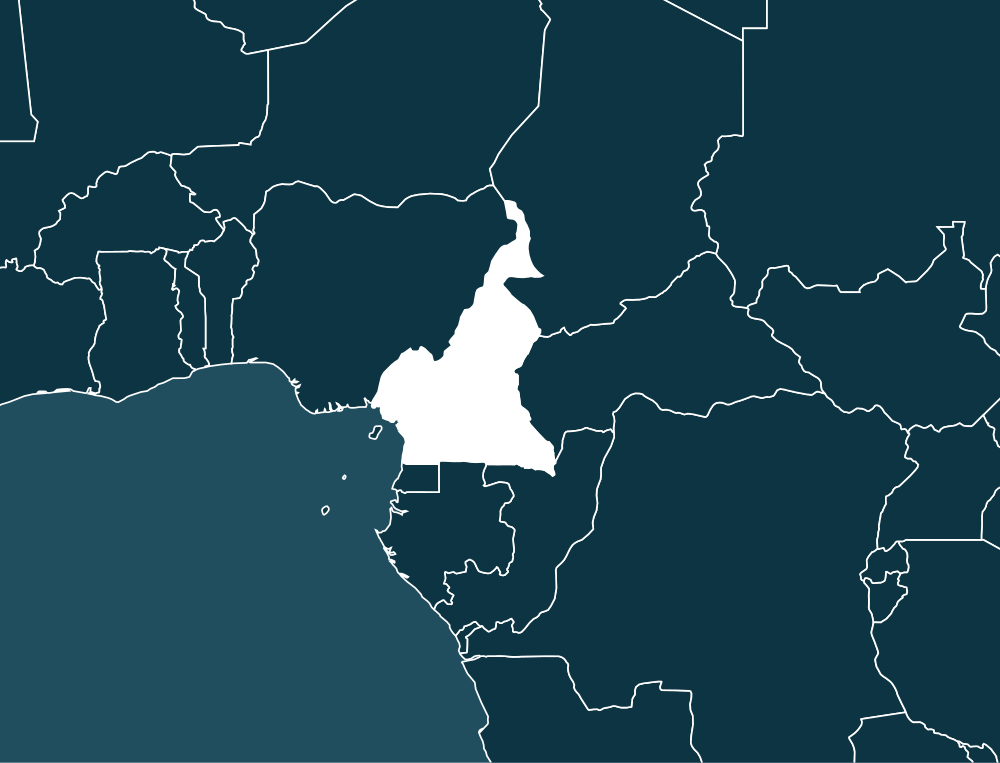
Its position between Nigeria, Chad, the Central African Republic, Equatorial Guinea, Gabon, and the Republic of the Congo places Cameroon amid overlapping security and governance pressures. Spillovers include jihadist violence in the Far North, refugee movements and arms trafficking from Chad and the Central African Republic, and political uncertainty following events in Gabon and Equatorial Guinea. Porous borders, uneven enforcement, and the July 2024 lifting of the Central African Republic’s UN arms embargo add to concerns involving illicit finance, cross-border crime, and limited implementation of UN sanctions obligations.
AML & Terrorist Financing
Cameroon remains subject to enhanced scrutiny for strategic AML/CFT deficiencies, despite progress noted by FATF and GABAC in intelligence dissemination and border asset seizures. Its risk profile is shaped by cash dependence, informal finance, cross-border flows, corruption, illicit resource exploitation, and terrorist-financing threats linked to armed groups, with ANIF receiving intelligence largely from banks while other sectors and authorities show uneven awareness and supervision. Outstanding concerns include weak risk-based oversight by bodies such as COBAC, CIMA and COSUMAF, limited confiscation and asset-management mechanisms, incomplete targeted-financial-sanctions implementation, and gaps involving DNFBPs, NPOs, VASPs and beneficial ownership.
Sanctions
Cameroon’s sanctions posture is primarily tied to implementing United Nations measures, while no international sanctions are currently in force against the country itself. Nevertheless, Cameroon-flagged vessels have been individually designated by OFAC under counter-terrorism and Iran-related programs, and Ukraine sanctioned three such ships in November 2025 over alleged exports from Russian-annexed Crimea. Concerns surrounding the registry’s links to North Korean, Russian, Iranian, Venezuelan, and Central African gold routes have also prompted measures such as UAE port restrictions and broader IMO pressure, with no specific unilateral Cameroonian sanctions against other nations identified.
Criminality
Cameroon continues to face entrenched corruption, with weak enforcement and inconsistent application of anti-corruption rules affecting public administration, procurement, concessions, and taxation despite the work of CONAC and occasional high-profile convictions. Criminal activity spans human trafficking, kidnapping for ransom, arms and cross-border smuggling, illegal logging and mining, cannabis distribution, and extortion, with separatist factions, terrorist organizations such as ISWAP, and alleged state-linked networks appearing in accounts of the country’s illicit markets.
Reports
Cameroon is making notable but uneven progress against trafficking, with increased victim identification and child-protection efforts alongside limited services, persistent concerns about official complicity, and exploitation affecting displaced people, children, and other vulnerable communities at home and abroad. Security threats also remain concentrated in the Far North and Northwest/Southwest, where Boko Haram, ISIS affiliates, and separatist groups contribute to displacement and serious violence, while initiatives involving the CAF, NAFI, the Multinational Joint Task Force, and PARC-Cameroon seek to strengthen prevention, reintegration, and community resilience.
Industry/Product Sector Risk
Cameroon’s risk landscape spans cash-intensive commerce, agriculture, forestry, mining, oil and gas, construction, transportation, telecommunications and non-profit activity, with several sectors rated high risk. Particular concerns relate to corruption, embezzlement of public funds, procurement abuses, customs and tax fraud, trafficking in wood and wildlife, and the movement of value through informal, cross-border and technology-enabled channels. The interplay between porous borders, beneficial-ownership challenges, weak oversight and expanding mobile-money activity—alongside vulnerabilities noted in public works, precious metals and stones, and NPOs—offers significant scope for deeper sector-by-sector analysis.
Economy & Investment Climate
Cameroon’s economy is showing cautious momentum, with 2024 growth supported by oil and non-oil production, easing inflation, and policy priorities under the National Development Strategy for 2030 spanning infrastructure, agriculture, ICT, and energy. Foreign investment is encouraged through the Investment Promotion Agency and regional frameworks overseen by BEAC, yet administrative bottlenecks, foreign-exchange delays, limited infrastructure and finance, state-sector dominance, and security concerns continue to shape the country’s opportunity-risk balance.
Cryptocurrency Regulations
Cryptocurrency occupies an uncertain position in Cameroon: it is neither legal tender nor expressly prohibited, while COBAC and COSUMAF maintain a cautious stance and dedicated rules for exchanges, VASPs, tokens, and offerings remain largely absent. At the same time, CEMAC-linked requirements, FATF-related AML concerns, identified risks involving armed groups, and tax treatment of crypto as intangible assets suggest that future oversight may develop through existing financial and tax structures.
Get full access
The information on this page is a brief summary. Get access to EDD country reports, all risk category scores and customisable weightings for 245 jurisdictions.