
Risk Indicators
- FATF/EU Blacklist/Greylist (Lower Concern)
- Terrorism Financing (Lower Concern)
- US Dept of State INCSR
- Proliferation Financing
- Corruption
- Criminality
- Resilience & Governance
- Financial Transparency
- Offshore Finance Centres
- Sanctions
Background
Canada’s modern identity reflects a gradual transition from self-governing dominion in 1867 to legislative independence in 1931 and constitutional independence through the Canada Act of 1982. Its vast territory, natural-resource wealth, technological development, and close economic ties with the United States shape both its opportunities and vulnerabilities. Domestic priorities include improving health care, education, social services, and competitiveness while addressing Quebec’s predominantly francophone concerns and balancing energy development with environmental commitments.
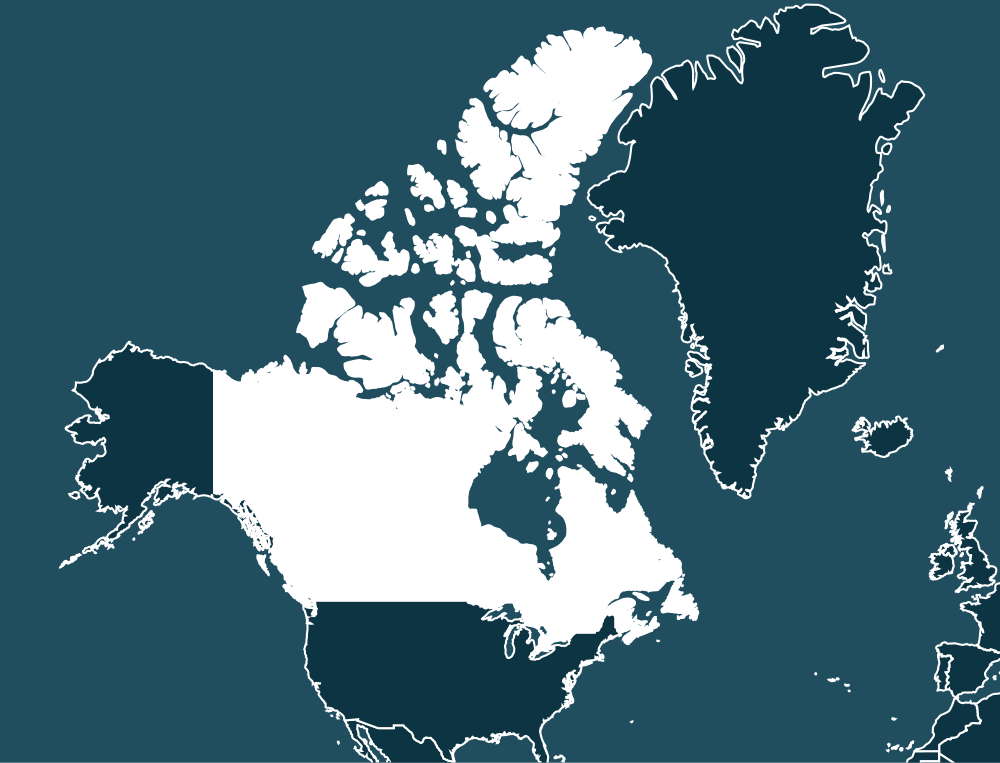
Although the United States is Canada’s only land neighbor, maritime connections to Russia, Denmark through Greenland, and France through Saint Pierre and Miquelon add distinctive Arctic and Atlantic dimensions. Current pressures range from trade and border tensions, organized crime, and fentanyl trafficking to Arctic sovereignty, maritime negotiations, and the security consequences of Russia’s war in Ukraine. Sanctions coordination and evasion risks have also elevated the roles of FINTRAC, FinCEN, export controls, intelligence sharing, and scrutiny of financial intermediaries and transshipment routes.
AML & Terrorist Financing
Canada maintains a broad AML/CFT framework and is not listed by FATF for strategic deficiencies, yet its 2021 assessment showed uneven effectiveness, with particular concerns surrounding legal professionals, beneficial ownership, and the pursuit and recovery of illicit assets. Money laundering risks remain linked to drug trafficking, fraud, corruption, tobacco smuggling, real estate, casinos, money services businesses, foreign proceeds, and increasingly virtual currencies, while terrorist-financing and proliferation-sanctions controls appear stronger among financial institutions than among DNFBPs. FINTRAC, the RCMP, OSFI, CRA, CBSA, and the emerging Canada Financial Crimes Agency are supported by legislative and registry reforms, but information-sharing constraints, fragmented oversight, limited monitoring, and enforcement gaps continue to shape Canada’s financial-crime landscape.
Sanctions
Canada enforces sanctions under the United Nations Act, Special Economic Measures Act, and Justice for Victims of Corrupt Foreign Officials Act against jurisdictions and persons linked to human-rights abuses, corruption, terrorism, and threats to Ukraine, using measures such as asset freezes, travel restrictions, trade controls, and financial prohibitions. Its enforcement increasingly targets evasion networks involving Russia, Iran, and North Korea, with FINTRAC reporting obligations, CBSA seizure powers, cross-border controls, G7 coordination, and designations reaching entities in places such as Ireland, Denmark, the Netherlands, Iran, and China. No international sanctions are currently in force against Canada, while domestic enforcement has included Russia-related seizures and a record FINTRAC penalty exceeding CAD 177 million against a cryptocurrency firm.
Criminality
Corruption in Canada is generally considered limited, with the Criminal Code and Corruption of Foreign Public Officials Act supported by active enforcement, procurement safeguards through Public Services and Procurement Canada, and oversight from the Conflict of Interest and Ethics Commissioner and Senate Ethics Officer. At the same time, organized crime remains active across drug trafficking, human exploitation, illicit trade, cybercrime, and especially money laundering through areas such as real estate and casinos, involving groups ranging from outlaw motorcycle gangs and mafia-style organizations to transnational networks and complicit businesses.
Reports
Canada is confronting expanding synthetic-drug production, evolving trafficking networks, and a domestic terrorism threat increasingly shaped by online radicalization, while agencies such as the RCMP and Health Canada enhance detection, enforcement, and prevention efforts. Alongside major investments in overdose response and continued cross-border cooperation, Canada remains a Tier 1 jurisdiction on human trafficking but faces uneven victim services, data gaps, and persistent vulnerabilities among Indigenous communities, migrants, and other at-risk groups.
Industry/Product Sector Risk
Canada’s industry landscape presents pronounced exposure across banking, real estate, casinos, money services businesses, securities, legal and corporate-structure services, mining, oil and gas, construction, hospitality, charities, and virtual currencies, with risks shaped by cash intensity, cross-border flows, complex ownership, and trade-based mechanisms. Broader sectors—including agriculture, manufacturing, technology, healthcare, transportation, utilities, education, and professional services—carry varied vulnerabilities involving fraud, corruption, tax evasion, smuggling, and the misuse of corporate vehicles. Oversight is distributed among bodies such as FINTRAC, the Canada Revenue Agency, provincial securities regulators, Public Safety, Global Affairs Canada, and the Canada Border Services Agency, leaving important distinctions in coverage, supervision, and emerging-risk treatment to explore.
Economy & Investment Climate
Canada offers a stable, highly developed economy with deep U.S. ties, strong institutions, abundant natural resources, sophisticated financial markets, and targeted incentives spanning advanced technology, critical minerals, infrastructure, and clean energy. At the same time, investors face evolving Investment Canada Act scrutiny, sector-specific ownership limits, residential real estate restrictions, provincial barriers, digital regulation, labor disruptions, and additional complexity under measures administered by agencies such as Invest in Canada, OSFI, and the Competition Bureau.
Cryptocurrency Regulations
Canada permits cryptocurrency within a tightly supervised framework, with the PCMLTFA, FINTRAC registration, Travel Rule obligations, and expanding CSA oversight shaping how virtual assets and trading platforms operate even though they are not legal tender. Tax treatment through the CRA, evolving rules for token offerings, and planned adoption of the OECD’s CARF point to increasingly detailed requirements for transaction reporting, investor protection, and compliance.
Get full access
The information on this page is a brief summary. Get access to EDD country reports, all risk category scores and customisable weightings for 245 jurisdictions.