
Risk Indicators
- FATF/EU Blacklist/Greylist (Lower Concern)
- Terrorism Financing (Lower Concern)
- US Dept of State INCSR
- Proliferation Financing
- Corruption
- Criminality
- Resilience & Governance
- Financial Transparency
- Offshore Finance Centres
- Sanctions
Background
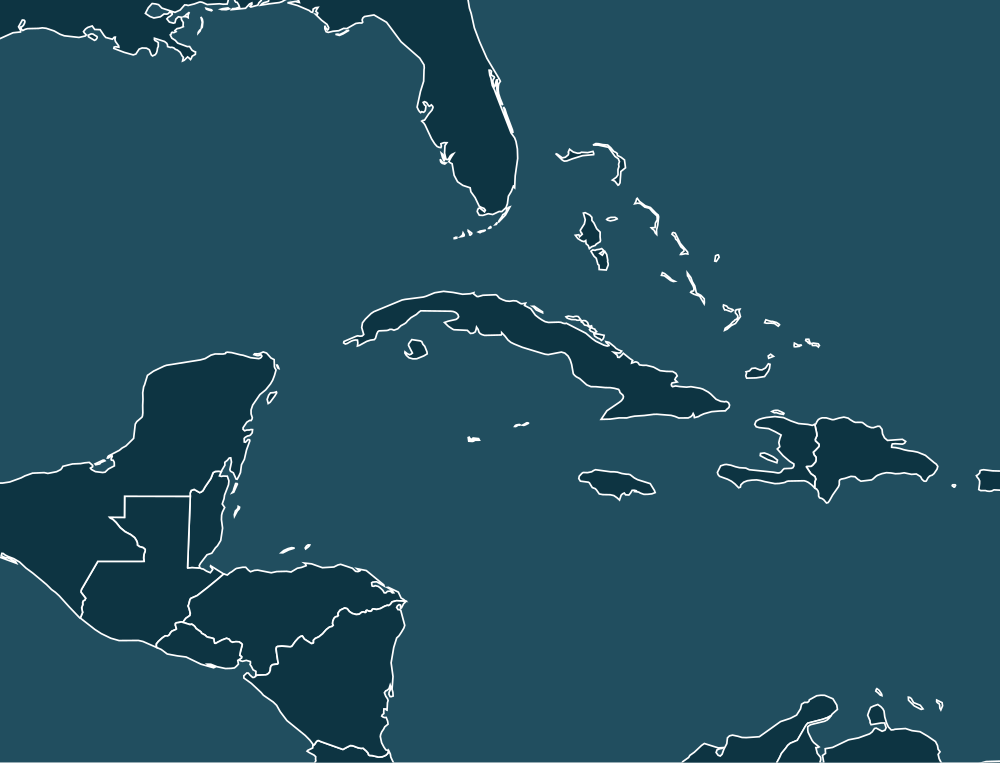
The Cayman Islands, shaped by British colonial rule and later administered by Jamaica, remained a British dependency after the dissolution of the Federation of the West Indies in 1962. Located south of Cuba and northwest of Jamaica, the territory has developed into a prominent offshore financial center. Its history and strategic Caribbean position provide important context for understanding its regional connections and exposure.
Cayman’s nearest neighbors present contrasting political and security concerns, from Cuba’s authoritarian governance, economic restrictions, and extensive U.S. embargo to Jamaica’s challenges involving violent crime, gangs, corruption, and human trafficking. U.S. measures affecting Cuba were tightened in 2025, while Jamaica has faced potential restrictions tied to trafficking enforcement rather than a comparable comprehensive regime. More broadly, U.S. warnings about illicit shipping, transshipment, and movements involving sanctioned goods underscore the maritime risks surrounding the Caribbean.
AML & Terrorist Financing
The Cayman Islands has made significant AML/CFT progress and, following FATF’s October 2023 statement, is no longer subject to increased monitoring, although its effectiveness ratings indicate continuing areas for development. As a major international financial centre, it remains exposed to overseas fraud, corruption, and tax-evasion proceeds, with particular attention warranted around complex structures, beneficial ownership information, and portions of the securities and DNFBP sectors. Authorities including CIMA, the FRA, RCIPS financial-crime investigators, and the AMLSG have strengthened supervision and enforcement, yet terrorist-financing identification, sanctions implementation, intelligence use, and complex or foreign-linked prosecutions remain topics requiring closer examination.
Sanctions
The Cayman Islands implements sanctions primarily through the United Kingdom’s framework, with the Cayman Islands Monetary Authority supporting access to UN consolidated-list information and country-specific UK, UN, and EU measures. While no international sanctions are currently in force against the Cayman Islands, UK Office of Financial Sanctions Implementation assessments have identified offshore account payments and enabler activity linked to the jurisdiction as heightened compliance concerns. Recent developments include the UK’s January 2026 transition to the FCDO’s UK Sanctions List and the Cayman Islands Financial Reporting Authority’s annual Frozen Assets Report obligation for assets connected to UK-designated persons.
Criminality
The available country-specific information does not identify particular crime trends, corruption cases, or enforcement agencies in the Cayman Islands. As a result, the current picture of crime and corruption remains unclear, with no further substantive details available here.
Industry/Product Sector Risk
Cayman Islands’ industry profile is shaped by a substantial international financial centre, with investment funds, wealth management, retail banking, insurance, securities businesses, and trust and company service providers serving complex cross-border structures and high-value clients. Key areas of concern include beneficial-ownership opacity, reliance on overseas or “excluded person” intermediaries, uneven ongoing monitoring, and exposure to foreign fraud, corruption, tax offences, and organised crime proceeds, while real estate, cash-intensive businesses, hospitality, and maritime transportation add distinct vulnerabilities. Oversight involves bodies such as the Cayman Islands Monetary Authority and the Department of Commerce and Investment, with developing attention also directed toward non-profit organisations, Special Economic Zone participants, property developers, and other sectors where supervision or risk understanding remains uneven.
Economy & Investment Climate
The Cayman Islands’ economy is dominated by services—particularly financial services, banking, insurance, and tourism—with its zero income-tax regime, stable political setting, and Moody’s Aa3 rating supporting strong international appeal. Alongside high living standards and substantial trade links with Europe and the United States, the territory faces scrutiny over financial transparency and practical pressures including living costs, waste management, limited freshwater, and development-related deforestation.
Cryptocurrency Regulations
The Cayman Islands permits cryptocurrency activity within an evolving framework centered on the Virtual Asset (Service Providers) Act, 2020, with CIMA registration or licensing, AML/CFT controls, and the Travel Rule shaping the obligations of exchanges and other VASPs. Although crypto is not legal tender and generally benefits from the jurisdiction’s absence of income and capital-gains taxes, questions around tax tracking, token offerings, securities treatment, and the planned 2027 adoption of the OECD CARF leave important details for businesses and investors to examine closely.
Get full access
The information on this page is a brief summary. Get access to EDD country reports, all risk category scores and customisable weightings for 245 jurisdictions.