
Risk Indicators
- FATF/EU Blacklist/Greylist (Lower Concern)
- Terrorism Financing (Medium Concern)
- US Dept of State INCSR
- Proliferation Financing
- Corruption
- Criminality
- Resilience & Governance
- Financial Transparency
- Offshore Finance Centres
- Sanctions
Background
The Central African Republic emerged from a history shaped by competing trade networks, intercommunal tensions, and exploitative colonial administration under Ubangui-Shari. Independence in 1960 was followed by repeated struggles for power, including Jean-Bedel BOKASSA’s authoritarian rule and brief transformation of the country into the Central African Empire. These legacies continue to inform a fragile political environment marked by corruption, contested authority, and unresolved social divisions.
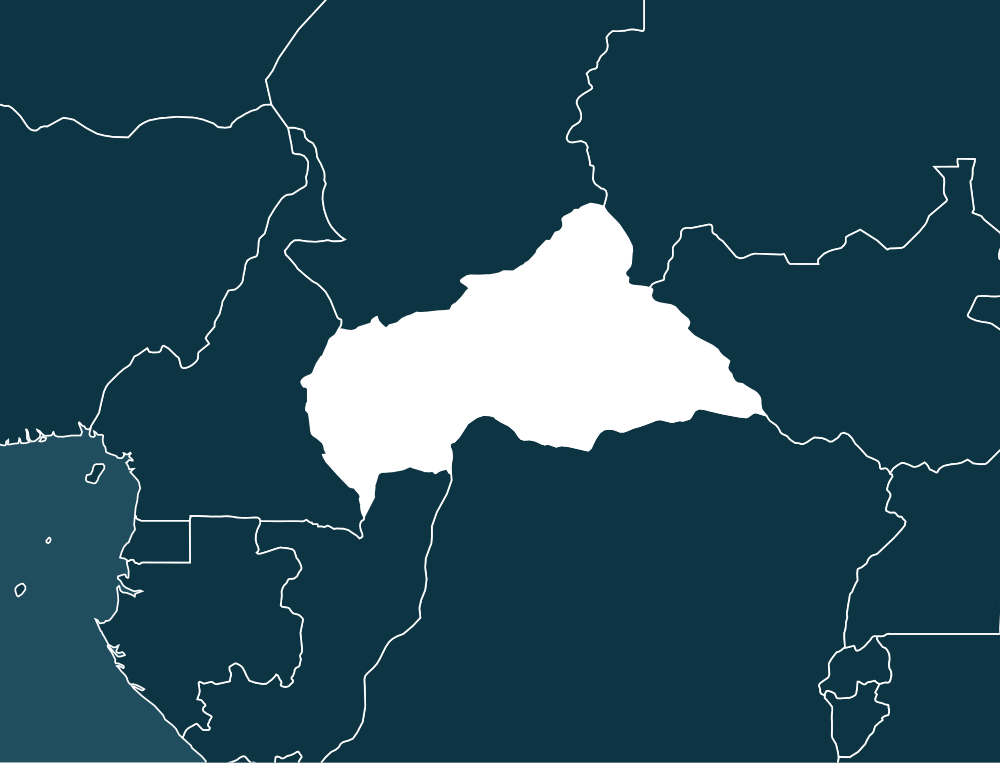
The 2013 seizure of Bangui by the Seleka and the subsequent rise of anti-Balaka self-defense groups deepened the country’s identity-based conflict and humanitarian challenges. Although Faustin-Archange TOUADERA and the United Hearts Movement have governed since 2016, the 2019 peace agreement has done little to dislodge armed groups from large areas, while the 2023 constitutional referendum opened the possibility of extended rule. CAR’s porous borders with Sudan, Chad, the Democratic Republic of the Congo, and South Sudan further expose it to refugee movements, arms trafficking, combatant flows, and sanctions-evasion risks, even as the UN Security Council maintains targeted measures against armed actors and associated individuals.
AML & Terrorist Financing
The Central African Republic is not on the FATF list of jurisdictions with strategic AML deficiencies, yet its 2023 evaluation found limited effectiveness amid cash dependence, porous borders, informal activity, corruption, illicit resource flows, and emerging virtual-asset risks. ANIF has demonstrated stronger risk awareness than many other authorities, but faces constraints involving resources, staffing, secure infrastructure, reporting coverage, and coordination, while COBAC supervision, DNFBP oversight, beneficial-ownership transparency, and enforcement remain uneven. Terrorist-financing and proliferation-financing controls appear particularly underdeveloped, with no recorded TF convictions, limited asset-disruption mechanisms, weaknesses in targeted financial sanctions and NPO supervision, and low effectiveness across the relevant immediate outcomes.
Sanctions
Central African Republic is subject to a broad, largely UN-aligned sanctions framework, including restrictions on arms transfers to armed groups, asset freezes, travel bans, and controls on military or dual-use goods, with limited government and humanitarian exceptions. These measures are implemented through mechanisms including U.S. OFAC’s Executive Order 13667, the EU’s Council Regulation (EU) 2025/610, the UK’s Central African Republic (Sanctions) (EU Exit) Regulations 2020, and corresponding legislation in Canada, Australia, Japan, New Zealand, Switzerland, and Norway. No distinct sanctions imposed by Central African Republic on other nations, or additional autonomous sanctions regime beyond these international and aligned measures, is identified, although illicit networks linked to Russian actors, armed groups, and regional transit hubs remain associated with evasion concerns.
Criminality
In the Central African Republic, armed groups and associated regional networks remain deeply involved in human exploitation, arms trafficking, and the illicit trade of diamonds, gold, timber, and wildlife, with proceeds sustaining conflict and local power structures. Corruption, money laundering, and complicity among some officials and security actors reportedly enable these markets, while limited oversight leaves vulnerable communities exposed to continuing criminal exploitation.
Reports
The Central African Republic has intensified investigations, prosecutions, convictions, victim identification, and coordination with protection actors, contributing to its move to Tier 2, though limited resources, inadequate services, official complicity, and confusion among officials continue to impede progress. Poverty, displacement, weak governance, and conflict leave communities—particularly Aka, Ba’Aka, and Bofi populations—vulnerable to exploitation in mines, domestic work, agriculture, and “houses of joy,” while FACA, the Wagner Group, the CPC, and other armed groups remain linked to child recruitment and forced labor.
Industry/Product Sector Risk
Central African Republic’s industry landscape is shaped by high exposure in banking, mining, precious-stone dealing, real estate, cash-intensive commerce, transport, construction, gaming, and informal foreign exchange, against a backdrop of low financial inclusion, porous borders, and limited state presence. Regional mechanisms and foreign banking groups provide some structure, but gaps in beneficial-ownership transparency, risk-based supervision, customer due diligence, and reporting remain evident across many sectors, while the Ministry of Interior and the planned electronic-transactions regulator ANTE have limited reach in their respective areas. The emergence of bitcoin and the Sango coin, alongside humanitarian networks, mobile money, timber and resource exports, and conflict-linked economic activity, creates a complex environment where corruption, smuggling, illicit mining, trafficking, public-fund diversion, and terrorist financing may intersect.
Economy & Investment Climate
Central African Republic’s economy remains anchored in agriculture—particularly cassava, groundnuts, and maize—with gold, diamonds, and timber providing important but constrained export potential, while food insecurity, weak infrastructure, and conflict continue to limit broader development. Although services account for the largest reported share of economic activity, investment remains difficult amid insecurity, corruption, limited financing, and an uneven legal environment, with MINUSCA and EUTM-RCA reflecting the wider international effort to support stability.
Cryptocurrency Regulations
Central African Republic’s cryptocurrency landscape shifted from the bold recognition of digital assets as legal tender under Law n°22.004 to a more uncertain position after parliament repealed that status in 2023, while COSUMAF and COBAC maintain a cautious stance amid limited exchange licensing and oversight. Taxation of crypto profits and initiatives such as Sango’s proposed natural-resource tokenization point to significant potential, but unresolved AML, KYC, ICO, consumer-protection, and transaction-tracking questions leave the market’s future closely tied to regulatory development.
Get full access
The information on this page is a brief summary. Get access to EDD country reports, all risk category scores and customisable weightings for 245 jurisdictions.