
Risk Indicators
- FATF/EU Blacklist/Greylist (Lower Concern)
- Terrorism Financing (Medium Concern)
- US Dept of State INCSR
- Proliferation Financing
- Corruption
- Criminality
- Resilience & Governance
- Financial Transparency
- Offshore Finance Centres
- Sanctions
Background
Chile’s history spans Indigenous communities, nearly a century of Inca influence in the north, Spanish rule, independence achieved in 1818, and territorial expansion following the War of the Pacific. The country later experienced the 1973 overthrow of Salvador Allende by General Augusto Pinochet before returning to elected government in 1990. Economic reforms, declining poverty, and sustained democratic institutions have supported Chile’s emergence as a stable regional and international actor.
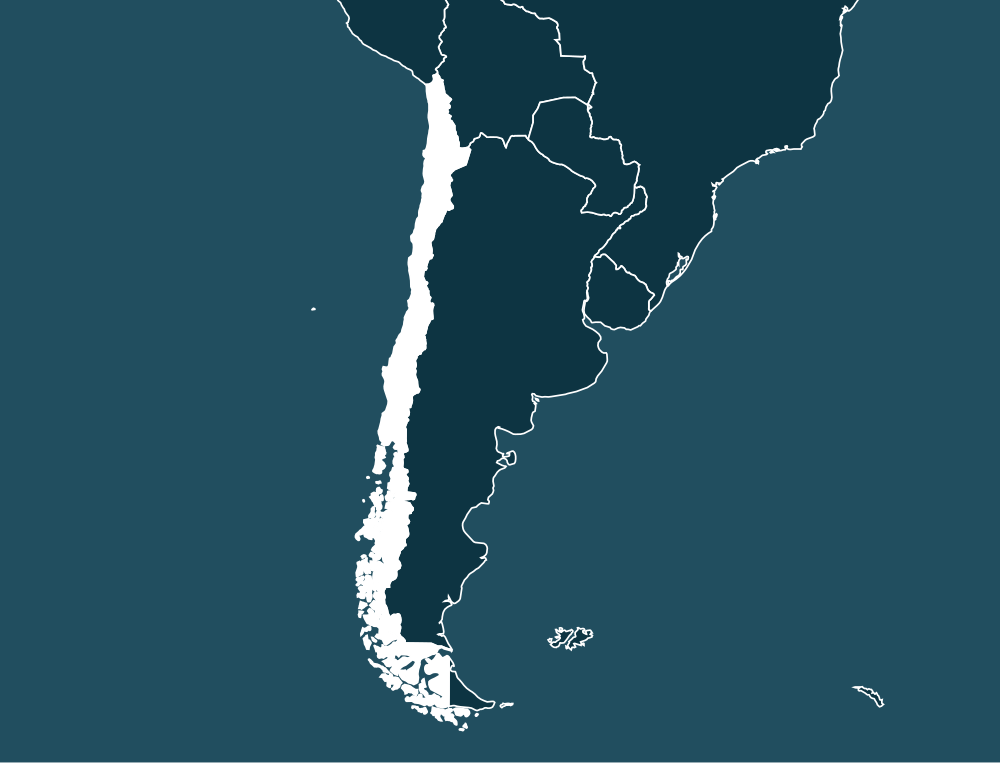
Chile’s borders with Peru, Bolivia, and Argentina connect it to varied pressures involving political instability, migration, organized crime, and unresolved historical sensitivities. Relations with Bolivia remain shaped by the legacy of the War of the Pacific and the absence of fully restored diplomatic ties, while Peru’s maritime dispute was addressed by the International Court of Justice in 2014. Regional concerns also include weak anti-money-laundering controls, illicit trade routes, Russia-related sanctions evasion, and Argentina’s potential role as a transshipment point.
AML & Terrorist Financing
Chile maintains an established AML/CFT framework and is not identified by FATF as having strategic deficiencies, although its 2021 evaluation showed a mix of compliant and largely compliant ratings with limited effectiveness at the highest levels. The UAF, Ministerio Público, PDI, Carabineros, and other authorities have developed risk assessments, financial intelligence, and enforcement capabilities, but challenges remain around resources, coordination, parallel financial investigations, sanctions, and vulnerabilities linked to drug trafficking, smuggling, corruption, long borders, and free-trade zones. Terrorist-financing understanding and reporting remain uneven, particularly beyond major financial institutions, while beneficial-ownership transparency, DNFBP supervision, and the timely application of targeted financial sanctions continue to warrant closer attention from bodies including the UAF, CMF, SCJ, and SII.
Sanctions
Chile is required to implement United Nations Security Council measures, including targeted financial, travel, arms, and commodity restrictions administered through sanctions committees and the Consolidated List, though no international sanctions are currently in force against Chile as a country. On February 20, 2026, the U.S. Department of State imposed visa restrictions on three Chilean officials, including Transport and Telecommunications Minister Juan Carlos Muñoz, citing concerns over a China-linked submarine cable project and critical infrastructure security. Chile has also been identified as a potential transit and financial hub for evasion of Russia-related sanctions, involving front companies, manipulated trade documents, layered transactions, and routes linking China, Hong Kong, Switzerland, Turkey, the UAE, and Thailand.
Criminality
Chile maintains a broad anti-corruption framework covering transparency, lobbying, asset disclosure, campaign finance, and corporate liability, with oversight involving the Comptroller General, Consejo para la Transparencia, and ChileCompra, although concerns about enforcement and accountability remain. Crime is marked by trafficking in people, drugs, and firearms, decentralized and increasingly violent local networks, and persistent exposure to financial scams, cybercrime, extortion, and environmentally damaging activity, particularly around vulnerable communities and the mining sector.
Reports
Chile remains classified as Tier 1 by the U.S. State Department, with increased victim identification, investigations, convictions—including two corporate entities—and a new trafficking shelter reflecting sustained government action. At the same time, uneven services, limited support for male victims and those outside Santiago, lenient sentencing patterns, and risks facing migrants and children point to continuing challenges across sectors from mining and agriculture to domestic service and online criminal exploitation.
Industry/Product Sector Risk
Chile’s financial and commercial landscape combines mature banking, securities and electronic-payment infrastructure with significant exposure in cash-intensive activities, real estate, casinos, currency exchange, remittances and logistics linked to ports, borders and free zones. Oversight by the UAF, CMF and Superintendence of Gambling Casinos has produced extensive inspections and sanctions, while persistent concerns include beneficial-ownership transparency, uneven risk-based controls, trade-based laundering and gaps involving lawyers, accountants and corporate service providers. Beyond finance, mining, construction, agriculture, telecommunications and nonprofit organisations present varied channels through which narcotics proceeds, contraband, fraud, tax offences and corruption may be placed, layered or integrated.
Economy & Investment Climate
Chile combines strong macroeconomic foundations, an open investment regime, and developed financial markets with opportunities spanning mining, energy, technology, data centers, and services; the Central Bank recorded 2.6% growth in 2024, while InvestChile continues to support foreign investors. Long-term prospects are balanced by commodity dependence, lengthy permitting and environmental processes, evolving pension and data rules, and emerging security and labor-market pressures.
Cryptocurrency Regulations
Chile permits cryptocurrency as a digital asset rather than legal tender, with the Fintech Law and CMF General Rule No. 502 bringing exchanges and related providers into an authorization, registration, and compliance framework overseen by the CMF and UAF. Tax reporting through the SII, planned adoption of the OECD’s CARF by 2027, and still-developing treatment of ICOs, tokenization, and the Travel Rule reveal a market moving toward greater transparency while leaving important areas unsettled.
Get full access
The information on this page is a brief summary. Get access to EDD country reports, all risk category scores and customisable weightings for 245 jurisdictions.