
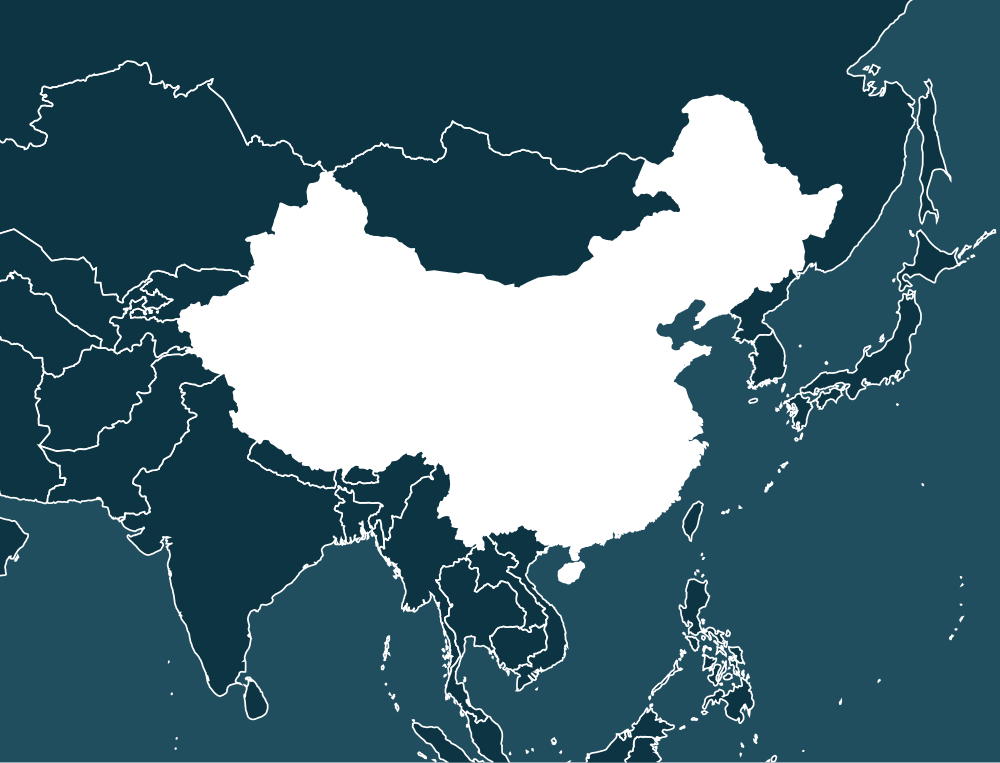
Risk Indicators
- FATF/EU Blacklist/Greylist (Lower Concern)
- Terrorism Financing (Lower Concern)
- US Dept of State INCSR
- Proliferation Financing
- Corruption
- Criminality
- Resilience & Governance
- Financial Transparency
- Offshore Finance Centres
- Sanctions
Background
China’s history extends from the Shang and Zhou dynasties through the imperial era, the 1911 revolution, and the establishment of the PRC under Mao Zedong in 1949. Later leaders, including Deng Xiaoping, Jiang Zemin, and Hu Jintao, oversaw market-oriented growth and broad economic opening, while the CCP retained political control. Under Xi Jinping, the country has combined global initiatives such as the Belt and Road Initiative with tightened domestic authority, including the National People’s Congress decision that removed presidential term limits.
China’s strategic environment is shaped by instability and sanctions concerns across neighboring states, from Taliban-ruled Afghanistan and civil-war-torn Myanmar to tensions involving India, Pakistan, and the South China Sea. Expanding trade with Russia, transit links through Central Asia, and relations with sanctioned North Korea have prompted scrutiny over dual-use goods, financial channels, and possible sanctions evasion. These pressures intersect with wider security challenges, including the Ukraine war, militant activity, missile and nuclear threats, and competing regional claims.
AML & Terrorist Financing
China is not identified by FATF as having strategic AML deficiencies, yet it remains under enhanced follow-up, with the 2022 assessment highlighting uneven compliance and limited effectiveness across key areas. The PBC, CAMLMAC, AMLB, MPS, and 36 provincial branches form an extensive institutional structure, but fragmented financial intelligence, limited DNFBP coverage, domestic PEP gaps, weak beneficial-ownership arrangements, and relatively few stand-alone money-laundering prosecutions remain concerns amid sophisticated threats involving underground banking, trade-based laundering, shell companies, virtual assets, and cross-border proceeds. Terrorist-financing and proliferation-financing controls likewise face shortcomings in targeted financial sanctions, delayed implementation, risk awareness, and oversight of non-profit organizations, even as China pursues AML-law revisions and expanded beneficial-ownership filings.
Sanctions
China implements UN Security Council sanctions through the Ministry of Foreign Affairs and other regulators such as the Ministry of Commerce, while its 2019 and 2021 measures provide counter-sanctions and blocking tools often connected to Taiwan, Hong Kong, Xinjiang, Tibet, and South China Sea disputes. No UN sanctions currently target China, but the United States, European Union, United Kingdom, Canada, Japan, and others have imposed varying combinations of asset freezes, investment and export restrictions, arms controls, tariffs, and entity designations, including measures involving the CMIC List, Shanghai Heiying, and Chinese companies linked to Russia. At the same time, Chinese entities and Hong Kong-based networks are identified as important channels for sanctions evasion involving Russia, Iran, and North Korea, prompting attention from authorities such as OFAC, the UK National Crime Agency, and EU institutions.
Criminality
China has pursued an extensive anti-corruption campaign through the NSC-CCDI, which reported roughly 877,000 investigations in 2024 and has targeted officials and public-duty holders across government, state-owned enterprises, hospitals, and universities, while application of these measures is described as uneven and discretionary. Alongside prominent corruption probes and intensified healthcare enforcement, serious criminal activity persists in areas including human trafficking, forced labour, cybercrime, financial scams, and the international movement of drug precursors, with some cases involving organized or state-embedded actors.
Reports
China’s profile spans concerns over historical and potentially current biological-weapons-related research, major roles in precursor-chemical and synthetic-drug markets, and persistent trafficking risks linked to domestic, overseas, maritime, and Belt and Road projects. At the same time, the National Narcotics Control Commission and U.S.–PRC Counternarcotics Working Group reflect ongoing enforcement cooperation, while State Department assessments highlight forced-labor allegations involving minority communities and migrant workers alongside a counterterrorism campaign centered on Xinjiang, even as no terrorism-related incidents or charges were reported.
Industry/Product Sector Risk
China’s financial and commercial landscape presents a varied risk profile, with particularly notable exposure around retail banking, mobile payments, online lending, trade finance, real estate, wealth management, and virtual currencies. Despite casinos being prohibited on the mainland, illegal gambling, underground banking, telecommunications and internet fraud, corruption, illegal fundraising, tax crimes, and counterfeiting remain significant channels for generating and moving illicit proceeds domestically and across borders. The extent of vulnerabilities linked to beneficial ownership, domestic PEP coverage, non-face-to-face services, cash movements, and uneven DNFBP supervision offers a deeper picture of where controls may be tested.
Economy & Investment Climate
China’s economy remains a major global industrial and trading power, but foreign investors face a more controlled and uncertain environment as inbound FDI fell 27.1 percent in 2024 to $114.8 billion, according to MOFCOM, while state priorities increasingly shape finance, technology, and market access. Measures involving the Market Access Negative List, data controls administered by the CAC, and the expanding roles of SAMR, NFRA, and MSS point to a market where opportunity persists alongside significant regulatory, political, and compliance risks.
Cryptocurrency Regulations
China maintains one of the world’s most restrictive cryptocurrency environments, with the PBOC, SAFE, and CAC supporting the September 2021 prohibition on transactions and mining while no mainland VASPs are licensed to operate. Yet the picture is evolving at the compliance margins, as proposed AML provisions, virtual-commodity tax treatment, and the enduring 2017 ICO prohibition point to closer monitoring without creating a conventional crypto market.
Get full access
The information on this page is a brief summary. Get access to EDD country reports, all risk category scores and customisable weightings for 245 jurisdictions.