
Risk Indicators
- FATF/EU Blacklist/Greylist (Lower Concern)
- Terrorism Financing (Medium Concern)
- US Dept of State INCSR
- Proliferation Financing
- Corruption
- Criminality
- Resilience & Governance
- Financial Transparency
- Offshore Finance Centres
- Sanctions
Background
Colombia emerged from the dissolution of Gran Colombia in 1830 and later endured decades of conflict involving government forces, paramilitaries, and insurgent groups such as the FARC, with the drug trade intensifying violence during the 1990s. A 2016 peace accord initiated the FARC’s demobilization, disarmament, and reintegration while establishing mechanisms including a truth commission, a search unit for the disappeared, and the Special Jurisdiction for Peace. Despite persistent security pressures linked to internal conflict and narcotics, Colombia retains comparatively strong democratic institutions, peaceful elections, and protections for civil liberties.
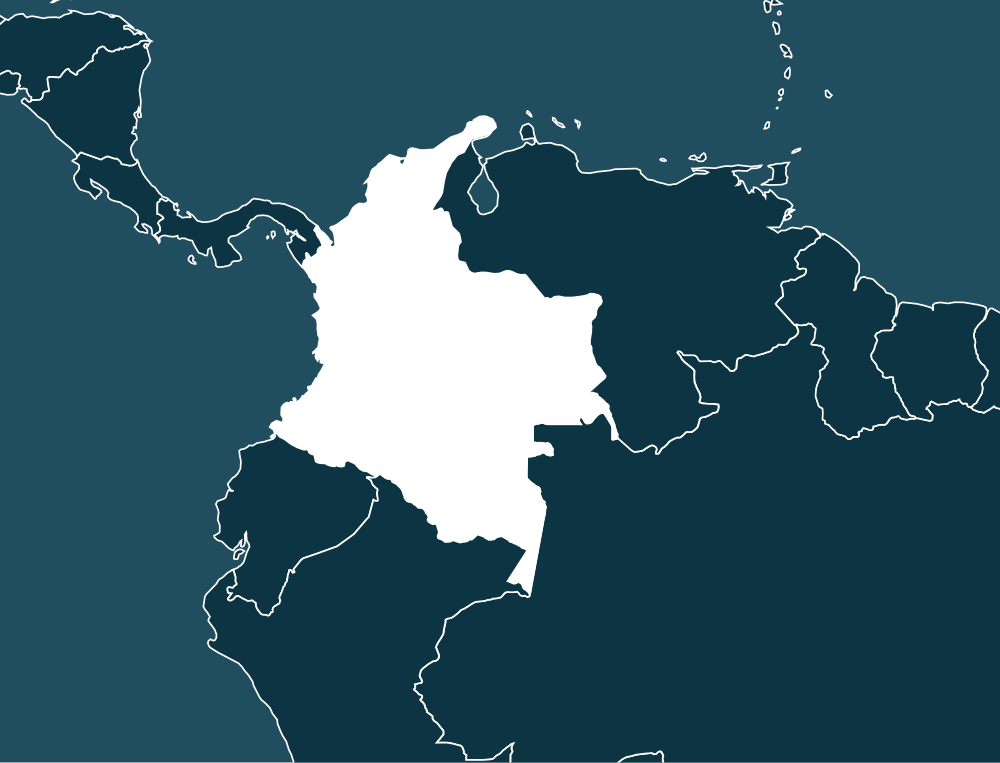
Its regional environment remains shaped most sharply by conditions along the Venezuelan and Panamanian borders, where armed groups, displacement, migration, transnational crime, and illicit financial activity intersect. The ELN and FARC dissidents have operated across the Venezuelan frontier, while Panama’s financial and maritime sectors have drawn scrutiny over money laundering, shipping practices, and sanctions-related activity involving entities such as PDVSA. Brazil, Peru, and Ecuador present more limited direct challenges, although organized crime, border concerns, and migration still form part of the wider security landscape.
AML & Terrorist Financing
Colombia maintains a substantial AML/CFT framework and is not subject to FATF strategic-deficiency listing, but GAFILAT follow-up findings continue to point to uneven implementation and enhanced monitoring needs. Key vulnerabilities involve organized crime, narcotics, illegal gold, trade-based laundering, real estate, cash, remittances, and increasingly cryptocurrency, while supervision and awareness remain weaker among DNFBPs than financial institutions. The UIAF, Fiscalía General de la Nación, Superintendencia Financiera, Superintendencia de Sociedades, and DIAN play central roles, yet challenges surrounding beneficial ownership, terrorist-financing prosecutions, proliferation-financing sanctions, intelligence sharing, virtual assets, and asset-forfeiture capacity leave important questions about effectiveness.
Sanctions
Colombia supports United Nations sanctions regimes, including measures addressing conflict, nuclear proliferation, and terrorism, while no international sanctions are currently in force against the country itself. Its strategic geography nevertheless makes it a significant transit and laundering point for restricted commodities linked to Venezuela, North Korea, Iran, and Russia/Belarus, with routes spanning the Darién Gap, Pacific maritime corridors, and informal financial networks. U.S. actions by OFAC and the Department of State against Clan del Golfo and related facilitators illustrate efforts to disrupt these flows, though shell companies, false shipping documents, and other evasive methods continue to pose concerns.
Criminality
Colombia faces persistent corruption in customs, taxation, and public works, with investigations and convictions involving senior officials, while state-embedded actors are also linked to embezzlement, judicial bribery, and cooperation with armed groups. Organized crime spans cocaine production, human smuggling, trafficking, illegal mining, deforestation, counterfeit goods, cybercrime, and money laundering, involving groups such as ex-FARC factions and the ELN alongside Mexican, Brazilian, and European networks; oversight bodies including the Transparency and Anti-Corruption Observatory, the CNCLCC, and the Presidential Secretariat of Transparency address these challenges.
Reports
Colombia remains central to regional counternarcotics concerns, with UNODC figures pointing to record coca cultivation and potential cocaine production even as Ministry of Defense data show unprecedented seizures and continued cooperation with U.S. agencies through initiatives such as Mission Cauca and Campaign Orion. Human trafficking vulnerabilities span migrants, Indigenous and Afro-Colombian communities, children, and informal workers, while groups including the ELN, FARC-EP dissidents, Clan del Golfo, and Tren de Aragua contribute to forced recruitment, exploitation, displacement, and rising insecurity.
Industry/Product Sector Risk
Colombia’s AML/CFT landscape spans a broad, interconnected economy in which banking, real estate, mining, trade, cash-intensive businesses and professional services present particularly notable exposure, alongside medium-risk vulnerabilities in areas such as agriculture, manufacturing, healthcare and utilities. Recurring themes include organised crime proceeds, corruption, illegal mining, smuggling, complex ownership structures, informal activity and cross-border value transfers, with oversight involving bodies such as Coljuegos, the tax and customs authority, the financial supervisor and the ICT ministry. The uneven coverage of certain professions, informal operators, fiduciary arrangements, payment networks and emerging technologies leaves important nuances around supervision, beneficial ownership and predicate-crime patterns to explore further.
Economy & Investment Climate
Colombia’s economy combines a large domestic market, natural-resource wealth, an educated middle class, and a generally open framework for foreign investment, but recent growth has slowed amid fiscal pressures, elevated financing costs, regulatory shifts, and weaker hydrocarbon exports. Investment prospects remain varied across sectors and regions, with ProColombia, MinCIT’s VUI, DANE, and the Central Bank reflecting ongoing efforts to facilitate business and modernize finance alongside persistent informality, institutional uncertainty, infrastructure and security challenges, and evolving policies affecting health, labor, pensions, energy, and intellectual property.
Cryptocurrency Regulations
Colombia permits cryptocurrency activity without recognizing digital assets as legal tender or financial instruments, while the UIAF and Superintendencia Financiera de Colombia (SFC) continue shaping an evolving framework through AML expectations, risk assessments, and a completed regulatory sandbox. Tax treatment overseen by DIAN already requires cryptoassets to be declared as intangible assets, but licensing, Travel Rule application, token offerings, and broader market safeguards remain areas where significant developments are anticipated.
Get full access
The information on this page is a brief summary. Get access to EDD country reports, all risk category scores and customisable weightings for 245 jurisdictions.