
Risk Indicators
- FATF/EU Blacklist/Greylist (Lower Concern)
- Terrorism Financing (Medium Concern)
- US Dept of State INCSR
- Proliferation Financing
- Corruption
- Criminality
- Resilience & Governance
- Financial Transparency
- Offshore Finance Centres
- Sanctions
Background
For centuries, the Comoros archipelago connected maritime networks linking the Middle East, India, and eastern Africa before becoming a French colonial outpost and declaring independence in 1975. Its post-independence history has been marked by repeated coups, contested authority, and efforts to balance power among Grande Comore, Anjouan, and Moheli through the Fomboni Accords. Constitutional changes, the crisis surrounding Anjouan, and disputed elections—including AZALI Assoumani’s 2024 victory, validated by the Supreme Court—continue to shape the country’s political landscape.
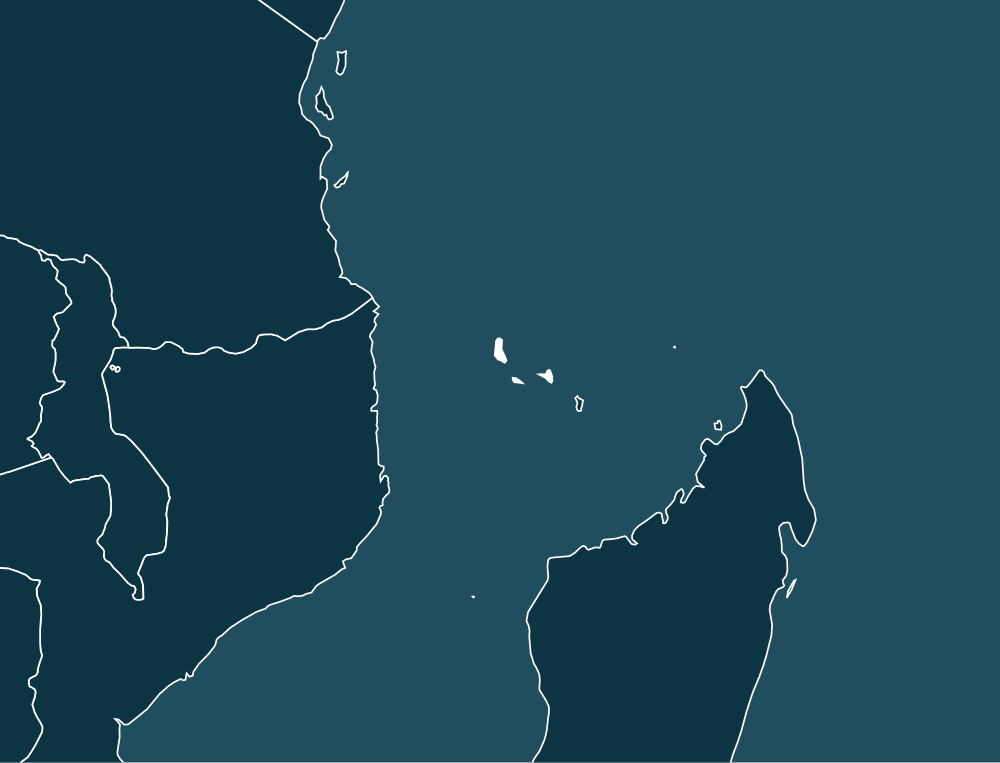
Located between Madagascar and the southeastern African mainland, Comoros is surrounded by neighbors whose security and governance conditions carry wider regional implications. Mozambique, Tanzania, and Madagascar face varying combinations of unrest, insurgency, political tensions, sanctions exposure, and financial-compliance concerns, while Mayotte and Seychelles present markedly different stability profiles. References to African Union measures, FATF monitoring, U.S. visa restrictions, and enforcement actions by Mozambique’s central bank point to a regional environment where political risk and AML vulnerabilities intersect.
AML & Terrorist Financing
Comoros faces a medium-high money-laundering risk profile shaped by fraud, corruption, narcotics trafficking, cash-based informal activity, and emerging concerns such as gold trafficking and migrant smuggling, while terrorist-financing exposure is linked in part to regional developments and certain charitable or faith-based flows. Although the country is not identified by FATF as having strategic AML deficiencies and has established bodies including the Central Bank of the Comoros (BCC), the Financial Intelligence Unit (CRF), and a National AML/CFT Committee, limited resources, incomplete risk application, and uneven institutional coordination constrain effectiveness. Reporting and enforcement remain particularly challenging, with few STRs, no identified TF cases, limited DNFBP and insurance-sector supervision, delays in targeted sanctions, and weaknesses in beneficial-ownership information maintained through the RCCM.
Sanctions
Comoros is obligated to implement United Nations Security Council measures, including targeted restrictions recorded on the UN Consolidated List and regimes addressing conflict, proliferation, and terrorism. Its most notable sanctions-related exposure involved the former citizenship-by-investment program, through which Comorian passports reportedly enabled Iranian nationals and sanctioned interests to mask identities and bypass international restrictions. The program was suspended in 2016, while State Security Court proceedings later produced severe convictions linked to the scheme; no separate foreign sanctions imposed directly against Comoros are identified.
Criminality
Comoros faces persistent corruption, public-fund embezzlement, illicit trafficking, and weaknesses in tracking criminal proceeds, with informal networks and official complicity contributing to the problem. Recent measures include a June anti-corruption law, expanded responsibilities for the Anti-Corruption Chamber, an online public-tender system, and ongoing AML/CFT work involving GIABA, while the Central Bank of Comoros continues to face operational capacity challenges.
Reports
Comoros remains on Tier 2 after adopting its first stand-alone anti-trafficking law, securing its first trafficking convictions, and increasing investigations and prosecutions, although insufficient shelter services and limited action on Anjouan and Moheli remain significant concerns. Women and children from rural communities, Quranic-school students, migrants transiting toward Mayotte, and Comorians abroad face risks including domestic servitude, forced labor, and sex trafficking across locations ranging from Grande Comore to the Gulf states and continental Africa.
Industry/Product Sector Risk
Comoros’ financial and commercial landscape is shaped by a large informal, cash-based economy, with the NRA highlighting particular exposure in money remittance, currency exchange, retail banking, real estate, construction, and political activity. The small banking sector, SNPSF, mobile-money providers, microfinance institutions, notaries, and family-run jewellery businesses each present distinct vulnerabilities connected to cross-border funds, land transactions, gold, fraud, corruption, and illicit maritime activity. At the same time, limited or emerging sectors—including virtual assets, securities, investment funds, and corporate finance—receive little or no specific sectoral treatment, leaving important areas to explore in greater depth.
Economy & Investment Climate
Comoros has a modest, agriculture-centered economy in which vanilla, cloves, fishing, tourism, and perfume distillation coexist with a larger services sector, while remittances equivalent to roughly 22.6% of GDP underscore its reliance on income from abroad. Prospects for diversification are tempered by political and infrastructure challenges, environmental pressures affecting soils and coral reefs, and an investment climate shaped by proposed state-enterprise privatizations, workforce training, and continued external assistance.
Cryptocurrency Regulations
Comoros permits cryptocurrency activity through the Anjouan Offshore Finance Authority’s Anjouan International Crypto License, while the Banque Centrale des Comores provides broader AML/KYC oversight under Money Laundering (Prohibition) Ordinance No. 3-002/PR 2003. Cryptocurrencies are not legal tender and remain subject to a developing, lightly defined framework in which licensing, taxation as intangible assets, token sales, and consumer safeguards leave important questions for businesses and investors.
Get full access
The information on this page is a brief summary. Get access to EDD country reports, all risk category scores and customisable weightings for 245 jurisdictions.