
Risk Indicators
- FATF/EU Blacklist/Greylist (Lower Concern)
- Terrorism Financing (Lower Concern)
- US Dept of State INCSR
- Proliferation Financing
- Corruption
- Criminality
- Resilience & Governance
- Financial Transparency
- Offshore Finance Centres
- Sanctions
Background
Cyprus emerged from British colonial rule as an independent state in 1960, but relations between its Greek and Turkish communities soon deteriorated, prompting UN peacekeeping efforts and deepening territorial division. Turkey’s 1974 military intervention followed a Greek Government-sponsored coup attempt, while the Turkish Cypriot-administered north later declared the internationally unrecognized Turkish Republic of Northern Cyprus. Reunification efforts, including the UN-mediated Annan Plan and negotiations suspended in 2017, have not overcome the island’s longstanding separation, even as Cyprus entered the EU in 2004 under a selectively applied acquis.
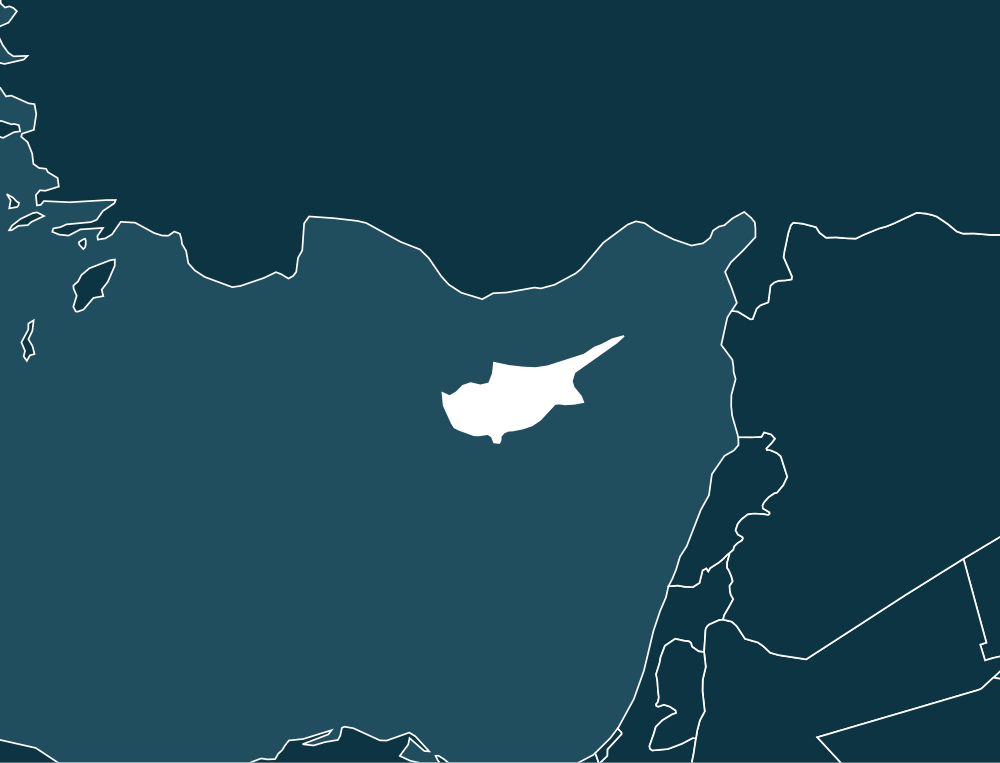
Its location places Cyprus near a region shaped by unresolved conflicts, fragile governance, and complex sanctions exposure. Turkey’s Kurdish conflict and defense-related US sanctions, Syria’s continuing fragmentation and extensive US and EU measures, Lebanon’s political and financial vulnerabilities, and Israel’s regional security tensions all create distinct surrounding risks. The Eastern Mediterranean setting also brings particular attention to unauthorized gas drilling, Iranian sanctions-evasion networks, illicit finance, smuggling, and the movement of dual-use goods.
AML & Terrorist Financing
Cyprus is not on the FATF list of jurisdictions with strategic deficiencies, yet MONEYVAL and the 2025 follow-up assessment continue to indicate uneven compliance and effectiveness across key areas. As an international financial centre, it remains exposed to foreign corruption, fraud, narcotics proceeds, complex corporate structures, real estate, virtual assets, and vulnerabilities involving administrative service providers, while MOKAS, the Central Bank of Cyprus, and CySEC operate within a supervisory and enforcement framework that is still described as fragmented or under-resourced in places. Terrorist-financing risks are linked mainly to Cyprus’s international financial role and proximity to conflict zones, with shortcomings noted around non-profit oversight, sanctions-evasion awareness, proliferation-financing controls, and the limited use of domestic designations or asset freezes.
Sanctions
Cyprus implements UN and EU restrictive measures through domestic enforcement, with the National Sanctions Implementation Unit established in July 2025 to oversee financial restrictions, asset freezes, and trade bans, alongside new criminal penalties under EU Directive 2024/1226. Although no international sanctions are currently in force against the Republic of Cyprus itself, Northern Cyprus remains subject to a long-standing UN- and EU-supported embargo affecting direct trade, flights, communications, and maritime access. Cyprus-linked businesses and individuals also face scrutiny from U.S. OFAC and UK OFSI over alleged sanctions-evasion risks involving Russia, Belarus, and Iran, while the former U.S. defense-trade denial policy has been suspended annually but remains subject to certification and case-by-case review.
Criminality
Corruption remains a significant concern in Cyprus despite a substantial legal and institutional framework, with public perceptions highlighting risks involving political parties, healthcare, building permits, and public tenders, while Auditor General reports have identified numerous alleged cases of mismanagement that often go unpunished or unresolved. The Financial Crime Unit, MOKAS, and the Auditor General provide established channels for enforcement and oversight, yet money laundering, procurement-related collusion, and organized criminal activity continue to expose vulnerabilities in public administration and the financial sector.
Reports
Cyprus’s government-controlled areas remain classified among the strongest performers in efforts to combat trafficking, with increased prosecutions, victim support, shelter funding, and involvement by the Social Welfare Service, while gaps persist in proactive identification and timely assistance. Elsewhere on the island, concerns center on unregulated labor and nightclub practices under Turkish Cypriot administration, while the Cypriot National Police maintained heightened security at key sites and recorded no terrorist incidents in 2024.
Industry/Product Sector Risk
Cyprus’s financial and business landscape combines a substantial international banking and corporate-services hub with significant exposure in real estate, construction, wealth management, casinos, correspondent banking, and remittance activity. Cross-border flows, non-resident customers, complex ownership structures, cash-intensive transactions, and investment channels linked to the Cyprus Investment Programme create varied vulnerabilities, with risks ranging from foreign corruption and tax crime to fraud, organised crime, and emerging terrorism-financing concerns. At the same time, the developing oversight of areas such as virtual assets, non-profit organisations, and cash movements—alongside the roles of administrative service providers, legal professionals, investment firms, and customs authorities—reveals a market whose risk profile is both broad and evolving.
Economy & Investment Climate
Cyprus combines a strategically positioned, services-led eurozone economy with solid recent momentum, a welcoming stance toward foreign investment, and expanding opportunities in technology, energy, shipping, tourism, and financial services, supported by organizations such as Invest Cyprus and the Cyprus Securities and Exchange Commission. Its attractive tax and business environment is balanced by sector-specific ownership limits, judicial delays, labor and regulatory considerations, and the island’s continuing political division, with the internationally unrecognized north presenting markedly greater legal, financial, and property-related risks.
Cryptocurrency Regulations
Cyprus permits cryptocurrency activity within a supervised framework rather than treating digital assets as legal tender, with CySEC registration, AML/KYC controls, and the €1,000 Travel Rule shaping the obligations of crypto-asset service providers. Its relatively favorable tax treatment, forthcoming MiCA alignment, planned 2027 CARF implementation, and evolving approach to tokens and ICO disclosures leave important details dependent on activity and regulatory interpretation.
Get full access
The information on this page is a brief summary. Get access to EDD country reports, all risk category scores and customisable weightings for 245 jurisdictions.